
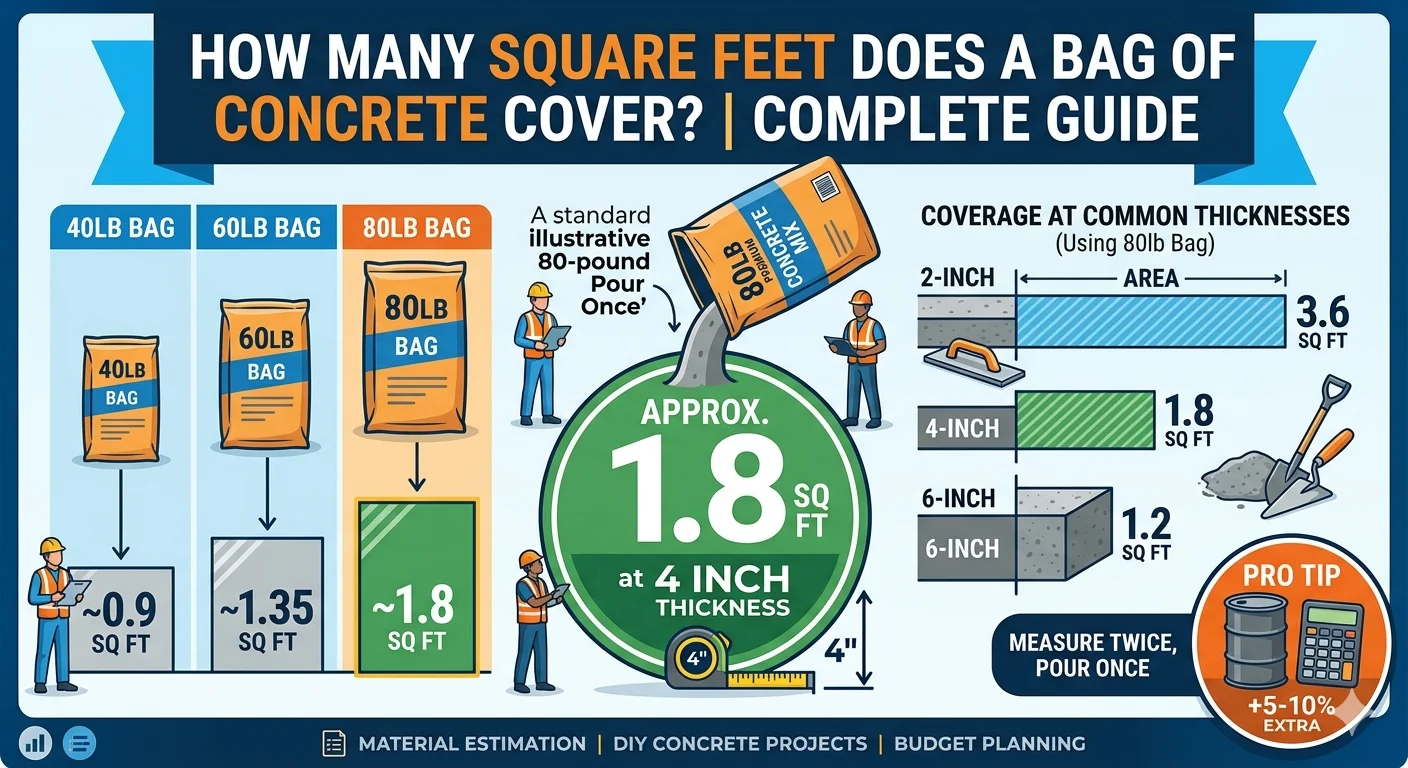
When planning a concrete project, one of the most common questions is: How many square feet does a bag of concrete cover? Whether you’re building a patio, sidewalk, shed foundation, driveway extension, or repairing an existing slab, understanding concrete coverage is essential for estimating materials accurately.
The amount of area a bag of concrete can cover depends primarily on two factors: the size of the concrete bag and the thickness of the concrete pour. A larger bag produces more concrete, while a thicker slab requires more material and therefore covers less surface area.
Knowing these calculations before starting your project can help you avoid running out of concrete, reduce waste, and stay within budget. This guide explains concrete coverage in detail, provides practical examples, and shows you how to estimate the number of bags needed for your project.
Understanding Concrete Coverage
Concrete coverage refers to the amount of surface area that a bag of concrete can cover at a specific thickness. Since concrete occupies volume rather than just area, both square footage and depth must be considered.
For example, one bag of concrete may cover several square feet when poured at a depth of 1 inch. However, if the same concrete is poured at 4 inches thick, the coverage area will be significantly smaller.
This is why concrete manufacturers often list yield in cubic feet rather than square feet.
Why Thickness Matters
Thickness directly affects concrete coverage.
A thin layer of concrete spreads over a larger area, while a thick slab requires more material per square foot. Most residential concrete projects require a thickness between 3 and 6 inches depending on their intended use.
Typical slab thicknesses include:
- 2 inches for light-duty pads
- 3 inches for walkways
- 4 inches for patios and sidewalks
- 5 to 6 inches for driveways and heavy loads
As thickness increases, the square footage covered by each bag decreases.
Concrete Coverage by Bag Size
Ready-mix concrete is commonly sold in several bag sizes. Each size yields a different volume of mixed concrete.
The following chart provides approximate coverage for common bag sizes.
| Bag Size | Yield (Cubic Feet) | Coverage at 2 Inches Thick | Coverage at 4 Inches Thick |
|---|---|---|---|
| 40 lb | 0.30 cu ft | 1.8 sq ft | 0.9 sq ft |
| 50 lb | 0.37 cu ft | 2.2 sq ft | 1.1 sq ft |
| 60 lb | 0.45 cu ft | 2.7 sq ft | 1.35 sq ft |
| 80 lb | 0.60 cu ft | 3.6 sq ft | 1.8 sq ft |
These figures are estimates and may vary slightly between manufacturers.
How to Calculate Concrete Coverage
You can calculate concrete coverage yourself using a simple formula.
Coverage Formula
Coverage (Square Feet) = Yield (Cubic Feet) ÷ Thickness (Feet)
Because thickness is often measured in inches, you’ll need to convert inches to feet first.
Thickness Conversion Chart
| Inches | Feet |
|---|---|
| 1 inch | 0.083 ft |
| 2 inches | 0.167 ft |
| 3 inches | 0.25 ft |
| 4 inches | 0.333 ft |
| 5 inches | 0.417 ft |
| 6 inches | 0.50 ft |
Example Calculation
Suppose you have an 80-pound bag that yields 0.60 cubic feet of concrete.
You want a slab that is 4 inches thick.
Convert thickness:
4 inches = 0.333 feet
Calculate:
0.60 ÷ 0.333 = 1.8 square feet
Therefore, one 80-pound bag covers approximately 1.8 square feet at a thickness of 4 inches.
Coverage at Common Thicknesses
Different projects require different slab depths. Understanding coverage at these depths helps estimate material needs more accurately.
2-Inch Thickness
A 2-inch slab is suitable for:
- Small utility pads
- Decorative concrete projects
- Light-duty walkways
Coverage estimates:
- 40 lb bag: 1.8 sq ft
- 60 lb bag: 2.7 sq ft
- 80 lb bag: 3.6 sq ft
3-Inch Thickness
Common uses include:
- Garden pathways
- Small patios
- Landscape edging
Coverage estimates:
- 40 lb bag: 1.2 sq ft
- 60 lb bag: 1.8 sq ft
- 80 lb bag: 2.4 sq ft
4-Inch Thickness
A 4-inch slab is the most common residential concrete thickness.
Suitable for:
- Sidewalks
- Patios
- Shed foundations
Coverage estimates:
- 40 lb bag: 0.9 sq ft
- 60 lb bag: 1.35 sq ft
- 80 lb bag: 1.8 sq ft
6-Inch Thickness
Recommended for:
- Driveways
- Garage floors
- Heavy equipment pads
Coverage estimates:
- 40 lb bag: 0.6 sq ft
- 60 lb bag: 0.9 sq ft
- 80 lb bag: 1.2 sq ft
How Many Bags of Concrete Do You Need?
Once you know the square footage and thickness of your slab, calculating the required number of bags becomes straightforward.
Patio Example
Suppose you’re building a patio that measures:
- Length: 10 feet
- Width: 10 feet
Area:
10 × 10 = 100 square feet
If the slab is 4 inches thick and you use 80-pound bags:
100 ÷ 1.8 = 55.5
Round up to ensure adequate material.
You’ll need approximately 56 bags.
Sidewalk Example
Sidewalk dimensions:
- Length: 20 feet
- Width: 3 feet
Area:
20 × 3 = 60 square feet
At 4 inches thick:
60 ÷ 1.8 = 33.3
You’ll need approximately 34 bags of 80-pound concrete.
Shed Foundation Example
A small shed foundation measuring 8 feet by 12 feet has an area of:
8 × 12 = 96 square feet
At a thickness of 4 inches:
96 ÷ 1.8 = 53.3
You’ll need approximately 54 bags of 80-pound concrete.
Factors That Affect Concrete Coverage
Coverage estimates are useful, but several factors can affect actual material usage.
Waste and Spillage
Some concrete is inevitably lost during:
- Mixing
- Transporting
- Pouring
- Finishing
Most professionals recommend ordering 5–10% extra material.
Uneven Ground
If the surface isn’t level, additional concrete may be needed to maintain consistent slab thickness.
Base Preparation
Poorly compacted soil can settle after pouring, affecting slab performance and potentially increasing material requirements.
Manufacturer Variations
Different concrete mixes produce slightly different yields. Always check the yield information printed on the bag.
Benefits of Accurate Concrete Estimation
Proper estimation provides several advantages.
Cost Savings
Buying the correct amount reduces unnecessary spending on excess materials.
Fewer Project Delays
Running out of concrete during a pour can cause delays and create weak joints in the finished slab.
Better Planning
Accurate calculations help with:
- Budgeting
- Transportation
- Labor scheduling
- Project timelines
Reduced Waste
Ordering only what you need minimizes leftover material and environmental impact.
Common Mistakes to Avoid
Many DIY homeowners make estimation mistakes that can increase costs and complicate projects.
Ignoring Thickness
Some people calculate square footage but forget slab depth.
Concrete calculations always require volume.
Forgetting Extra Material
Unexpected conditions often require additional concrete.
Adding 5–10% extra helps avoid shortages.
Using Incorrect Measurements
Always double-check:
- Length
- Width
- Thickness
Small measurement errors can lead to significant material shortages.
Not Accounting for Obstacles
Subtract areas occupied by:
- Drain openings
- Utility boxes
- Existing structures
This improves estimate accuracy.
Expert Tips for Concrete Projects
Buy Extra Concrete
Most contractors purchase slightly more concrete than calculations suggest.
This provides a safety margin for waste and unexpected needs.
Choose the Right Bag Size
Larger bags can reduce:
- Packaging waste
- Number of bags required
- Mixing time
For larger projects, 80-pound bags are often more efficient.
Prepare Everything Before Mixing
Concrete begins setting quickly.
Before opening bags:
- Build forms
- Gather tools
- Prepare water
- Level the site
Preparation helps ensure a smooth pour.
Consider Ready-Mix for Large Projects
When a project requires dozens of bags, ready-mix delivery may save time, labor, and money.
Real-World Concrete Coverage Examples
Here are some common projects and approximate bag requirements using 80-pound bags poured at 4 inches thick.
| Project | Size | Approximate Bags Needed |
|---|---|---|
| Small Pad | 4′ × 4′ | 9 Bags |
| Walkway | 3′ × 10′ | 17 Bags |
| Patio | 10′ × 10′ | 56 Bags |
| Shed Base | 8′ × 12′ | 54 Bags |
| Small Driveway Section | 10′ × 20′ | 112 Bags |
These figures are estimates and should include a waste allowance.
Frequently Asked Questions
Does an 80-pound bag cover more area than a 60-pound bag?
Yes. An 80-pound bag yields more concrete and therefore covers more square footage at the same thickness.
How much area does a bag cover at 4 inches thick?
An 80-pound bag covers approximately 1.8 square feet at 4 inches thick.
How many bags are needed for 100 square feet?
At 4 inches thick, approximately 56 eighty-pound bags are required.
Should I buy extra concrete?
Yes. Most professionals recommend purchasing 5–10% extra to account for waste and unexpected conditions.
Is bagged concrete suitable for large projects?
For small and medium projects, bagged concrete works well. For large slabs, ready-mix delivery is often more efficient.
Conclusion
Understanding how many square feet does a bag of concrete cover is essential for planning any concrete project. The exact coverage depends on both bag size and slab thickness, but in general, an 80-pound bag covers about 1.8 square feet at a thickness of 4 inches. By using coverage charts, calculating volume correctly, and allowing for a small amount of extra material, you can estimate your concrete needs accurately and complete your project with confidence. Whether you’re pouring a patio, sidewalk, foundation, or driveway repair, proper planning helps save money, reduce waste, and ensure professional-quality results.