

If you’ve ever looked at a property listing, land survey, or real estate advertisement, you may have asked yourself, how many square feet is a half an acre? Understanding land measurements is important whether you’re buying property, planning a construction project, designing a landscape, or simply comparing lot sizes.
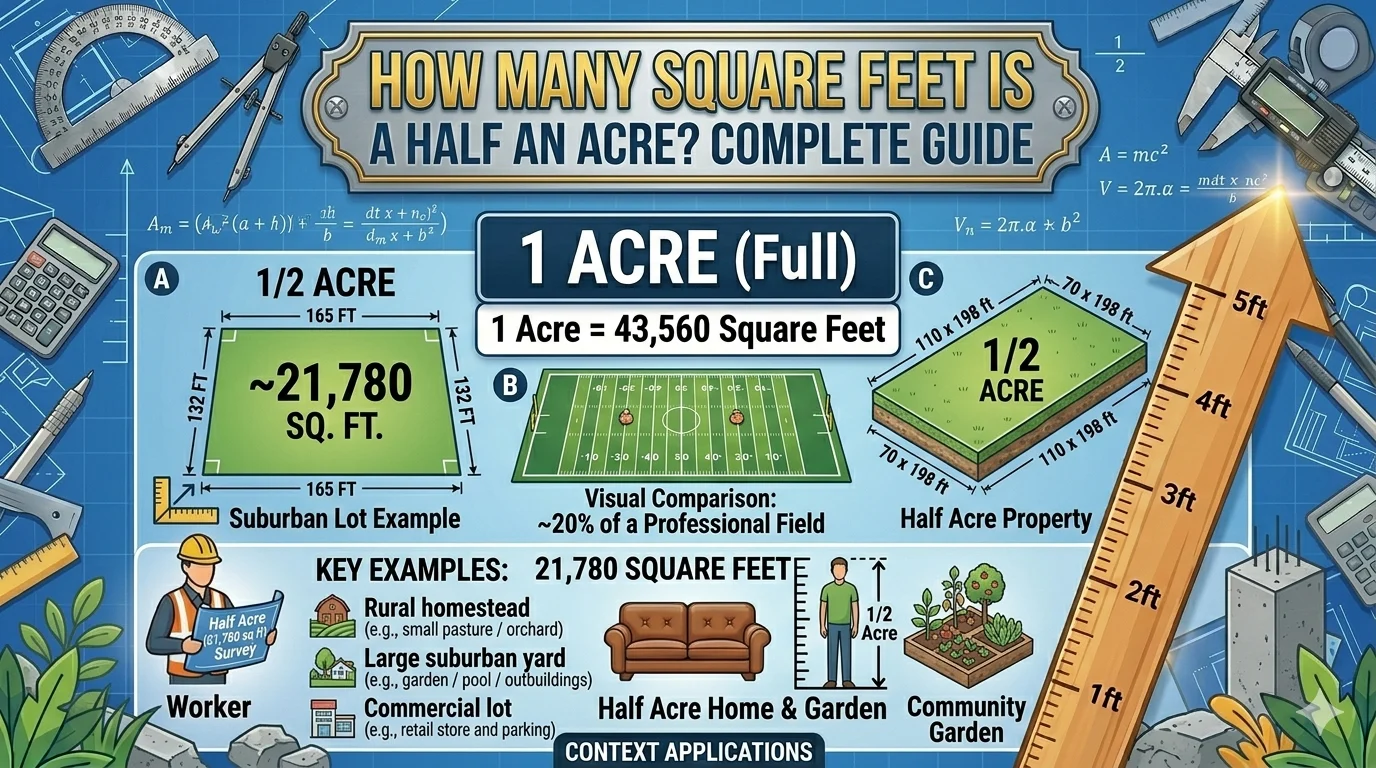
The short answer is simple: a half acre equals 21,780 square feet.
While this number is easy to calculate, many people find it difficult to visualize what 21,780 square feet actually looks like in real life. Is it enough land to build a house? How does it compare to a football field? What are the typical dimensions of a half-acre lot?
In this comprehensive guide, you’ll learn everything you need to know about half-acre measurements, including conversion formulas, practical examples, lot dimensions, comparisons, and common uses.
Understanding Acres and Square Feet
Before calculating a half acre, it helps to understand the two units involved.
What Is an Acre?
An acre is a unit of land measurement commonly used in the United States and several other countries. It is primarily used to measure large areas of land, including residential lots, farms, commercial properties, and undeveloped land.
Today, one acre is officially defined as:
1 Acre = 43,560 Square Feet
The acre has been used for centuries and remains one of the most recognized units for measuring land.
What Is a Square Foot?
A square foot is a unit of area equal to a square measuring one foot on each side.
Square feet are commonly used to measure:
- Homes
- Rooms
- Buildings
- Yards
- Property lots
- Commercial spaces
Since square feet provide a more precise measurement for smaller spaces, converting acreage into square footage often makes land sizes easier to understand.
How Many Square Feet Is a Half an Acre?
The conversion is straightforward.
Since:
1 Acre = 43,560 Square Feet
A half acre is:
43,560 ÷ 2 = 21,780 Square Feet
Final Answer
Half an acre = 21,780 square feet
This measurement remains the same regardless of the property’s shape.
Whether the lot is square, rectangular, or irregularly shaped, the total area of a half acre is always 21,780 square feet.
Acre to Square Feet Formula
The general formula for converting acres into square feet is:
Square Feet = Acres × 43,560
Using this formula:
0.5 × 43,560 = 21,780
You can also use the formula to convert other acreage values.
Examples
- 0.25 acre = 10,890 square feet
- 0.50 acre = 21,780 square feet
- 0.75 acre = 32,670 square feet
- 1 acre = 43,560 square feet
- 2 acres = 87,120 square feet
This formula is useful for property buyers, real estate agents, builders, and land developers.
Acre to Square Feet Conversion Chart
The table below provides quick acreage conversions.
| Acres | Square Feet |
|---|---|
| 0.10 | 4,356 |
| 0.25 | 10,890 |
| 0.50 | 21,780 |
| 0.75 | 32,670 |
| 1.00 | 43,560 |
| 2.00 | 87,120 |
| 5.00 | 217,800 |
| 10.00 | 435,600 |
This chart can help when comparing different property sizes.
What Does Half an Acre Look Like?
Knowing that half an acre equals 21,780 square feet is useful, but visual comparisons make the size easier to understand.
Compared to a Football Field
A standard American football field, including end zones, covers approximately 57,600 square feet.
Half an acre represents roughly:
38% of a football field
Although it’s much smaller than a football field, it is still a substantial piece of land for residential use.
Compared to Residential Lots
Many suburban homes sit on lots ranging from 5,000 to 10,000 square feet.
At 21,780 square feet, a half-acre lot is:
- More than twice the size of a 10,000-square-foot lot
- Over four times larger than a 5,000-square-foot lot
This extra space provides room for landscaping, recreation, and future expansion.
Compared to Parking Spaces
A typical parking space occupies approximately 180 square feet.
Half an acre can theoretically fit:
21,780 ÷ 180 = 121 parking spaces
This comparison highlights just how much usable space a half-acre property can provide.
Common Dimensions of a Half-Acre Lot
One of the most common misconceptions is that a half acre has a specific shape.
In reality, there are countless dimension combinations that equal 21,780 square feet.
Here are some examples:
| Length | Width | Area |
|---|---|---|
| 150 ft | 145.2 ft | 21,780 sq ft |
| 200 ft | 108.9 ft | 21,780 sq ft |
| 220 ft | 99 ft | 21,780 sq ft |
| 300 ft | 72.6 ft | 21,780 sq ft |
| 330 ft | 66 ft | 21,780 sq ft |
As long as the total area equals 21,780 square feet, the property is considered half an acre.
Practical Uses of Half an Acre
A half-acre lot provides enough land for many residential and commercial purposes.
Building a Home
Many homeowners prefer larger lots because they offer:
- More privacy
- Larger yards
- Space for pools
- Outdoor entertainment areas
- Detached garages
- Additional storage buildings
A half-acre property is often considered spacious without being difficult to maintain.
Gardening
Garden enthusiasts can use half an acre for:
- Vegetable gardens
- Fruit trees
- Flower beds
- Greenhouses
- Composting areas
Many homeowners find half an acre ideal for producing fresh fruits and vegetables.
Small-Scale Farming
Half an acre can support:
- Chickens
- Small livestock
- Beekeeping
- Orchard planting
- Intensive vegetable production
Although not large enough for major commercial farming, it provides substantial space for homesteading.
Recreational Activities
Half an acre can easily accommodate:
- Children’s playgrounds
- Basketball courts
- Fire pits
- Outdoor kitchens
- RV parking
- Hobby workshops
The flexibility of the space is one reason why larger lots remain highly desirable.
Benefits of Owning Half an Acre
Increased Privacy
Larger lots naturally create more distance between neighboring properties.
More Design Freedom
Property owners have more flexibility when planning:
- Home additions
- Landscaping projects
- Outdoor living spaces
- Storage structures
Greater Property Appeal
Properties with larger lots often attract more buyer interest, especially in suburban and rural areas.
Room for Future Expansion
A half-acre lot leaves space for future improvements without overcrowding the property.
Better Outdoor Living
The extra land creates opportunities for recreation, gardening, and family activities.
Common Mistakes When Calculating Land Area
Confusing Square Feet and Linear Feet
Linear feet measure distance.
Square feet measure area.
They are completely different units and should not be used interchangeably.
Assuming Shape Changes Acreage
The shape of the property does not affect acreage.
A square lot and a rectangular lot can both equal half an acre if their total area is 21,780 square feet.
Ignoring Easements
Utility easements, drainage areas, and setbacks may reduce the usable portion of the property.
Estimating Without Accurate Measurements
Property dimensions should always be verified using:
- Surveys
- Property records
- County documents
- Professional assessments
Accurate measurements help prevent costly mistakes.
How to Measure a Half-Acre Property
If your lot is rectangular, use this formula:
Length × Width = Area
For example:
150 feet × 145.2 feet = 21,780 square feet
If the property has an irregular shape, professional surveyors may use specialized equipment or mapping software to determine the exact area.
Today, many online land measurement tools and GIS mapping platforms can also help property owners calculate acreage.
Why Acreage Matters in Real Estate
Understanding acreage is important because it directly impacts:
- Property value
- Zoning regulations
- Development opportunities
- Tax assessments
- Construction planning
Two properties may have similar homes but significantly different lot sizes. In many markets, larger lots command higher prices due to their increased utility and privacy.
For buyers, knowing that a half acre equals 21,780 square feet provides a valuable benchmark when comparing listings.
Tips for Land Buyers
When evaluating a half-acre property, consider the following:
- Verify lot dimensions through a professional survey.
- Review zoning regulations before purchasing.
- Check utility access and infrastructure.
- Understand setback requirements.
- Examine drainage and soil conditions.
- Evaluate future development potential.
- Compare usable land rather than total acreage alone.
These factors can significantly influence a property’s long-term value and functionality.
Frequently Asked Questions
Is half an acre considered a large lot?
Yes. A half-acre lot is larger than most suburban residential lots and provides substantial outdoor space for homes, gardens, and recreation.
How many square feet are in half an acre?
A half acre contains exactly 21,780 square feet.
How do I convert acres to square feet?
Multiply the number of acres by 43,560.
Can I build a house on half an acre?
Yes. In most locations, a half-acre lot provides more than enough room for a home, garage, driveway, and yard.
How many parking spaces fit on half an acre?
Based on an average parking space size of 180 square feet, approximately 121 parking spaces could fit within a half-acre area.
Conclusion
If you’re wondering how many square feet is a half an acre, the answer is straightforward: 21,780 square feet. Understanding this conversion can help you compare properties, estimate land value, plan construction projects, and make informed real estate decisions.
A half-acre lot offers significant space for residential living, gardening, recreation, and future development. Whether you’re buying land, building a home, or simply learning about property measurements, knowing that a half acre equals 21,780 square feet gives you a practical understanding of how much land you’re working with.
By using the acre-to-square-feet conversion formula and the examples provided in this guide, you’ll be able to confidently evaluate land sizes and better visualize property dimensions in the future.