

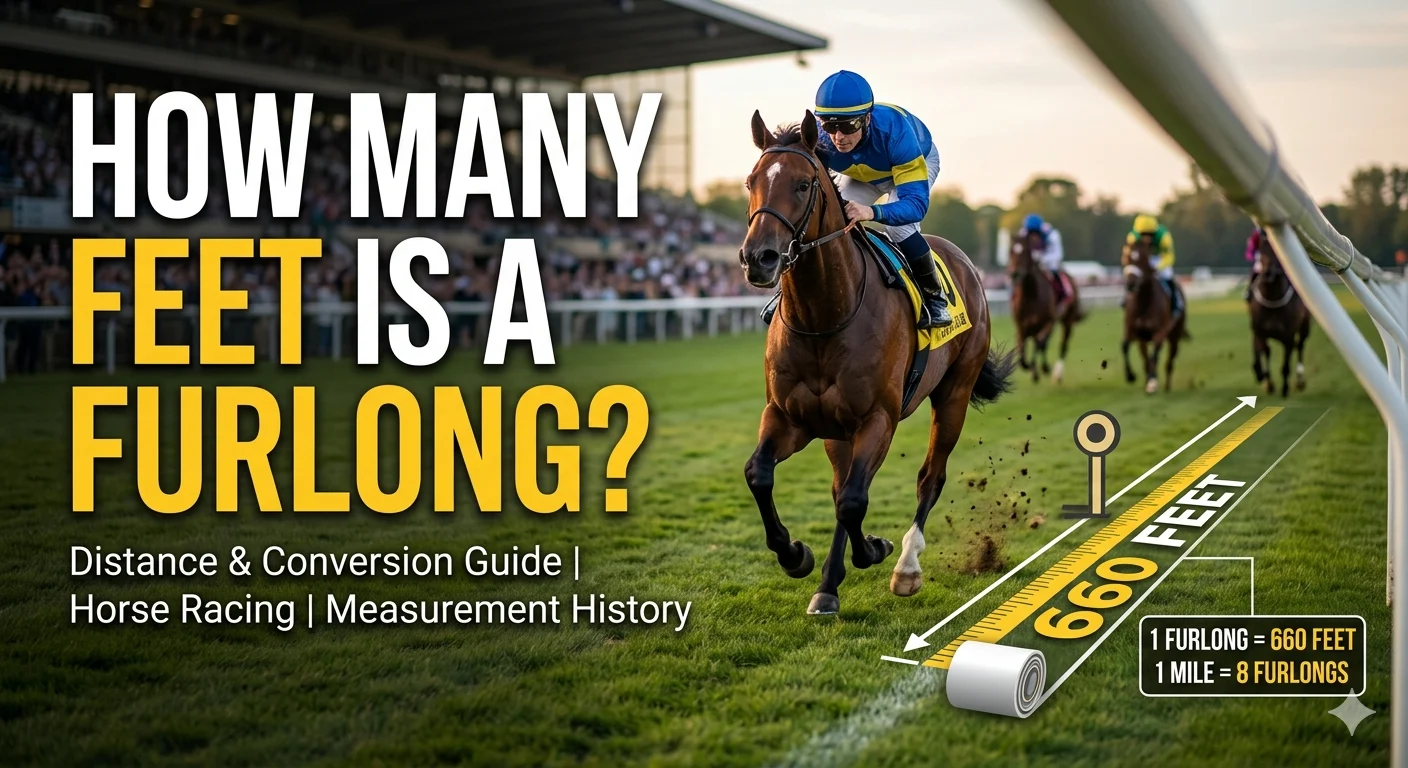
If you have ever watched a horse race, studied old land records, or come across traditional units of measurement, you may have wondered, how many feet is a furlong? The answer is simple: one furlong equals exactly 660 feet.
Although the furlong is not commonly used in everyday life, it remains an important unit in horse racing, historical land measurement, and educational materials. Understanding this classic unit can help you make quick conversions and better understand traditional distance measurements.
In this guide, you will learn exactly how many feet are in a furlong, where the measurement came from, how to convert it, and why it is still used today.
What Is a Furlong?
A furlong is a traditional unit of distance used in the imperial and U.S. customary measurement systems. The word comes from the Old English terms “furh” (furrow) and “lang” (long), meaning the length of a furrow in a plowed field.
Centuries ago, farmers used the furlong to measure the distance a team of oxen could plow without resting. Over time, the measurement became standardized and was adopted into the English system of weights and measures.
Today, a furlong is officially defined as:
- 660 feet
- 220 yards
- 10 chains
- 40 rods
- 1/8 of a mile
These relationships make the furlong a useful unit for understanding historical and sporting distances.
How Many Feet Is a Furlong?
The exact conversion is straightforward:
1 furlong = 660 feet
This value never changes and is accepted wherever the furlong measurement is used.
To convert furlongs into feet, simply multiply the number of furlongs by 660.
Formula:
Feet = Furlongs × 660
For example:
- 1 furlong = 660 feet
- 2 furlongs = 1,320 feet
- 4 furlongs = 2,640 feet
- 8 furlongs = 5,280 feet (exactly one mile)
Because the conversion factor is easy to remember, converting between furlongs and feet takes only a few seconds.
Furlong to Feet Conversion Chart
The following chart provides quick conversions for some of the most common furlong values.
| Furlongs | Feet |
|---|---|
| 0.5 | 330 feet |
| 1 | 660 feet |
| 2 | 1,320 feet |
| 3 | 1,980 feet |
| 4 | 2,640 feet |
| 5 | 3,300 feet |
| 6 | 3,960 feet |
| 7 | 4,620 feet |
| 8 | 5,280 feet |
| 10 | 6,600 feet |
This table is especially useful for students, surveyors, and horse racing fans who need a quick reference.
Why Was the Furlong Created?
The furlong originated from agriculture in medieval England. Farmers needed a practical way to measure fields before modern surveying equipment existed.
Farming Origins
A furlong represented the typical length of a furrow that a team of oxen could plow before needing a break. This practical approach helped farmers divide and manage their land efficiently.
Connection to Other Traditional Units
The furlong fits neatly into the imperial system:
- 1 chain = 66 feet
- 10 chains = 1 furlong
- 8 furlongs = 1 mile
These simple relationships made calculations easier for farmers, surveyors, and landowners.
Where Is the Furlong Still Used Today?
Although most countries now use the metric system, the furlong continues to have practical uses.
Horse Racing
Horse racing is the most common place where furlongs are still used. Race distances are frequently described in furlongs instead of meters or miles.
Examples include:
- Sprint races: 5–6 furlongs
- Middle-distance races: 8–10 furlongs
- Long-distance races: 12 furlongs or more
For racing enthusiasts, understanding that one furlong equals 660 feet helps visualize the total race distance.
Historical Land Records
Older maps, property deeds, and legal documents often include furlongs as a unit of measurement. Historians and surveyors regularly encounter the term when researching historical boundaries.
Education and Measurement Studies
The furlong is also used in educational settings to teach the history of measurement systems and the development of modern units.
Furlong Compared to Other Distance Units
Comparing a furlong to more familiar measurements makes it easier to understand.
| Unit | Equivalent to 1 Furlong |
|---|---|
| Feet | 660 feet |
| Yards | 220 yards |
| Miles | 1/8 mile |
| Chains | 10 chains |
| Rods | 40 rods |
| Meters | Approximately 201.17 meters |
| Kilometers | Approximately 0.201 kilometers |
Since one furlong is slightly more than 200 meters, it is not far from the length of two soccer fields placed end to end.
Practical Examples of a Furlong
Many people know the conversion but still have trouble picturing how far 660 feet actually is. Here are a few practical examples.
Slightly More Than Two Football Fields
An American football field is 300 feet long, excluding the end zones. A furlong is just over two football fields placed together.
Around Half a Standard Running Track
A standard outdoor running track measures 400 meters, or about 1,312 feet, around one complete lap. One furlong is roughly half that distance.
About Two Average City Blocks
Depending on the layout, a furlong is close to the length of two average city blocks in many urban areas.
These comparisons help make the measurement easier to visualize in everyday life.
How to Convert Furlongs to Feet
Converting furlongs to feet is simple because the multiplication factor is always the same.
Step 1: Identify the Number of Furlongs
Start with the distance you want to convert.
Step 2: Multiply by 660
Multiply the number of furlongs by 660 to get the answer in feet.
Examples
Example 1: Convert 3 furlongs into feet.
3 × 660 = 1,980 feet
Example 2: Convert 5.5 furlongs into feet.
5.5 × 660 = 3,630 feet
Example 3: A horse race is 8 furlongs long. How many feet is it?
8 × 660 = 5,280 feet, which is exactly one mile.
Converting Feet Back to Furlongs
If you need to convert feet into furlongs, divide the number of feet by 660.
Formula:
Furlongs = Feet ÷ 660
For example:
- 1,320 feet ÷ 660 = 2 furlongs
- 3,300 feet ÷ 660 = 5 furlongs
Benefits of Understanding Furlong Measurements
Even though the furlong is an old-fashioned unit, knowing how it works can still be useful.
Some key benefits include:
- Better understanding of horse racing distances.
- Easier interpretation of historical maps and documents.
- Improved knowledge of traditional imperial measurements.
- Quick conversions between feet, yards, and miles.
- A deeper appreciation for the history of land measurement.
Learning traditional units like the furlong also helps build a stronger understanding of how modern measurement systems evolved.
Common Mistakes to Avoid
People often make small errors when working with furlongs. Here are the most common ones.
Confusing Feet with Yards
A furlong equals 660 feet, not 660 yards. In fact, it equals only 220 yards.
Forgetting the Mile Conversion
Many people assume that 10 furlongs make a mile. The correct relationship is:
- 8 furlongs = 1 mile
Mixing Metric and Imperial Values
A furlong is approximately 201.17 meters, not exactly 200 meters. For precise calculations, use the exact conversion.
Avoiding these mistakes ensures accurate distance measurements.
Interesting Facts About the Furlong
The furlong has a fascinating history that many people do not realize.
- The measurement dates back over a thousand years.
- It originated from farming rather than transportation or sports.
- One acre was traditionally defined as a strip of land one furlong long and one chain wide.
- Horse racing in countries such as the United Kingdom, Ireland, and the United States still uses furlongs to measure race distances.
- Exactly eight furlongs equal one mile, making the conversion easy to remember.
These facts show why the furlong has remained part of traditional measurement systems for centuries.
Expert Tips for Remembering the Conversion
If you only need to remember one thing, remember this number:
1 furlong = 660 feet
Here are a few memory tricks:
- Think of a furlong as a little more than two football fields.
- Remember that eight furlongs equal one mile.
- Use the simple formula: Furlongs × 660 = Feet.
- Associate the number 660 with horse racing, where furlongs are commonly used.
These tips make the conversion easy to recall whenever you need it.
Frequently Asked Questions
1. How many feet are in one furlong?
One furlong contains exactly 660 feet.
2. How many yards are in a furlong?
A furlong is equal to 220 yards.
3. How many furlongs make a mile?
There are 8 furlongs in one mile.
4. Why is the furlong still used in horse racing?
Horse racing continues to use traditional British measurement units, and furlongs provide a convenient way to describe race distances.
5. Is a furlong longer than 200 meters?
Yes. One furlong equals approximately 201.17 meters, making it slightly longer than 200 meters.
Conclusion
If you have ever asked, “how many feet is a furlong?”, the answer is simple: one furlong equals exactly 660 feet. This historic unit began as a practical farming measurement and eventually became an official part of the imperial system.
Although it is no longer widely used in everyday life, the furlong remains important in horse racing, historical land records, and educational studies. By remembering that 1 furlong = 660 feet = 220 yards = 1/8 of a mile, you can easily understand and convert this traditional unit whenever you come across it.