
Understanding the Meaning of Acres and Feet
When people ask how many feet is 3 acres, they are usually trying to understand land size in simple terms. But there is an important point to understand first: acres and feet are not the same type of measurement.
An acre measures area, while a foot measures length. Because of this, you cannot directly convert acres into “feet” unless you are talking about square feet.
What is an acre?
An acre is a standard unit used to measure land, especially in real estate and agriculture.
- 1 acre = 43,560 square feet
- It represents a total surface area, not a straight line
So when someone says “3 acres,” they are referring to a total land space.
Why feet alone is not enough
Feet only measure one direction (length). Land, however, has two dimensions:
- Length
- Width
That is why we always convert acres into square feet for accuracy.
Exact Conversion of 3 Acres Into Square Feet
To answer the question properly, we use the standard conversion:
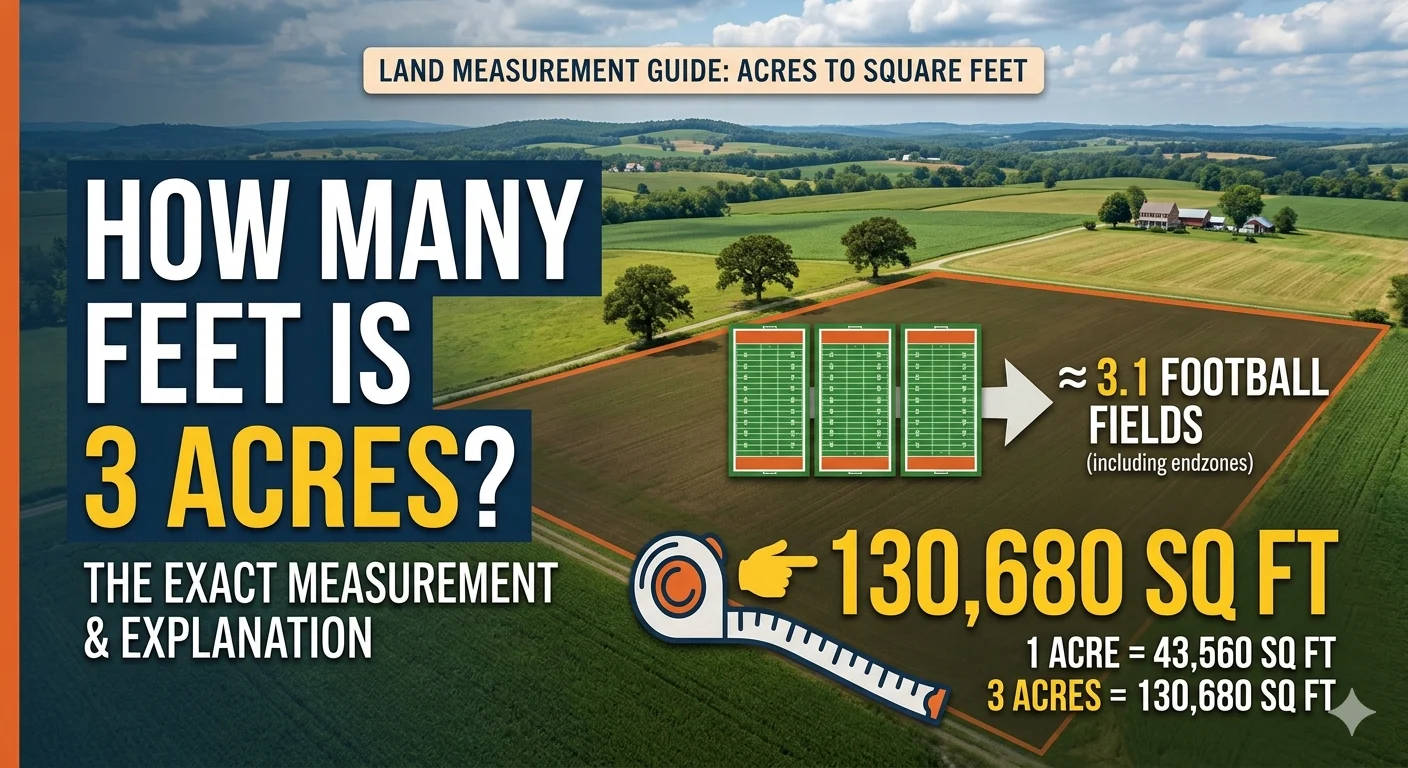
1 acre = 43,560 square feet
Now calculate:
3 acres = 43,560 × 3
Step-by-step:
- 43,560 × 3 = 130,680
✔️ Final Answer:
3 acres = 130,680 square feet
This is the exact and widely accepted conversion used in real estate and land measurement.
How Big Is 3 Acres Visually?
Numbers can feel difficult to imagine, so let’s break it down into real-life comparisons.
Comparison with football fields
A standard American football field (including end zones) is about 57,600 square feet.
- 1 football field ≈ 1.32 acres
- 3 acres ≈ 2.27 football fields
So, 3 acres is a little more than two football fields combined.
Real-life examples
3 acres of land is commonly used for:
- Medium-sized farms
- Large residential plots
- Small housing developments
- Orchards or gardens
It is considered a moderate to large land size depending on location.
Shape Matters: How 3 Acres Can Look Different
Even though the total area is fixed at 130,680 square feet, the shape can change how the land looks.
Square-shaped land
If the land is perfectly square:
√130,680 ≈ 361.5 feet
So:
- 361.5 ft × 361.5 ft = 3 acres
Rectangular examples
3 acres can also look like:
- 200 ft × 653.4 ft
- 300 ft × 435.6 ft
- 150 ft × 871.2 ft
All of these equal the same area but look very different on the ground.
Practical Uses of Knowing 3 Acres in Square Feet
Understanding how many feet is 3 acres (130,680 sq ft) is useful in many situations.
Real estate planning
- Estimating property value
- Planning housing layouts
- Dividing land into plots
Farming and agriculture
- Growing crops
- Building storage or barns
- Managing livestock areas
Construction projects
- Designing residential communities
- Planning commercial buildings
- Allocating parking and open space
Common Mistakes in Acre to Feet Conversion
Mistake 1: Confusing feet and square feet
Many people think acres convert directly into feet, but they do not.
Mistake 2: Ignoring area concept
Land is two-dimensional, not one-dimensional.
Mistake 3: Not using standard conversion
Always remember:
- 1 acre = 43,560 sq ft
Expert Tips for Understanding Land Size
- Always convert acres to square feet first
- Use real-life comparisons like football fields
- Remember: shape changes appearance, not area
- Learn basic conversions for quick estimates
Quick Reference Chart
| Acres | Square Feet |
|---|---|
| 1 acre | 43,560 sq ft |
| 2 acres | 87,120 sq ft |
| 3 acres | 130,680 sq ft |
| 4 acres | 174,240 sq ft |
| 5 acres | 217,800 sq ft |
FAQs
1. How many feet is 3 acres exactly?
3 acres equals 130,680 square feet.
2. Can acres be converted directly into feet?
No. Acres measure area, while feet measure length. You must use square feet.
3. How big is 3 acres in real life?
It is roughly equal to two football fields combined.
4. What shape is 3 acres in square form?
A square 3-acre plot is about 361.5 feet on each side.
5. Is 3 acres enough for a house?
Yes, 3 acres is large enough for a house, garden, and additional structures.
Conclusion
So, how many feet is 3 acres?
The exact answer is:
3 acres = 130,680 square feet
This makes 3 acres a medium-to-large piece of land that can be used for farming, housing, or commercial projects. While the shape of the land may change how it looks, the total area always stays the same.
Understanding this conversion helps you make better decisions in real estate, agriculture, and land planning.