
Baseball is a game built on precision, balance, and carefully measured field dimensions. One of the most common questions fans and beginners ask is: how many feet between bases in baseball?
The answer is straightforward in professional baseball, but the full explanation becomes much more interesting when you look at different levels of play, field design, and game strategy. The distance between bases is not just a measurement it directly shapes how the game is played.
Let’s explore everything in a simple, clear, and expert way.
Understanding the Baseball Diamond Layout
To understand base distances, you first need to understand the structure of the field.
A baseball field is called a diamond because the four bases form a square rotated at a 45-degree angle. The bases are:
- Home plate
- First base
- Second base
- Third base
These four points create the infield, where most of the action happens.
Why the layout matters
The layout ensures:
- Equal distance between all bases
- Fair competition between offense and defense
- A consistent structure across all fields
Every movement in baseball is built around this diamond shape.
How Many Feet Between Bases in Baseball?
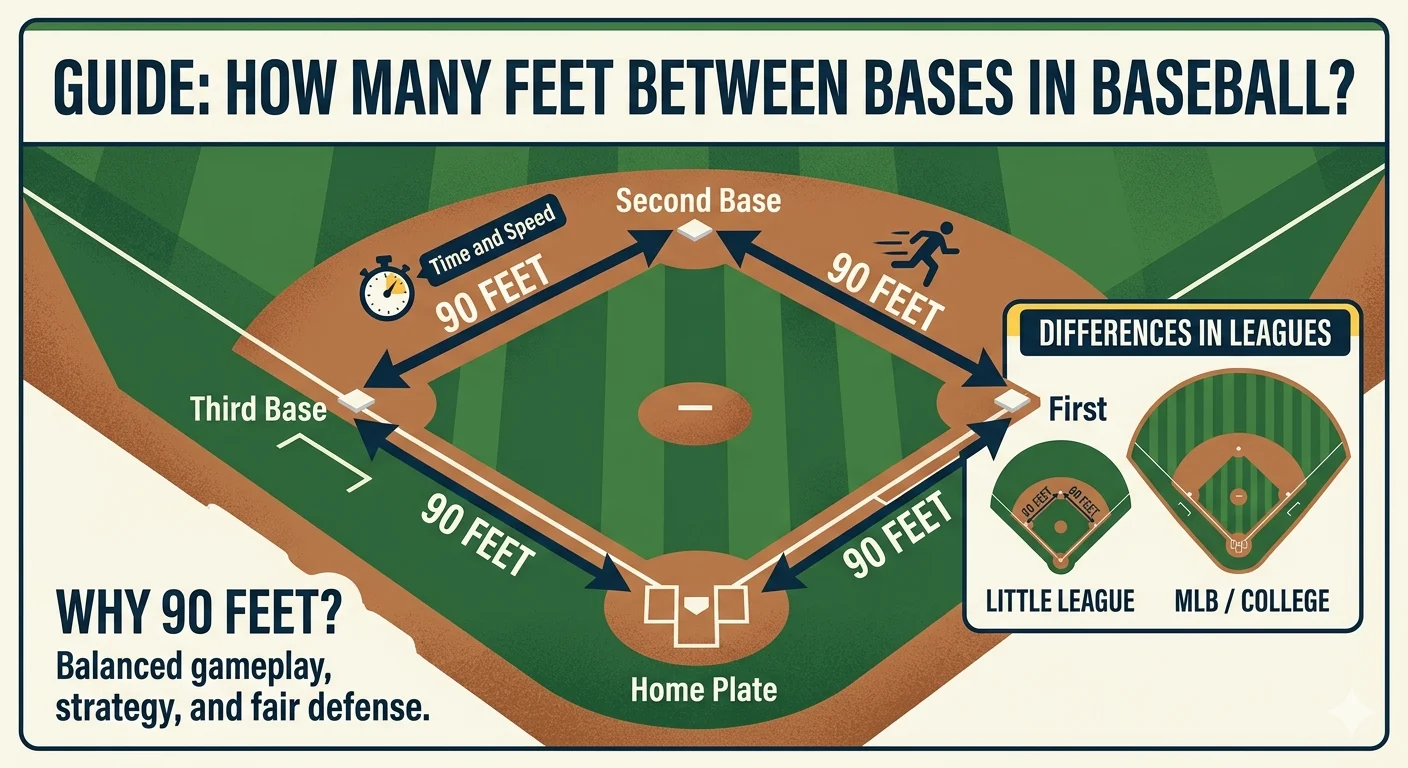
The official distance between bases in professional baseball is:
👉 90 feet
This means:
- Home to first base = 90 feet
- First to second base = 90 feet
- Second to third base = 90 feet
- Third to home = 90 feet
This standard is used in Major League Baseball and most professional and amateur adult leagues.
Why Are Bases 90 Feet Apart?
The 90-foot distance was carefully chosen after early versions of baseball were tested in the 1800s. Different distances were tried, and 90 feet became the ideal balance.
The reasoning behind 90 feet:
- 80 feet made stealing bases too easy
- 100 feet made offense too slow
- 90 feet balanced speed, skill, and strategy
This distance ensures that:
- Infielders have enough time to react
- Base runners can still attempt steals
- The game remains exciting and competitive
Base Distances in Different Levels of Baseball
Not every level of baseball uses 90 feet. The distance changes based on age and skill level.
Major League Baseball
- Base distance: 90 feet
- Used in professional games under Major League Baseball
High School Baseball
- Base distance: 90 feet
- Same as professional level for consistency and development
College Baseball
- Base distance: 90 feet
- Matches MLB standards
Little League Baseball
In Little League Baseball, younger players use smaller fields:
- Base distance: 60 feet
This makes the game easier and safer for children by:
- Reducing running distance
- Allowing quicker plays
- Helping skill development
How Base Distance Affects Gameplay
The 90-foot base distance is not random—it deeply impacts how baseball is played.
1. Speed vs Defense Balance
Baseball is a balance between:
- Fast runners trying to reach bases quickly
- Defenders trying to stop them with accurate throws
At 90 feet, both sides have equal opportunity.
2. Stolen Base Strategy
Stealing bases depends on timing and speed.
- Shorter distances make stealing easier
- 90 feet makes it a skill-based decision
Players must read pitchers and react quickly.
3. Infield Reaction Time
Fielders must:
- Catch the ball
- React instantly
- Throw accurately within seconds
The 90-foot gap creates just enough challenge for defensive players.
Other Important Baseball Field Measurements
Base distance is only one part of the field design.
Pitcher to Home Plate Distance
- 60 feet 6 inches
This is the distance pitchers throw to batters, creating a direct duel between them.
Base Path vs Diagonal Distance
People often misunderstand field geometry.
- Base to base: 90 feet
- Home to second (diagonal): about 127 feet
So the baseball field is not just a simple square in movement terms.
Outfield Dimensions
Outfield distances vary by stadium:
- Left field: ~300–350+ feet
- Center field: ~400+ feet
- Right field: varies
These dimensions are not fixed like base paths.
Comparison of Base Distances
| Level of Play | Base Distance |
| MLB | 90 feet |
| College Baseball | 90 feet |
| High School Baseball | 90 feet |
| Little League | 60 feet |
Expert Insights on Baseball Design
Baseball field dimensions have remained almost unchanged for over a century because they work extremely well.
Experts agree:
- 90 feet creates fair gameplay
- It supports both offense and defense
- It keeps games competitive and exciting
Even in modern analytics-driven baseball, this structure remains perfect.
Common Mistakes People Make
Many beginners misunderstand baseball measurements.
Mistake 1: All levels use 90 feet
Not true—youth leagues use shorter distances.
Mistake 2: Confusing mound distance with base distance
Pitcher’s mound is 60 feet 6 inches, not 90 feet.
Mistake 3: Thinking the field is a square
It is a diamond shape in structure and movement.
Real-World Example from Professional Baseball
In Major League Baseball, elite players can run 90 feet in about 3.5 to 4 seconds.
That short time window determines:
- Safe or out
- Scoring runs
- Game-changing moments
Every fraction of a second matters in professional baseball.
FAQs
1. How many feet between bases in baseball?
The standard distance is 90 feet in professional and college baseball.
2. Is it the same in youth baseball?
No, Little League Baseball uses 60 feet between bases.
3. Why is 90 feet used?
It balances speed, strategy, and fairness in gameplay.
4. How far is home plate to second base?
Approximately 127 feet diagonally.
5. Is baseball field size always the same?
Base paths are fixed, but outfield sizes vary by stadium.
Conclusion
So, how many feet between bases in baseball? The official answer is 90 feet in professional leagues like Major League Baseball, while youth leagues such as Little League Baseball use shorter distances.
This simple measurement is one of the most important parts of baseball. It defines the pace of the game, influences strategy, and keeps the sport balanced between offense and defense.
Understanding this distance gives you a clearer appreciation of why baseball is such a perfectly structured and competitive game.
Baseball is a game built on precision, balance, and carefully measured field dimensions. One of the most common questions fans and beginners ask is: how many feet between bases in baseball?
The answer is straightforward in professional baseball, but the full explanation becomes much more interesting when you look at different levels of play, field design, and game strategy. The distance between bases is not just a measurement it directly shapes how the game is played.
Let’s explore everything in a simple, clear, and expert way.
Understanding the Baseball Diamond Layout
To understand base distances, you first need to understand the structure of the field.
A baseball field is called a diamond because the four bases form a square rotated at a 45-degree angle. The bases are:
- Home plate
- First base
- Second base
- Third base
These four points create the infield, where most of the action happens.
Why the layout matters
The layout ensures:
- Equal distance between all bases
- Fair competition between offense and defense
- A consistent structure across all fields
Every movement in baseball is built around this diamond shape.
How Many Feet Between Bases in Baseball?
The official distance between bases in professional baseball is:
👉 90 feet
This means:
- Home to first base = 90 feet
- First to second base = 90 feet
- Second to third base = 90 feet
- Third to home = 90 feet
This standard is used in Major League Baseball and most professional and amateur adult leagues.
Why Are Bases 90 Feet Apart?
The 90-foot distance was carefully chosen after early versions of baseball were tested in the 1800s. Different distances were tried, and 90 feet became the ideal balance.
The reasoning behind 90 feet:
- 80 feet made stealing bases too easy
- 100 feet made offense too slow
- 90 feet balanced speed, skill, and strategy
This distance ensures that:
- Infielders have enough time to react
- Base runners can still attempt steals
- The game remains exciting and competitive
Base Distances in Different Levels of Baseball
Not every level of baseball uses 90 feet. The distance changes based on age and skill level.
Major League Baseball
- Base distance: 90 feet
- Used in professional games under Major League Baseball
High School Baseball
- Base distance: 90 feet
- Same as professional level for consistency and development
College Baseball
- Base distance: 90 feet
- Matches MLB standards
Little League Baseball
In Little League Baseball, younger players use smaller fields:
- Base distance: 60 feet
This makes the game easier and safer for children by:
- Reducing running distance
- Allowing quicker plays
- Helping skill development
How Base Distance Affects Gameplay
The 90-foot base distance is not random—it deeply impacts how baseball is played.
1. Speed vs Defense Balance
Baseball is a balance between:
- Fast runners trying to reach bases quickly
- Defenders trying to stop them with accurate throws
At 90 feet, both sides have equal opportunity.
2. Stolen Base Strategy
Stealing bases depends on timing and speed.
- Shorter distances make stealing easier
- 90 feet makes it a skill-based decision
Players must read pitchers and react quickly.
3. Infield Reaction Time
Fielders must:
- Catch the ball
- React instantly
- Throw accurately within seconds
The 90-foot gap creates just enough challenge for defensive players.
Other Important Baseball Field Measurements
Base distance is only one part of the field design.
Pitcher to Home Plate Distance
- 60 feet 6 inches
This is the distance pitchers throw to batters, creating a direct duel between them.
Base Path vs Diagonal Distance
People often misunderstand field geometry.
- Base to base: 90 feet
- Home to second (diagonal): about 127 feet
So the baseball field is not just a simple square in movement terms.
Outfield Dimensions
Outfield distances vary by stadium:
- Left field: ~300–350+ feet
- Center field: ~400+ feet
- Right field: varies
These dimensions are not fixed like base paths.
Comparison of Base Distances
| Level of Play | Base Distance |
| MLB | 90 feet |
| College Baseball | 90 feet |
| High School Baseball | 90 feet |
| Little League | 60 feet |
Expert Insights on Baseball Design
Baseball field dimensions have remained almost unchanged for over a century because they work extremely well.
Experts agree:
- 90 feet creates fair gameplay
- It supports both offense and defense
- It keeps games competitive and exciting
Even in modern analytics-driven baseball, this structure remains perfect.
Common Mistakes People Make
Many beginners misunderstand baseball measurements.
Mistake 1: All levels use 90 feet
Not true—youth leagues use shorter distances.
Mistake 2: Confusing mound distance with base distance
Pitcher’s mound is 60 feet 6 inches, not 90 feet.
Mistake 3: Thinking the field is a square
It is a diamond shape in structure and movement.
Real-World Example from Professional Baseball
In Major League Baseball, elite players can run 90 feet in about 3.5 to 4 seconds.
That short time window determines:
- Safe or out
- Scoring runs
- Game-changing moments
Every fraction of a second matters in professional baseball.
FAQs
1. How many feet between bases in baseball?
The standard distance is 90 feet in professional and college baseball.
2. Is it the same in youth baseball?
No, Little League Baseball uses 60 feet between bases.
3. Why is 90 feet used?
It balances speed, strategy, and fairness in gameplay.
4. How far is home plate to second base?
Approximately 127 feet diagonally.
5. Is baseball field size always the same?
Base paths are fixed, but outfield sizes vary by stadium.
Conclusion
So, how many feet between bases in baseball? The official answer is 90 feet in professional leagues like Major League Baseball, while youth leagues such as Little League Baseball use shorter distances.
This simple measurement is one of the most important parts of baseball. It defines the pace of the game, influences strategy, and keeps the sport balanced between offense and defense.
Understanding this distance gives you a clearer appreciation of why baseball is such a perfectly structured and competitive game.
Discover More Articles
how many cubic feet in a yard of topsoil