
Many people wonder, “How many feet is a flight of stairs?” The answer depends on the building type, ceiling height, and staircase design. However, in most residential homes, a standard flight of stairs is usually between 8 and 12 feet tall vertically.
A typical flight contains around 13 to 16 steps. Since each step normally rises about 7 to 8 inches, the total vertical height often lands close to 9 or 10 feet.
Understanding staircase measurements is important for home construction, remodeling, real estate planning, and safety. In this guide, you’ll learn standard stair dimensions, how to calculate staircase height, and what affects the size of a flight of stairs.
What Is a Flight of Stairs?
A flight of stairs is a continuous series of steps connecting one level to another without interruption.
For example:
- Ground floor to first floor
- Basement to main floor
- One landing to another landing
Many people confuse a staircase with a flight of stairs.
Here’s the difference:
| Term | Meaning |
|---|---|
| Flight of stairs | One uninterrupted section of stairs |
| Staircase | The entire stair structure including landings and railings |
So, a staircase may contain multiple flights.
How Many Feet Is a Standard Flight of Stairs?
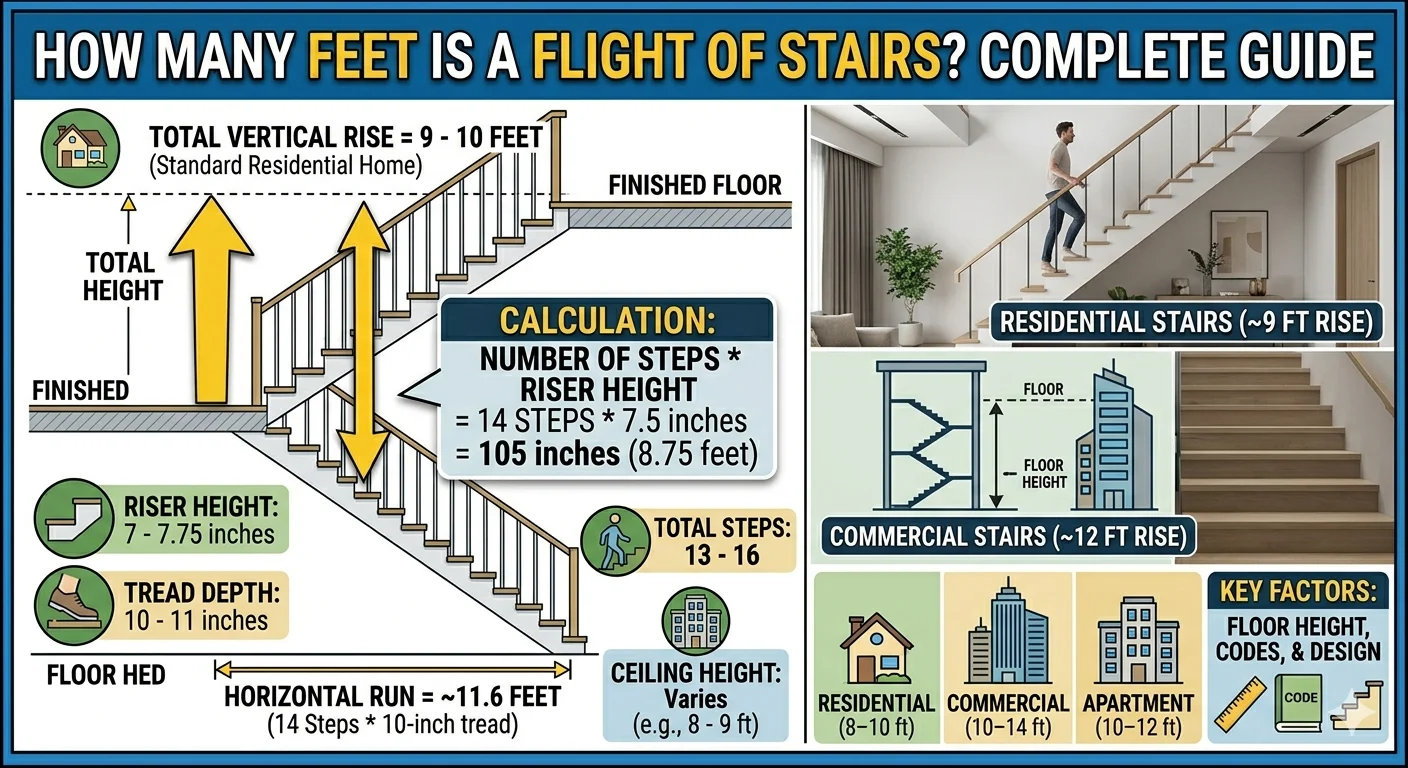
The average residential flight of stairs rises about 8 to 10 feet vertically.
Here’s a quick breakdown:
| Building Type | Average Vertical Height |
|---|---|
| Residential home | 8–10 feet |
| Apartment building | 10–12 feet |
| Commercial building | 10–14 feet |
Most homes in the United States have ceiling heights between 8 and 9 feet. After including floor thickness, the floor-to-floor distance usually becomes about 9 to 10 feet.
That means a standard flight of stairs often covers:
- 9 feet vertically
- 13–16 stair steps
- Around 10–14 feet horizontally
Standard Stair Dimensions Explained
To understand staircase height better, you need to know the basic stair measurements.
Stair Riser Height
The riser is the vertical part of each step.
Most residential stair risers are:
- 7 to 7.75 inches high
Building codes usually limit risers to prevent steep stairs.
Stair Tread Depth
The tread is the flat part where you place your foot.
Typical tread depth:
- 10 to 11 inches
Deeper treads improve comfort and safety.
Total Vertical Rise
The vertical rise is the height from one finished floor to the next.
In many homes:
- Total rise = 108 inches (9 feet)
Horizontal Run
The horizontal run is the total forward distance covered by the stairs.
For example:
- 14 steps × 10-inch tread depth
- Total run = around 140 inches
- About 11.6 feet
Typical Staircase Measurements Table
Here are common staircase dimensions for different buildings.
| Stair Type | Average Steps | Vertical Height | Horizontal Run |
|---|---|---|---|
| Small residential | 12–13 | 8 feet | 9–10 feet |
| Standard residential | 13–16 | 9–10 feet | 10–14 feet |
| Apartment stairs | 15–18 | 10–12 feet | 12–16 feet |
| Commercial stairs | 16–20 | 12–14 feet | 14–18 feet |
These numbers may vary based on local building codes and design preferences.
How to Calculate the Height of a Flight of Stairs
Calculating stair height is simple if you know the number of steps and riser height.
Use this formula:
Example Calculation
Suppose your staircase has:
- 14 steps
- 7.5-inch risers
The calculation becomes:
105 inches equals:
So, the flight of stairs is approximately 8.75 feet tall.
Factors That Affect Stair Height
Not every staircase is the same. Several factors change how many feet a flight of stairs will be.
Ceiling Height
Homes with higher ceilings require taller staircases.
Examples:
- 8-foot ceiling → shorter staircase
- 10-foot ceiling → taller staircase
Building Codes
Local regulations control:
- Maximum riser height
- Minimum tread depth
- Landing requirements
Codes improve safety and comfort.
Landings
Some staircases include landings between sections.
This can divide one staircase into multiple flights.
Stair Style
Different staircase styles affect dimensions.
For example:
- Spiral stairs take less horizontal space
- Straight stairs need more room
- Floating stairs may have custom dimensions
Residential vs Commercial Staircases
Residential and commercial stairs are designed differently.
Residential Stairs
Usually designed for comfort and space efficiency.
Common measurements:
- 7.5-inch riser
- 10-inch tread
- Narrower width
Commercial Stairs
Designed for heavy foot traffic and safety.
Features include:
- Wider stairs
- Larger landings
- More gradual rise
- Stricter code compliance
Commercial staircases often extend higher because commercial buildings have taller floors.
Common Staircase Types and Their Heights
Different stair styles change the overall dimensions.
Straight Stairs
The most common staircase type.
Typical height:
- 8–10 feet per flight
L-Shaped Stairs
Include a landing and turn.
Often divided into:
- Two shorter flights
Spiral Stairs
Compact and space-saving.
Usually:
- Steeper
- Smaller footprint
- Shorter horizontal run
Split Stairs
Common in large homes and public buildings.
These stairs branch into multiple directions after a landing.
Building Code Guidelines for Stair Dimensions
Most building codes follow safety standards similar to the International Residential Code (IRC).
Common requirements include:
| Stair Feature | Standard Requirement |
|---|---|
| Maximum riser height | 7.75 inches |
| Minimum tread depth | 10 inches |
| Minimum stair width | 36 inches |
| Minimum headroom | 6 feet 8 inches |
These guidelines help reduce accidents and improve comfort.
Always check local building regulations before construction.
Common Mistakes When Measuring Stairs
Many people make errors while planning or measuring staircases.
Ignoring Landings
Landings affect total staircase dimensions.
Always include them in measurements.
Measuring Only Vertical Height
You must calculate:
- Vertical rise
- Horizontal run
- Stair width
Using Incorrect Riser Sizes
Uneven risers can create safety hazards.
Even small differences may cause trips and falls.
Forgetting Floor Thickness
The distance between finished floors matters more than ceiling height alone.
Expert Tips for Stair Planning
Whether you are remodeling or building a new home, these expert tips can help.
Prioritize Comfort
Comfortable stairs usually have:
- Lower risers
- Wider treads
- Proper handrails
Follow Local Codes
Never rely only on estimates.
Building codes vary by location.
Plan for Furniture Movement
Make staircases wide enough for moving furniture safely.
Consider Lighting
Good stair lighting improves safety significantly.
Use Non-Slip Materials
Especially important for:
- Elderly residents
- Children
- Outdoor stairs
FAQs
How many steps are usually in one flight of stairs?
Most residential flights contain 13 to 16 steps.
How tall is a standard staircase in feet?
A standard residential staircase is usually 8 to 10 feet tall vertically.
What is the average rise of one stair step?
Most stair risers measure between 7 and 7.75 inches.
How long is a flight of stairs horizontally?
Most residential staircases run about 10 to 14 feet horizontally.
Do building codes affect staircase height?
Yes. Building codes regulate riser height, tread depth, stair width, and other safety requirements.
Conclusion
So, how many feet is a flight of stairs? In most homes, a standard flight of stairs is typically between 8 and 10 feet high vertically, with around 13 to 16 steps. However, the exact dimensions depend on ceiling height, building design, staircase style, and local building codes.
Understanding standard staircase measurements helps with home planning, renovations, safety improvements, and construction projects. Whether you are designing a new staircase or simply curious about stair dimensions, knowing the average height, tread depth, and riser size gives you a much clearer picture of how staircases are built.
By following proper measurements and building guidelines, you can create stairs that are safe, comfortable, and efficient for everyday use.