
If you have ever purchased soil, gravel, mulch, or concrete, you may have asked yourself: how many cubic feet in 1 yd? This is one of the most common volume conversion questions in construction, landscaping, and home improvement projects.
The quick answer is simple:
Understanding this conversion can save time, money, and frustration. Whether you are filling a garden bed, ordering concrete, or calculating moving truck space, knowing how cubic yards and cubic feet relate is extremely useful.
In this guide, you will learn:
- What cubic feet and cubic yards mean
- How to convert between them
- Real-life examples
- Easy formulas
- Conversion charts
- Common mistakes to avoid
By the end, you will be able to calculate cubic measurements confidently.
Understanding Cubic Measurements
Before learning the conversion, it helps to understand what these measurements actually represent.
What Is a Cubic Foot?
A cubic foot measures volume. It represents the amount of space inside a cube that is:
- 1 foot long
- 1 foot wide
- 1 foot high
Cubic feet are commonly used for:
- Refrigerators
- Storage boxes
- Moving trucks
- Small landscaping projects
For example, a storage container measuring 1 foot on each side holds 1 cubic foot of material.
What Is a Cubic Yard?
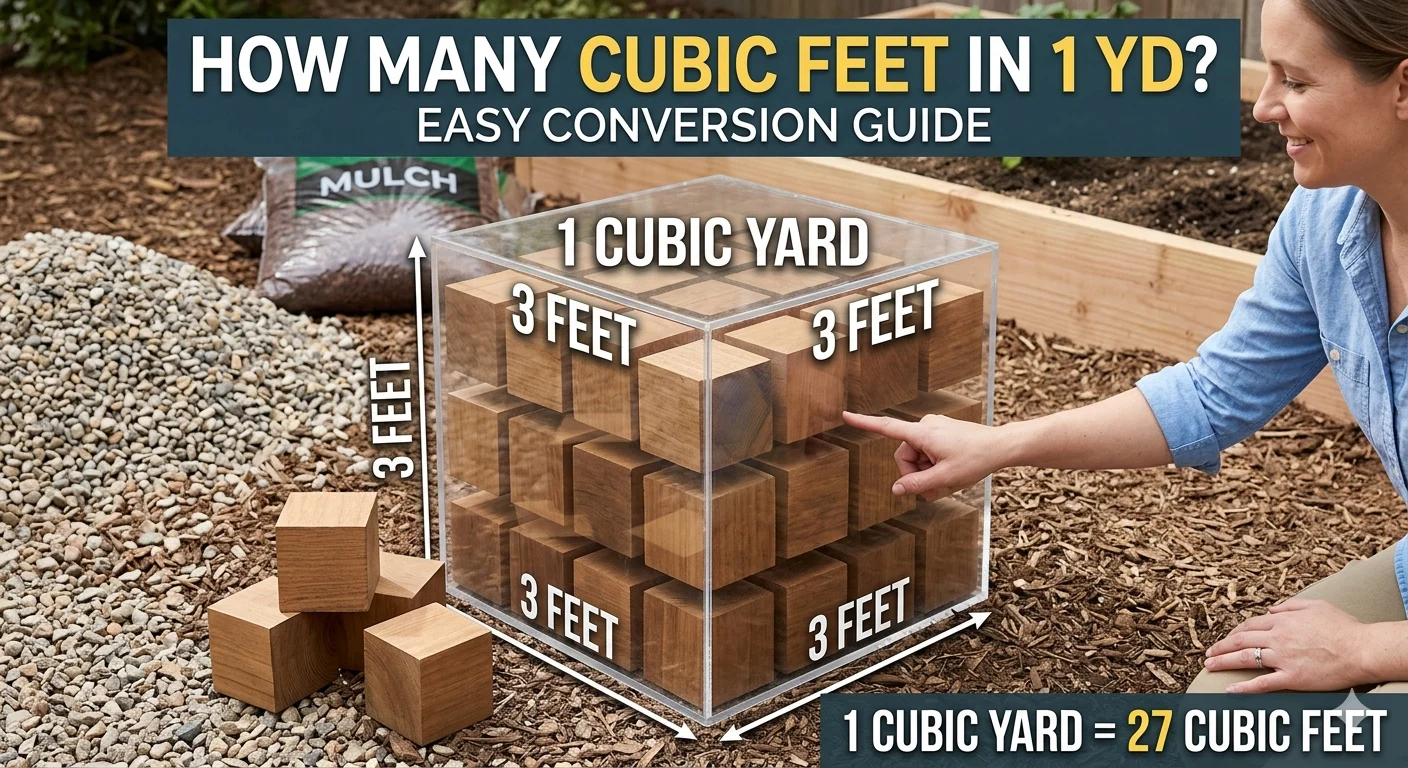
A cubic yard is a larger volume measurement. It represents a cube measuring:
- 3 feet long
- 3 feet wide
- 3 feet high
Cubic yards are commonly used for:
- Concrete
- Gravel
- Sand
- Mulch
- Topsoil
Because these materials are often sold in bulk, cubic yards are more practical than cubic feet.
How Many Cubic Feet in 1 Yd?
Now let’s answer the main question clearly.
There are:
This means one cubic yard contains 27 cubic feet.
The conversion happens because:
- 1 yard = 3 feet
- Volume uses three dimensions
- So you multiply 3 × 3 × 3
Which equals:
That is why one cubic yard equals 27 cubic feet.
Simple Formula
To convert cubic yards into cubic feet, use this formula:
To convert cubic feet into cubic yards:
These two formulas solve almost every yard-to-feet conversion problem.
Cubic Yard to Cubic Feet Conversion Table
Here is a quick conversion chart for easy reference.
| Cubic Yards | Cubic Feet |
| 1 yd³ | 27 ft³ |
| 2 yd³ | 54 ft³ |
| 3 yd³ | 81 ft³ |
| 4 yd³ | 108 ft³ |
| 5 yd³ | 135 ft³ |
| 10 yd³ | 270 ft³ |
| 15 yd³ | 405 ft³ |
| 20 yd³ | 540 ft³ |
This table is especially useful for landscaping and construction estimates.
How to Convert Cubic Yards to Cubic Feet
Learning the conversion process is easier than most people think.
Step-by-Step Process
Step 1: Identify the Number of Cubic Yards
Start with the cubic yard value.
Example:
- 2 cubic yards
Step 2: Multiply by 27
Use the conversion formula.
Step 3: Write the Final Answer
2 cubic yards equals 54 cubic feet.
Example Calculations
Example 1: Mulch Project
Suppose you buy 5 cubic yards of mulch.
Calculation:
You have 135 cubic feet of mulch.
Example 2: Concrete Order
A contractor orders 10 cubic yards of concrete.
Calculation:
That equals 270 cubic feet of concrete.
Example 3: Soil Delivery
You receive 1.5 cubic yards of topsoil.
Calculation:
So the delivery contains 40.5 cubic feet.
Real-World Uses of Cubic Yard Conversions
Knowing how many cubic feet in 1 yd is useful in many situations.
Landscaping
Landscaping companies often sell:
- Mulch
- Gravel
- Sand
- Soil
These materials are usually priced per cubic yard.
If your garden requires 54 cubic feet of mulch, you can divide by 27 to determine you need 2 cubic yards.
Concrete Projects
Concrete is almost always ordered in cubic yards.
Examples include:
- Driveways
- Patios
- Sidewalks
- Foundations
Understanding the conversion helps avoid ordering too much or too little material.
Moving and Storage
Moving truck sizes are commonly listed in cubic feet.
Knowing cubic yard conversions helps estimate how much space large items occupy.
For example:
- 1 cubic yard = 27 cubic feet
- A 270 cubic foot truck holds about 10 cubic yards
Construction Work
Builders regularly calculate:
- Excavation volume
- Dirt removal
- Material requirements
Accurate volume conversions improve project planning and budgeting.
Common Mistakes People Make
Even simple conversions can create confusion. Here are common mistakes to avoid.
Confusing Square Feet With Cubic Feet
Square feet measure area.
Cubic feet measure volume.
For example:
- Square feet = floor space
- Cubic feet = total space including height
This is one of the biggest mistakes beginners make.
Forgetting to Cube the Dimensions
Some people multiply by 3 instead of 27.
Remember:
Because volume uses three dimensions, the conversion factor is 27.
Ordering Too Little Material
Many DIY projects fail because people underestimate volume needs.
Experts often recommend ordering:
- 5–10% extra material
This allows for waste, settling, and uneven surfaces.
Cubic Feet vs Square Feet
People often confuse these measurements.
Here is a simple comparison.
| Measurement | Used For | Dimensions |
| Square Feet | Area | Length × Width |
| Cubic Feet | Volume | Length × Width × Height |
For example:
- A room floor may be 100 square feet
- The room volume may be 800 cubic feet
Understanding the difference prevents costly mistakes.
Why This Conversion Matters
You may wonder why learning cubic conversions is important.
Here are some practical benefits.
Saves Money
Correct measurements prevent overbuying expensive materials.
Improves Project Accuracy
Better calculations lead to better project planning.
Reduces Waste
Ordering the correct amount minimizes unused materials.
Makes Communication Easier
Contractors and suppliers usually work in cubic yards.
Homeowners often think in cubic feet.
Knowing both units helps avoid confusion.
Expert Tips for Accurate Measurements
Professionals use several tricks to improve accuracy.
Measure Twice
Always double-check dimensions before ordering materials.
Use Consistent Units
Convert everything into feet before calculating volume.
Round Carefully
For large projects, rounding too much can cause major errors.
Understand Material Compression
Some materials settle after delivery.
Examples include:
- Mulch
- Soil
- Gravel
This may slightly reduce actual volume coverage.
Use a Volume Calculator
Online calculators can speed up large project estimates.
However, understanding the math yourself is still valuable.
Practical Example for Homeowners
Imagine you want to fill a raised garden bed.
The bed dimensions are:
- Length: 9 feet
- Width: 3 feet
- Height: 1 foot
Volume calculation:
Since 27 cubic feet equals 1 cubic yard, you need:
So you should order 1 cubic yard of soil.
Quick Memory Trick
Here is an easy way to remember the conversion.
Think of this:
- 1 yard = 3 feet
- Volume uses three dimensions
- 3 × 3 × 3 = 27
So:
- 1 cubic yard = 27 cubic feet
This trick helps you remember the formula instantly.
FAQs
How many cubic feet are in 1 cubic yard?
There are 27 cubic feet in 1 cubic yard.
Why is 1 cubic yard equal to 27 cubic feet?
Because one yard equals three feet, and volume uses three dimensions:
3 × 3 × 3 = 27.
How do I convert cubic yards to cubic feet?
Multiply the number of cubic yards by 27.
How many cubic feet are in 2 yards?
2 cubic yards equal 54 cubic feet.
Is cubic feet the same as square feet?
No. Square feet measure area, while cubic feet measure volume.
Conclusion
So, how many cubic feet in 1 yd?
The answer is simple:
This conversion is essential for landscaping, construction, gardening, concrete work, and many home improvement projects. Once you understand the formula, converting between cubic yards and cubic feet becomes quick and easy.
Remember:
- Multiply cubic yards by 27 to get cubic feet
- Divide cubic feet by 27 to get cubic yards
With the charts, formulas, and examples in this guide, you can confidently calculate material volumes and avoid costly mistakes on your next project.
Discover More Articles
how many square feet in a half an acre