
When people ask, “how many feet is 1 story,” they usually want a quick way to estimate the height of a building. Whether you are looking at a house, apartment, office tower, or construction project, understanding story height helps you visualize the actual size of a structure.
The simple answer is that 1 story is usually between 10 and 14 feet tall. However, the exact height depends on the type of building, ceiling design, floor thickness, and construction style.
Residential homes often have shorter stories, while office buildings and commercial properties are usually taller. Some luxury homes and modern buildings can also exceed the average height because of high ceilings and decorative architecture.
In this guide, you will learn:
- The average height of one story
- Differences between residential and commercial buildings
- Easy ways to estimate building height
- Common examples and charts
- Factors that affect story height
By the end, you will clearly understand how building stories are measured and why the numbers vary.
What Does “1 Story” Mean?
A story refers to a single level or floor within a building. In simple terms, each usable level above the ground counts as one story.
For example:
- A bungalow has 1 story
- A duplex may have 2 stories
- An apartment tower could have 20 or more stories
People often use the words “story” and “floor” interchangeably, but they can mean slightly different things in architecture.
Difference Between Floor and Story
- A floor is the actual walking surface
- A story is the vertical space between one floor and the next
This vertical space includes:
- Ceiling height
- Floor structure
- Insulation
- Wiring
- Plumbing
- HVAC systems
That is why the total height of a story is usually larger than just the visible room height.
How Many Feet Is 1 Story on Average?
The average height of one story depends mainly on the building type.
Here is a general rule:
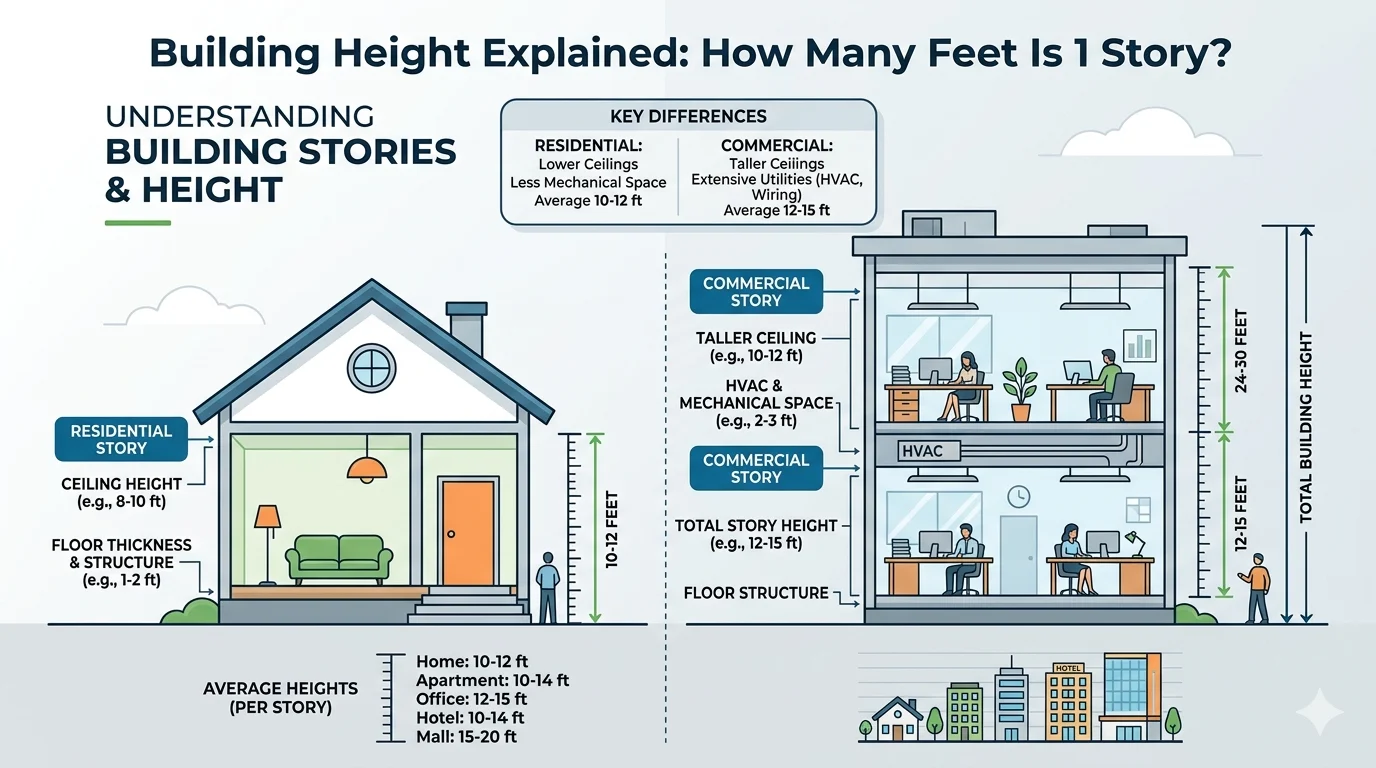
| Building Type | Average Height Per Story |
|---|---|
| Residential house | 10–12 feet |
| Apartment building | 10–14 feet |
| Office building | 12–15 feet |
| Hotel | 10–14 feet |
| High rise commercial tower | 14 feet or more |
Most homes in the United States use 8 to 10 foot ceilings. Once you add the floor structure and utilities between floors, the total reaches around 10 to 12 feet per story.
Commercial buildings usually require extra space for:
- Air conditioning systems
- Electrical wiring
- Elevators
- Fire protection systems
Because of that, they are generally taller.
Average Story Height Chart
The table below gives a clearer picture of average story heights across different building types.
| Building Type | Typical Ceiling Height | Total Story Height |
|---|---|---|
| Small home | 8 feet | 10 feet |
| Modern house | 9 feet | 10–12 feet |
| Luxury home | 10–12 feet | 12–14 feet |
| Apartment | 8–10 feet | 10–12 feet |
| Office building | 10–12 feet | 12–15 feet |
| Shopping mall | 14–18 feet | 15–20 feet |
This chart helps explain why some buildings appear much taller even if they have the same number of stories.
Why Story Height Varies
Not every story has the same height. Several factors influence the final measurement.
Ceiling Height
The ceiling is one of the biggest factors.
Older homes may have:
- 8 foot ceilings
Modern homes often use:
- 9 foot ceilings
Luxury homes can include:
- 12 foot ceilings
- Vaulted ceilings
- Open floor plans
Higher ceilings create a spacious feel but increase total building height.
Floor Thickness
Between each floor is a structural layer containing:
- Wood or steel framing
- Concrete slabs
- Insulation
- Pipes
- Wiring
This hidden section can add several feet.
HVAC and Mechanical Space
Commercial buildings need room for:
- Duct systems
- Air conditioning
- Sprinklers
- Electrical systems
That is why office stories are usually taller than residential stories.
Roof Design
Roof style changes the visible height dramatically.
Examples include:
- Flat roofs
- Gable roofs
- Dome roofs
- Vaulted roofs
A one story house with a steep roof may appear taller than a two story building with a flat roof.
Residential vs Commercial Story Heights
Residential and commercial buildings follow different construction standards.
Residential Buildings
Homes focus more on comfort and efficiency.
Typical features:
- Lower ceilings
- Smaller utility systems
- Less structural complexity
Average height:
- 10 to 12 feet per story
Commercial Buildings
Commercial spaces require:
- Larger ceilings
- Mechanical systems
- Fire safety infrastructure
- Open layouts
Average height:
- 12 to 15 feet per story
Comparison Table
| Feature | Residential | Commercial |
|---|---|---|
| Average story height | 10–12 feet | 12–15 feet |
| Ceiling height | Lower | Higher |
| HVAC systems | Smaller | Larger |
| Structural complexity | Moderate | High |
| Utility space | Minimal | Extensive |
How to Estimate Building Height by Stories
Estimating building height is easier when you know the average feet per story.
Simple Formula
For example:
- 2 story house:
- 2 × 10 feet = 20 feet
- 5 story office building:
- 5 × 14 feet = 70 feet
This method gives a good estimate, although exact measurements may differ.
Common Building Height Examples
Here are some practical examples people commonly search for.
1 Story Building
Average height:
- 10 to 14 feet
Typical examples:
- Ranch homes
- Small retail stores
- Single level offices
2 Story Building
Average height:
- 20 to 28 feet
Common examples:
- Family homes
- Duplexes
- Townhouses
3 Story Building
Average height:
- 30 to 42 feet
Examples:
- Apartment buildings
- Small hotels
- Commercial properties
10 Story Building
Average height:
- 100 to 150 feet
These may include:
- Office towers
- Hotels
- Residential high rises
How Tall Is a One Story House?
Most one story houses are around 10 to 15 feet tall from ground level to the roof peak.
However, styles vary significantly.
Ranch Style Homes
Traditional ranch homes usually have:
- 8 foot ceilings
- Moderate roof pitch
Average total height:
- 10–12 feet
Modern Homes
Modern architecture often includes:
- Taller ceilings
- Open concepts
- Large windows
Average total height:
- 12–14 feet
Homes With Vaulted Ceilings
Vaulted ceilings increase visible interior height.
These homes may reach:
- 15 feet or more
even though they are technically still one story.
Common Mistakes When Estimating Story Height
People often miscalculate building height because they overlook important details.
Ignoring Roof Height
The roof can add several extra feet.
Flat roofs:
- Add little height
Steep roofs:
- Add significant height
Assuming Every Story Is Equal
Buildings rarely have identical story heights.
For example:
- Hotel lobby floors are often taller
- Penthouse levels may differ
- Parking levels may have larger clearances
Forgetting Mechanical Space
Commercial buildings need hidden utility areas between floors.
This extra space is not always visible from outside.
Why Story Height Matters
Understanding story height is useful in many situations.
Construction Planning
Builders need accurate measurements for:
- Materials
- Engineering
- Structural safety
Real Estate
Buyers often compare:
- Ceiling height
- Open space
- Property appearance
Taller ceilings can increase property value.
Fire Safety
Emergency services use building height to determine:
- Ladder access
- Evacuation planning
- Safety regulations
City Regulations
Local governments often limit:
- Maximum building height
- Story count
- Zoning requirements
Knowing average story height helps developers comply with regulations.
Expert Tips for Measuring Building Height
Here are a few expert recommendations:
Use Google Maps or Property Records
Many city databases list official building heights.
Count Windows Carefully
Windows often help estimate:
- Number of stories
- Floor spacing
Look at Roof Shape
A steep roof may add more height than expected.
Understand Building Purpose
Commercial buildings usually have taller stories than homes.
Use Standard Estimates
For quick calculations:
- Residential:
- 10 feet per story
- Commercial:
- 14 feet per story
These estimates work well for rough planning.
FAQs
How many feet is 1 story in a house?
Most residential homes have stories that are 10 to 12 feet tall, including floor thickness and ceiling space.
How tall is a 2 story house?
A typical 2 story house is around 20 to 25 feet tall, depending on roof style and ceiling height.
Are commercial buildings taller per story?
Yes. Commercial buildings often use 12 to 15 feet per story because they need more mechanical and utility space.
Does roof height count as part of a story?
The roof itself is not usually considered a story, but it does add to the total building height.
How do architects calculate building height?
Architects measure from ground level to the roofline and include floor structures, ceilings, and mechanical systems.
Conclusion
So, how many feet is 1 story? In most cases, one story equals about 10 to 14 feet tall. Residential homes usually stay near the lower end of that range, while commercial buildings often reach higher because of added structural and mechanical space.
Understanding story height helps with construction planning, real estate research, architecture, and estimating building size quickly. Although averages are useful, remember that ceiling design, roof shape, and building purpose can significantly change the final height.
Whether you are estimating a small house or a skyscraper, using standard feet-per-story measurements gives you a reliable starting point for understanding building dimensions.