
Cornhole is one of the most popular backyard games, enjoyed at family gatherings, tailgates, barbecues, and competitive tournaments. Whether you’re a beginner setting up your first game or an experienced player preparing for competition, understanding how many feet between cornhole boards is essential.
Using the correct distance helps ensure fair gameplay, improves accuracy, and creates a more enjoyable experience for everyone involved. While many casual players estimate the spacing, official cornhole organizations use specific measurements that standardize play across leagues and tournaments.
This guide explains the official distance between cornhole boards, how to measure it correctly, common setup mistakes, and tips for creating the perfect cornhole court.
Official Distance Between Cornhole Boards
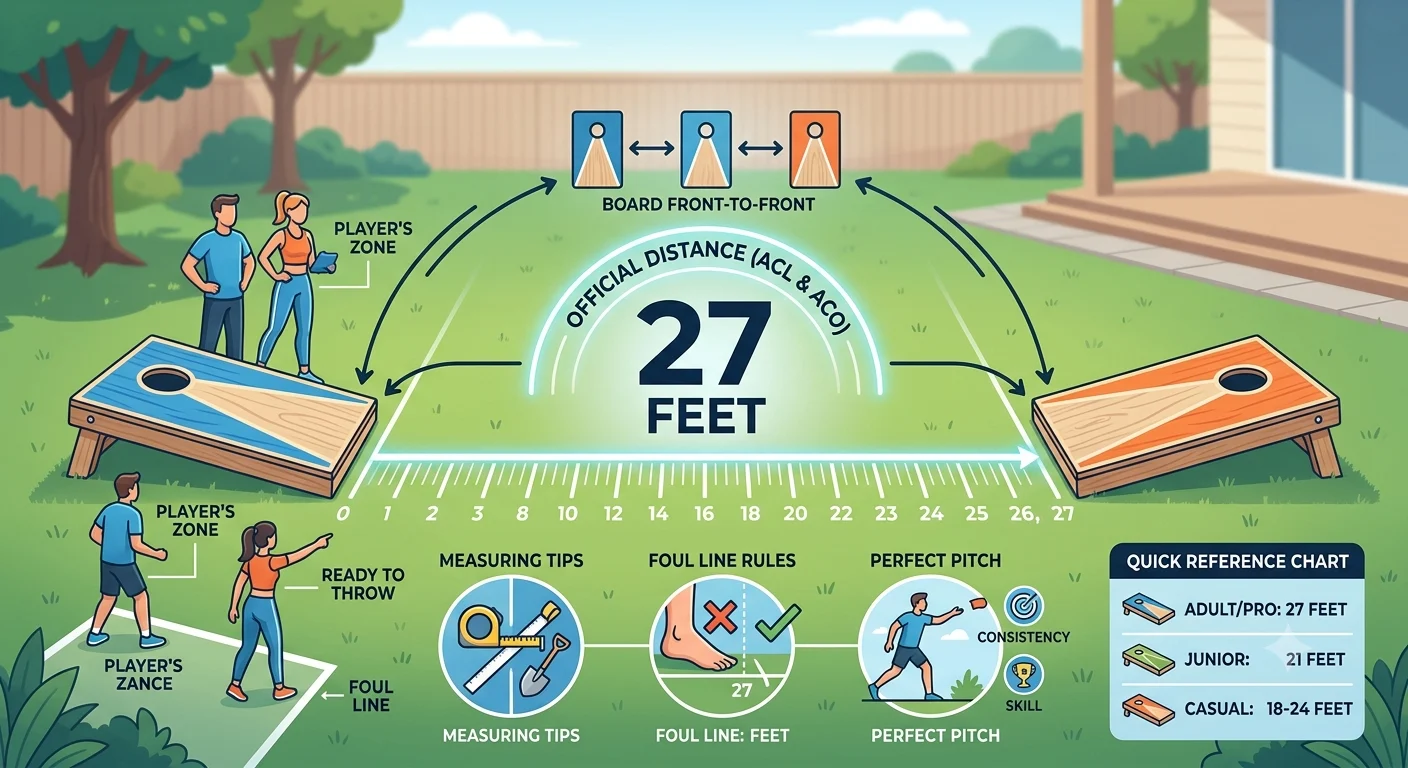
The official distance between cornhole boards is 27 feet from the front edge of one board to the front edge of the other board.
This measurement is recognized by major cornhole organizations and is used in competitive and tournament play. When properly set up, the boards provide the right balance of challenge and skill, allowing players to compete fairly.
Many people mistakenly believe the distance should be measured from hole to hole or from the back of the boards. However, the official measurement is always taken from the front edge of each board.
Why the Official Distance Matters
The 27-foot spacing was established to create consistent gameplay. If the boards are too close together, scoring becomes too easy. If they are too far apart, the game becomes unnecessarily difficult.
Using the proper distance provides several benefits:
- Creates fair competition
- Improves player accuracy
- Standardizes gameplay
- Helps players develop consistent throwing techniques
- Prepares players for tournament competition
Whether you’re playing casually or competitively, using the correct distance makes the game more enjoyable.
Understanding Cornhole Court Dimensions
The distance between boards is only one part of a regulation cornhole setup. Several other measurements contribute to a proper court.
Standard Cornhole Board Dimensions
- Board length: 4 feet
- Board width: 2 feet
- Rear board height: 12 inches
- Front board height: 3 to 4 inches
- Hole diameter: 6 inches
Court Measurements
- Front edge to front edge: 27 feet
- Hole center to hole center: Approximately 33 feet
These dimensions ensure consistency across all levels of play.
How to Measure the Distance Correctly
Setting up cornhole boards accurately is simple if you follow the proper steps.
Step 1: Place the First Board
Position the first board on a flat surface.
Step 2: Find the Front Edge
Locate the front edge of the board, which is the side closest to the ground.
Step 3: Measure 27 Feet
Use a measuring tape and extend it 27 feet straight out from the front edge of the first board.
Step 4: Position the Second Board
Place the front edge of the second board at the 27-foot mark.
Step 5: Align Both Boards
Make sure both boards directly face each other and are centered on the same line.
Proper measurement ensures a fair and professional setup.
Cornhole Distances for Different Skill Levels
While tournament players use the official 27-foot distance, recreational players often adjust the spacing based on skill level.
Adults
Adults and experienced players should use the full 27-foot distance whenever possible.
Beginners
New players often enjoy the game more when the boards are placed 20 to 24 feet apart. This shorter distance makes it easier to land bags on the board and build confidence.
Children
Children may use distances ranging from 12 to 21 feet depending on age and ability.
Senior Players
Many senior players prefer distances between 20 and 24 feet to reduce physical strain while maintaining competitive gameplay.
Adjusting the distance can make the game more enjoyable without sacrificing fun.
Official Tournament Setup
Competitive cornhole tournaments follow strict guidelines to ensure fairness.
Tournament requirements typically include:
- Regulation-sized boards
- Front edges exactly 27 feet apart
- Level playing surface
- Proper lighting for indoor play
- Boards facing directly toward one another
- Consistent court conditions
Players who practice at official distances often perform better during tournaments because they are familiar with regulation conditions.
Common Mistakes When Measuring Cornhole Board Distance
Many players unintentionally set up their boards incorrectly.
Measuring From the Wrong Location
The most common mistake is measuring from the back of the boards instead of the front edge.
Guessing the Distance
Estimating the spacing often results in inaccurate setups.
Uneven Ground
A sloped surface can significantly affect gameplay and scoring.
Poor Alignment
Boards that are not directly facing each other make throws more difficult and inconsistent.
Ignoring Player Experience
Using tournament distances for young children or beginners may make the game frustrating rather than fun.
Avoiding these mistakes creates a better overall playing experience.
Front Edge Measurement vs Hole-to-Hole Measurement
Many players become confused when discussing cornhole distances because two different measurements are commonly referenced.
Front Edge to Front Edge
This is the official measurement used when setting up boards.
Distance: 27 feet
Hole Center to Hole Center
This measurement is approximately 33 feet.
Although useful as a reference, it is not the official setup measurement.
Always use the front-edge measurement when positioning cornhole boards.
Backyard Cornhole vs Tournament Cornhole
The setup for backyard games often differs from competitive play.
Backyard Cornhole
- Flexible distances
- Casual rules
- Family-friendly gameplay
- Easier setups
Tournament Cornhole
- Strict 27-foot spacing
- Official rules
- Regulation equipment
- Consistent court conditions
Both approaches can be enjoyable depending on the goals of the players.
Benefits of Playing at the Official Distance
Using the official spacing offers several advantages.
Improved Accuracy
Players develop better throwing consistency and control.
Fair Competition
Everyone plays under the same conditions.
Better Skill Development
Official distances encourage proper technique and strategy.
Tournament Readiness
Practicing at regulation distances prepares players for competitive events.
More Challenging Gameplay
The game becomes more strategic and rewarding when players must throw accurately over the full distance.
Practical Example
Imagine hosting a backyard gathering with friends.
If the boards are only 18 feet apart, most players will score frequently, and games may end quickly. While this can be fun for beginners, experienced players may find it too easy.
Now imagine the boards positioned at the official 27-foot distance. Players must focus on technique, strategy, and consistency. Games become more competitive and engaging.
This simple adjustment can dramatically improve the overall quality of play.
Tips for the Perfect Cornhole Setup
To create the best possible playing experience, follow these tips:
Use a Measuring Tape
Always measure rather than estimate.
Choose Flat Ground
Level surfaces produce more consistent gameplay.
Mark Permanent Locations
If you frequently play in the same area, consider marking the official board locations.
Check Board Stability
Ensure boards do not wobble or shift during play.
Leave Throwing Space
Provide enough room behind each board for players to throw comfortably.
Small setup improvements can make a noticeable difference in gameplay quality.
Weather and Playing Conditions
Although the distance remains the same, environmental factors can influence the game.
Wind
Strong winds can alter the flight of cornhole bags.
Rain
Wet bags may behave differently than dry bags.
Soft Ground
Boards may shift if placed on uneven or muddy surfaces.
Sunlight
Bright sunlight can affect visibility and concentration.
Whenever possible, choose stable weather conditions for the best playing experience.
Should You Always Use 27 Feet?
Not necessarily.
The official 27-foot distance is ideal for:
- Competitive players
- Tournament practice
- Experienced throwers
- Organized leagues
Shorter distances may be better for:
- Children
- Beginners
- Casual family games
- Recreational events
The most important goal is ensuring that all players have fun while still enjoying a reasonable challenge.
Conclusion
If you’re wondering how many feet between cornhole boards, the official answer is 27 feet measured from the front edge of one board to the front edge of the other board.
This regulation distance is used in tournaments and competitive play because it creates the ideal balance of challenge, accuracy, and fairness. While casual players may choose shorter distances for children or beginners, practicing at the official spacing helps develop skills and prepares players for higher levels of competition.
Whether you’re setting up a backyard game or organizing a tournament, using the correct cornhole board distance ensures a better playing experience for everyone involved.