

Understanding how many bones in your feet is not just a basic biology question—it is a key insight into how the human body supports movement, balance, and strength every single day. Your feet carry your entire body weight, absorb shock, and allow you to walk, run, jump, and stand with stability.
Each step you take depends on a highly complex structure of bones working together. In this guide, you will clearly learn how many bones are in your feet, how they are organized, and why they are so important for your health and mobility.
Introduction to Foot Bones
The human foot is one of the most advanced structures in the skeletal system. It may look simple from the outside, but inside it contains many small bones, joints, and ligaments working in harmony.
When we ask how many bones in your feet, we are referring to a system designed for:
- Balance and stability
- Movement and flexibility
- Shock absorption during walking or running
- Supporting full body weight
Without this structure, basic movement would be impossible or extremely difficult.
How Many Bones in Your Feet?
The clear and correct answer is:
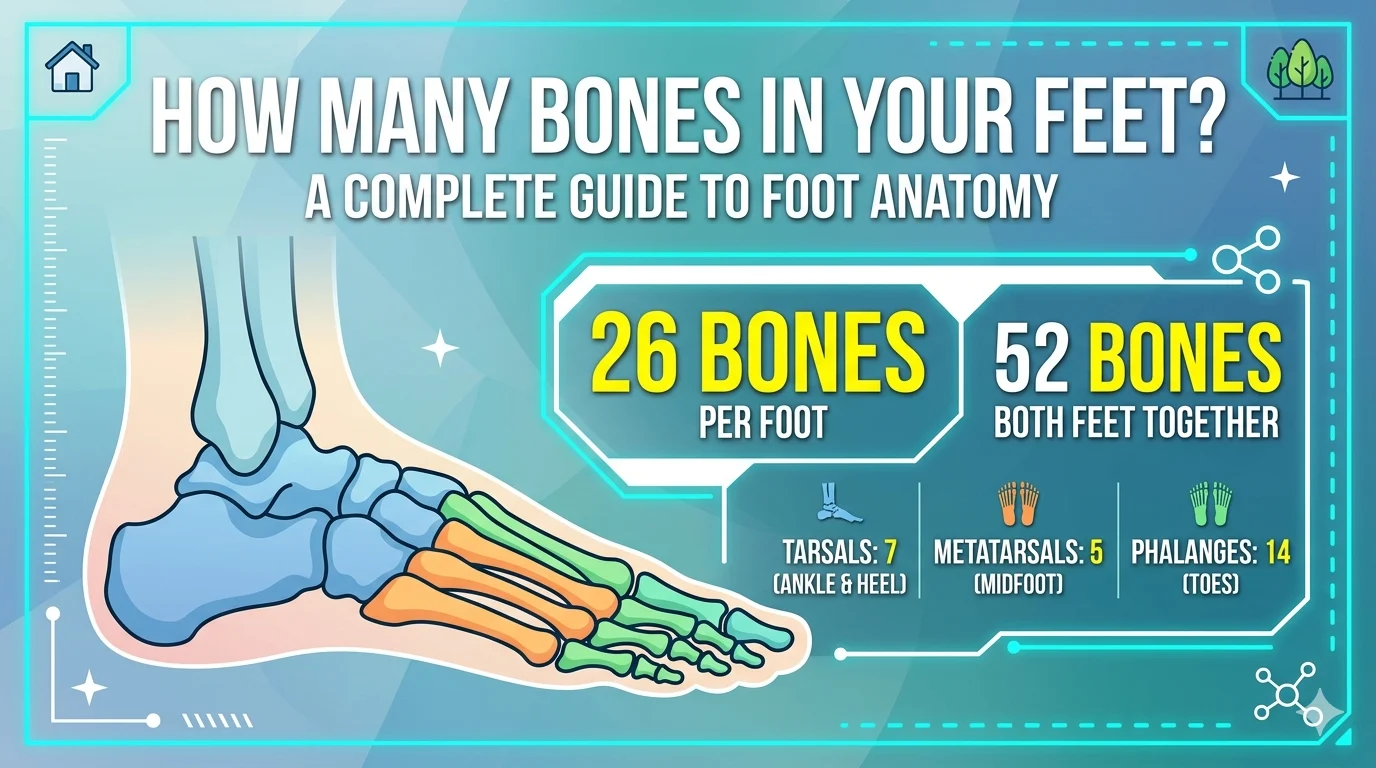
- One human foot contains 26 bones
- Both feet together contain 52 bones
- The human body has a total of 206 bones, meaning almost one-fourth are in the feet alone
This shows how important the feet are in human anatomy and movement.
Types of Bones in the Human Foot
To fully understand how many bones in your feet, it is important to break them down into three main groups.
Tarsal Bones (Heel and Ankle Region)
Each foot contains 7 tarsal bones, located in the back part of the foot.
These include:
- Talus
- Calcaneus (heel bone)
- Navicular
- Cuboid
- Three cuneiform bones
Functions:
- Connect foot to the leg
- Support body weight
- Form the ankle joint
- Allow smooth movement
Metatarsal Bones (Midfoot Area)
Each foot has 5 metatarsal bones, forming the middle section.
Functions:
- Connect toes to the rest of the foot
- Support the arch structure
- Help in walking and running motion
- Distribute body weight evenly
Phalanges (Toe Bones)
Each foot contains 14 phalanges (toe bones).
Breakdown:
- Big toe has 2 bones
- Other four toes have 3 bones each
Functions:
- Provide balance
- Help push the body forward when walking
- Improve stability and grip
Why Do Feet Have So Many Bones?
One of the most interesting questions after learning how many bones in your feet is why the structure is so complex.
1. Balance and Stability
Multiple bones allow the foot to adjust to uneven surfaces and maintain balance.
2. Shock Absorption
Every step creates pressure. Foot bones distribute this force to protect joints and spine.
3. Flexibility
More bones mean more joints, allowing smooth movement in different directions.
4. Efficient Movement
The structure helps transfer energy while walking or running, making movement smooth and natural.
Structure of the Human Foot
The foot is designed with a strong yet flexible structure.
Foot Arches
There are three main arches:
- Medial arch
- Lateral arch
- Transverse arch
These arches:
- Support body weight
- Maintain balance
- Absorb shock
Ligaments and Joints
Ligaments connect bones while joints allow movement. Together they:
- Stabilize the foot
- Prevent injury
- Enable smooth motion
Comparison of Foot Bones
| Type of Bone | Number per Foot | Main Function |
|---|---|---|
| Tarsals | 7 | Stability and ankle movement |
| Metatarsals | 5 | Structure and support |
| Phalanges | 14 | Toe movement and balance |
| Total | 26 | Full foot function |
Common Problems Related to Foot Bones
Understanding how many bones in your feet also helps you understand possible health issues.
Fractures
Foot bones can break due to injury or stress.
Flat Feet
When arches collapse, causing pain and imbalance.
Arthritis
Joint inflammation affecting movement and comfort.
How to Keep Foot Bones Healthy
Healthy feet support a healthy body.
Wear Proper Footwear
Shoes with good arch support reduce pressure on bones.
Exercise Regularly
Walking, stretching, and foot exercises strengthen bones and muscles.
Eat Bone-Friendly Foods
- Calcium-rich foods
- Vitamin D sources
- Protein-rich diet
Avoid Overuse
Rest is important to prevent strain and injury.
Real-Life Importance of Foot Bones
Foot bones are essential in daily life.
- Every step you take depends on them
- Athletes rely on them for performance
- They affect posture and spine alignment
- They support full body weight constantly
Even small issues in foot bones can impact overall mobility.
FAQs
1. How many bones are in one foot?
One foot contains 26 bones.
2. How many bones are in both feet?
Both feet together have 52 bones.
3. What are the main foot bones called?
Tarsals, metatarsals, and phalanges.
4. Why do feet have so many bones?
To provide balance, flexibility, and shock absorption.
5. Can foot bones get injured easily?
Yes, they are prone to fractures and strain if not properly cared for.
Conclusion
Knowing how many bones in your feet helps you understand the incredible engineering of the human body. With 26 bones in each foot, your feet are built for strength, balance, and flexibility.
Every bone—from the tarsals to the phalanges—plays a critical role in movement and stability. Taking care of your feet through proper footwear, nutrition, and exercise ensures long-term health and mobility.
Your feet support your entire life—so understanding and caring for them is essential.