
If you’re planning to build a basketball court, install sports flooring, repaint court lines, or simply satisfy your curiosity, one of the first questions you may ask is: How many square feet is a basketball court?
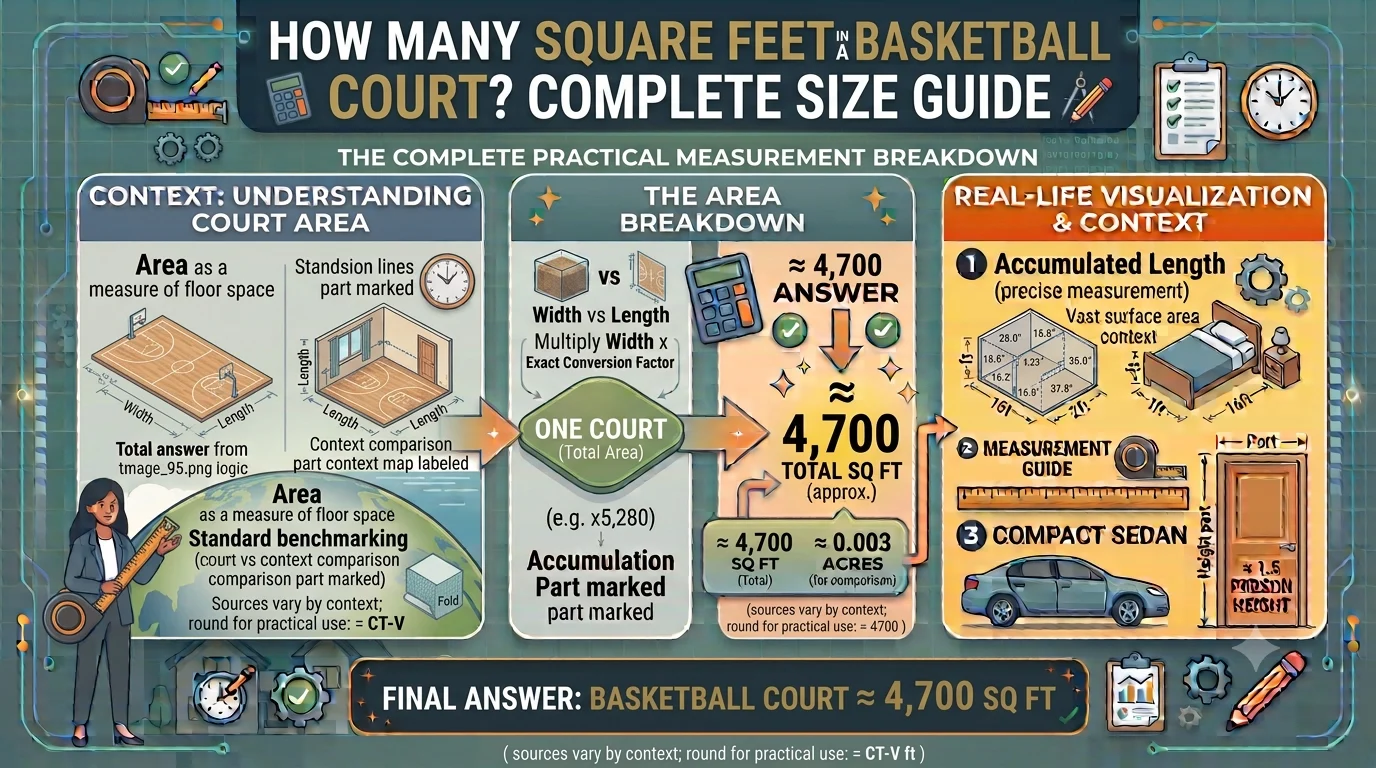
The answer depends on the type of court. A full-size NBA or college basketball court measures 4,700 square feet, while a high school court covers 4,200 square feet. Youth and backyard courts vary in size, so their total square footage can be much smaller.
In this guide, you’ll learn how to calculate the square footage of different basketball courts, compare court sizes, and understand why these measurements matter for construction, flooring, maintenance, and sports planning.
Standard Basketball Court Dimensions
Basketball court sizes differ depending on the league or level of play. Here are the most common court dimensions.
| Court Type | Dimensions (Feet) | Total Square Feet |
|---|---|---|
| NBA Court | 94 × 50 | 4,700 sq ft |
| NCAA College Court | 94 × 50 | 4,700 sq ft |
| High School Court | 84 × 50 | 4,200 sq ft |
| Junior High Court | 74 × 42 | 3,108 sq ft |
| Youth Court | 60 × 40 | 2,400 sq ft |
| Half Court (NBA) | 47 × 50 | 2,350 sq ft |
As you can see, the official NBA and NCAA courts have the largest standard playing area, while youth courts are designed to better match younger players’ abilities.
How to Calculate Square Feet in a Basketball Court
Finding the square footage is simple.
Formula:
Square Feet = Length × Width
For example, an official NBA court is:
- Length = 94 feet
- Width = 50 feet
Calculation:
94 × 50 = 4,700 square feet
The same formula works for any rectangular basketball court.
Example 1: High School Court
- Length: 84 feet
- Width: 50 feet
84 × 50 = 4,200 square feet
Example 2: Youth Court
- Length: 60 feet
- Width: 40 feet
60 × 40 = 2,400 square feet
This straightforward calculation is useful when planning flooring, painting, resurfacing, or estimating construction costs.
Why Does Square Footage Matter?
Knowing the total square footage helps in many practical situations.
Flooring Installation
Sports flooring is priced by the square foot. Accurate measurements prevent ordering too much or too little material.
Court Construction
Builders use square footage to estimate:
- Concrete requirements
- Asphalt quantity
- Wood flooring
- Artificial sports surfaces
- Labor costs
Painting Court Lines
Court markings require a properly sized playing area to ensure official dimensions.
Maintenance
Cleaning, refinishing hardwood, resurfacing outdoor courts, and applying protective coatings are often priced according to square footage.
Basketball Court Size Comparison
Here’s a quick comparison of common court sizes.
| Court Type | Length | Width | Square Feet |
|---|---|---|---|
| NBA | 94 ft | 50 ft | 4,700 |
| NCAA | 94 ft | 50 ft | 4,700 |
| High School | 84 ft | 50 ft | 4,200 |
| Junior High | 74 ft | 42 ft | 3,108 |
| Youth | 60 ft | 40 ft | 2,400 |
| Backyard Court | Varies | Varies | Depends on size |
How Big Is 4,700 Square Feet?
Many people have trouble visualizing 4,700 square feet.
Here are a few comparisons:
- About the size of two average family homes.
- Larger than many retail stores.
- Roughly equivalent to several two-car garages combined.
- Large enough to comfortably accommodate a full basketball game with proper safety space.
These comparisons help put the size of an official basketball court into perspective.
Half-Court vs. Full-Court Square Footage
Many homeowners choose half courts instead of full courts because they require less space.
| Court Type | Square Feet |
|---|---|
| Full NBA Court | 4,700 |
| Half NBA Court | 2,350 |
A half court uses exactly half the playing area while still providing enough room for shooting practice, one-on-one games, and skill development.
Indoor vs. Outdoor Basketball Courts
The playing dimensions usually remain the same, but construction materials differ.
Indoor Courts
Common flooring includes:
- Maple hardwood
- Engineered wood
- Synthetic sports flooring
Indoor courts generally cost more because of premium flooring materials and climate-controlled construction.
Outdoor Courts
Outdoor courts are commonly made from:
- Concrete
- Asphalt
- Modular sport tiles
These materials are designed to withstand weather while providing a durable playing surface.
Space Needed Beyond the Court
The court itself isn’t the only space required.
Builders usually recommend adding extra clearance around all sides for player safety.
Typical recommendations include:
- 3 to 10 feet beyond sidelines
- Additional space behind each basket
- Room for benches, spectators, and equipment
This means the total project area is often significantly larger than the court’s actual square footage.
Estimating Flooring Materials
Suppose you’re installing hardwood flooring on an NBA court.
Court area:
4,700 square feet
If flooring is sold in cartons covering 25 square feet each:
4,700 ÷ 25 = 188 cartons
Professionals usually order 5–10% extra to account for cuts, waste, and future repairs.
Real-World Examples
Community Recreation Center
A city recreation center building a regulation court needs enough hardwood flooring to cover approximately 4,700 square feet, plus additional material for walkways and seating areas.
School Gym
A high school gym typically requires flooring for around 4,200 square feet of playing area, along with extra space for bleachers and equipment storage.
Backyard Court
A homeowner building a practice court may choose a half-court measuring approximately 2,350 square feet, making it easier to fit within a residential property while still providing an excellent practice space.
Common Mistakes When Measuring a Basketball Court
Avoid these common errors:
- Measuring only the painted playing area.
- Forgetting to include the full court dimensions.
- Confusing square feet with linear feet.
- Ignoring additional safety clearance.
- Ordering flooring without accounting for installation waste.
Taking careful measurements helps prevent expensive mistakes during construction or renovation.
Expert Tips
If you’re planning a basketball court project, keep these recommendations in mind:
- Measure the site more than once.
- Verify league-specific court dimensions.
- Purchase slightly more flooring than required.
- Plan for drainage on outdoor courts.
- Include enough clearance around the court for safe play.
- Consider future maintenance costs before selecting flooring materials.
These simple steps can save time, money, and frustration.
Factors That Affect Basketball Court Size
Although official dimensions are standardized, some courts vary because of:
- Available land
- Age group
- Budget
- Recreational vs. competitive use
- Local building regulations
Backyard and neighborhood courts often prioritize available space over official measurements.
Final Thoughts
The answer to how many square feet in a basketball court depends on the type of court you’re measuring. An official NBA and NCAA basketball court covers 4,700 square feet, while a high school court measures 4,200 square feet. Smaller youth and practice courts require less space and are ideal for recreational use.
Whether you’re building a new court, replacing sports flooring, estimating construction costs, or planning a renovation, calculating square footage is easy. Simply multiply the court’s length by its width. Knowing the correct measurements ensures accurate planning, better budgeting, and a successful basketball court project.