

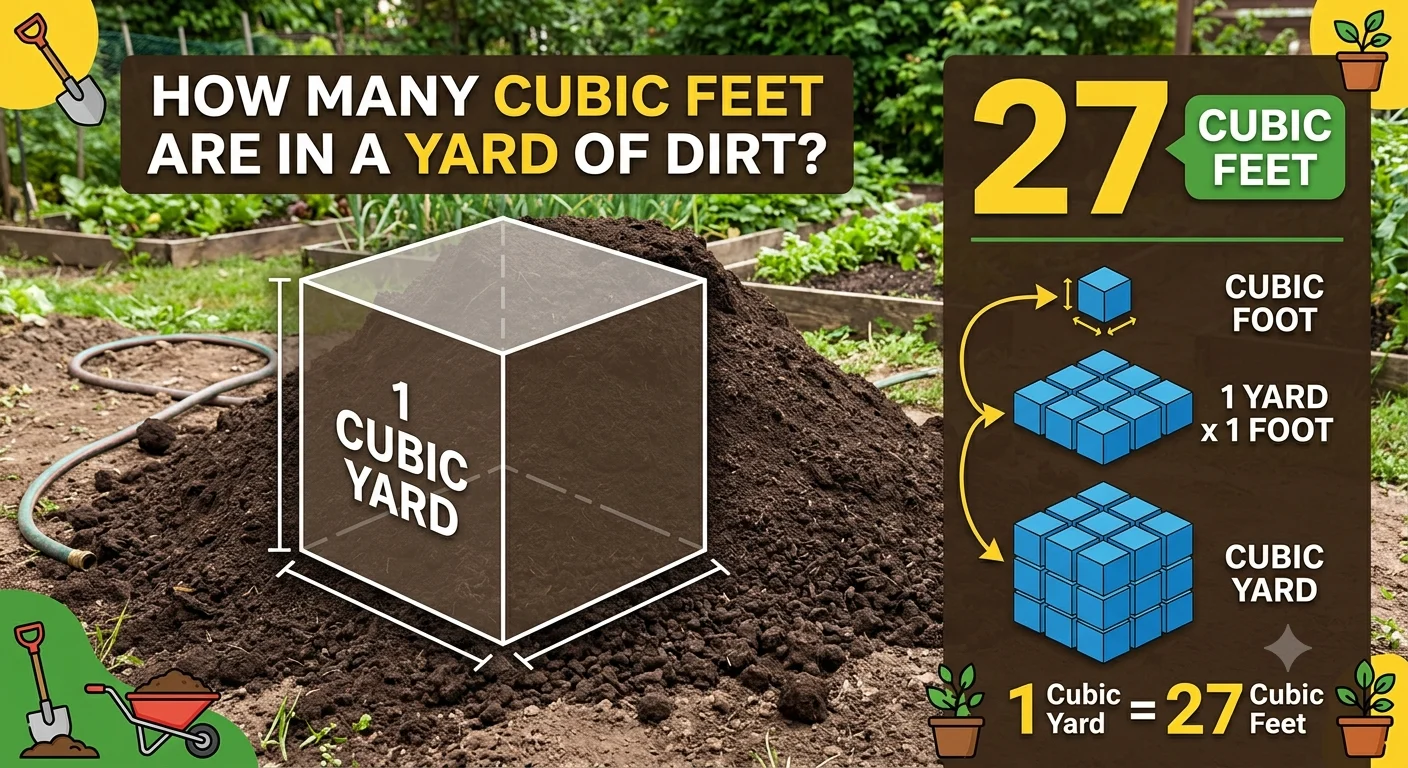
If you’re planning a landscaping, gardening, or construction project, you may wonder: how many cubic feet are in a yard of dirt?
Understanding this conversion is essential when ordering soil, fill dirt, topsoil, compost, or other landscaping materials. Ordering too little can delay your project, while ordering too much can waste money.
The good news is that the conversion is simple. Once you understand the relationship between cubic yards and cubic feet, you’ll be able to estimate material requirements accurately for almost any project.
This guide explains the conversion formula, provides practical examples, offers conversion charts, and shows how professionals calculate dirt volume.
Quick Answer
A yard of dirt, more accurately called a cubic yard of dirt, contains:
1 cubic yard = 27 cubic feet
Therefore:
1 yard of dirt = 27 cubic feet of dirt
This conversion applies to all types of dirt, including:
- Topsoil
- Fill dirt
- Garden soil
- Sand
- Gravel
- Compost
- Mulch
The material type may affect weight, but it does not affect volume.
Understanding Cubic Feet and Cubic Yards
Before calculating dirt requirements, it’s important to understand these two units of volume.
What Is a Cubic Foot?
A cubic foot is the volume of a cube measuring:
- 1 foot long
- 1 foot wide
- 1 foot high
The formula is:
Length × Width × Height
A box measuring 1 foot on each side contains exactly 1 cubic foot.
What Is a Cubic Yard?
A cubic yard is the volume of a cube measuring:
- 3 feet long
- 3 feet wide
- 3 feet high
Because each dimension equals 3 feet:
3 × 3 × 3 = 27
This is why one cubic yard equals 27 cubic feet.
How Many Cubic Feet Are in a Yard of Dirt?
The answer is always the same:
1 cubic yard = 27 cubic feet
No matter whether you’re buying:
- Fill dirt
- Topsoil
- Compost
- Sand
- Gravel
A cubic yard always occupies 27 cubic feet of space.
Conversion Formula
To convert cubic yards to cubic feet:
Cubic Feet = Cubic Yards × 27
Examples:
| Cubic Yards | Cubic Feet |
|---|---|
| 1 | 27 |
| 2 | 54 |
| 3 | 81 |
| 4 | 108 |
| 5 | 135 |
| 10 | 270 |
Why the Number Never Changes
Volume is based on dimensions rather than material type.
For example:
- 1 cubic yard of topsoil = 27 cubic feet
- 1 cubic yard of sand = 27 cubic feet
- 1 cubic yard of mulch = 27 cubic feet
The volume remains identical even though the weight differs significantly.
Cubic Yard to Cubic Feet Conversion Chart
Use this quick reference chart when estimating material needs.
| Cubic Yards | Cubic Feet |
|---|---|
| 0.5 | 13.5 |
| 1 | 27 |
| 1.5 | 40.5 |
| 2 | 54 |
| 2.5 | 67.5 |
| 3 | 81 |
| 4 | 108 |
| 5 | 135 |
| 6 | 162 |
| 7 | 189 |
| 8 | 216 |
| 9 | 243 |
| 10 | 270 |
This chart is especially useful for landscaping and excavation projects.
Practical Examples
Let’s see how this conversion works in real situations.
Landscaping Project
Suppose a landscaping company delivers 4 cubic yards of topsoil.
Calculation:
4 × 27 = 108 cubic feet
The delivery contains:
108 cubic feet of soil
This amount may be sufficient for several flower beds or a medium-sized lawn renovation.
Raised Garden Beds
Imagine a raised garden bed measuring:
- Length: 12 feet
- Width: 4 feet
- Depth: 1 foot
Volume:
12 × 4 × 1 = 48 cubic feet
Convert to cubic yards:
48 ÷ 27 = 1.78 cubic yards
You would typically order about 2 cubic yards of soil.
Filling Low Areas
A low area in your yard measures:
- 15 feet long
- 10 feet wide
- 0.5 feet deep
Volume:
15 × 10 × 0.5 = 75 cubic feet
Convert to cubic yards:
75 ÷ 27 = 2.78 cubic yards
Ordering 3 cubic yards would provide enough material.
How to Calculate Dirt Needed for Your Project
Knowing how many cubic feet are in a yard of dirt helps you estimate material requirements accurately.
Step 1: Measure Length, Width, and Depth
Measure the area in feet.
Example:
- Length = 20 feet
- Width = 12 feet
- Depth = 0.5 feet
Step 2: Calculate Cubic Feet
Multiply all dimensions.
20 × 12 × 0.5 = 120 cubic feet
Step 3: Convert to Cubic Yards
Divide cubic feet by 27.
120 ÷ 27 = 4.44 cubic yards
You would likely order 4.5 to 5 cubic yards.
Common Dirt Volume Conversions
Here are several common conversions used in landscaping and construction.
| Material Volume | Cubic Feet |
|---|---|
| 1 Cubic Yard | 27 |
| 2 Cubic Yards | 54 |
| 3 Cubic Yards | 81 |
| 5 Cubic Yards | 135 |
| 10 Cubic Yards | 270 |
| 15 Cubic Yards | 405 |
| 20 Cubic Yards | 540 |
These values help estimate truckloads and delivery quantities.
Why Contractors Use Cubic Yards
Most suppliers sell dirt by the cubic yard rather than by the cubic foot.
There are several reasons:
Easier Bulk Measurement
Large projects often require hundreds of cubic feet of material.
Using cubic yards simplifies calculations.
Industry Standard
Landscaping and construction suppliers commonly price:
- Topsoil
- Gravel
- Sand
- Fill dirt
- Compost
By the cubic yard.
Better Delivery Planning
Truck capacities are generally measured in cubic yards.
For example:
- Small dump truck: 5–7 cubic yards
- Medium truck: 10–14 cubic yards
- Large truck: 15–20 cubic yards
Factors That Affect Dirt Requirements
Although one cubic yard always equals 27 cubic feet, actual project needs can vary.
Soil Settlement
Fresh soil may compact over time.
You may need extra material to compensate.
Uneven Ground
Slopes and low spots often require additional fill.
Waste and Spillage
Some material is typically lost during transportation and spreading.
Project Changes
Many homeowners expand project areas once work begins.
Ordering slightly extra can prevent additional delivery charges.
Common Mistakes to Avoid
When calculating dirt volume, avoid these frequent errors.
Measuring Depth Incorrectly
Always convert inches into feet.
Examples:
- 3 inches = 0.25 feet
- 6 inches = 0.5 feet
- 12 inches = 1 foot
Forgetting to Convert Units
Keep all measurements in the same unit before calculating volume.
Ordering Exact Quantities
Small calculation errors can leave you short on material.
Many professionals add 5–10% extra.
Confusing Weight and Volume
A cubic yard measures volume, not weight.
Different materials weigh differently:
- Dry soil
- Wet soil
- Sand
- Gravel
All can occupy 27 cubic feet while weighing very different amounts.
Expert Tips for Ordering Dirt
To get accurate results and save money:
- Measure twice before ordering.
- Convert inches to feet correctly.
- Round up rather than down.
- Account for settling and compaction.
- Ask suppliers about delivery minimums.
- Use cubic yards for ordering and cubic feet for calculations.
- Keep a copy of your measurements for future projects.
These simple practices help prevent costly mistakes.
FAQs
How many cubic feet are in one yard of dirt?
One cubic yard of dirt contains exactly 27 cubic feet.
How do I convert cubic yards to cubic feet?
Multiply the number of cubic yards by 27.
How many cubic feet are in 5 yards of dirt?
Five cubic yards contain 135 cubic feet.
Why is a cubic yard equal to 27 cubic feet?
A cubic yard measures 3 feet by 3 feet by 3 feet, and 3 × 3 × 3 equals 27.
Does dirt type change the cubic feet conversion?
No. Whether it is topsoil, fill dirt, compost, or sand, one cubic yard always equals 27 cubic feet.
Conclusion
Understanding how many cubic feet are in a yard of dirt is essential for landscaping, gardening, and construction projects. The conversion is simple: 1 cubic yard equals 27 cubic feet. By using this standard measurement, you can accurately estimate soil requirements, avoid overordering or underordering, and keep your project on schedule.
Whether you’re filling a garden bed, leveling a yard, installing landscaping features, or managing a construction site, knowing that a yard of dirt contains 27 cubic feet gives you the confidence to calculate material needs quickly and accurately.