
If you’re planning a driveway, patio, sidewalk, or foundation, one of the most common questions is: how many square feet does a yard of concrete cover? Knowing the answer helps you estimate materials correctly, avoid extra costs, and complete your project smoothly.
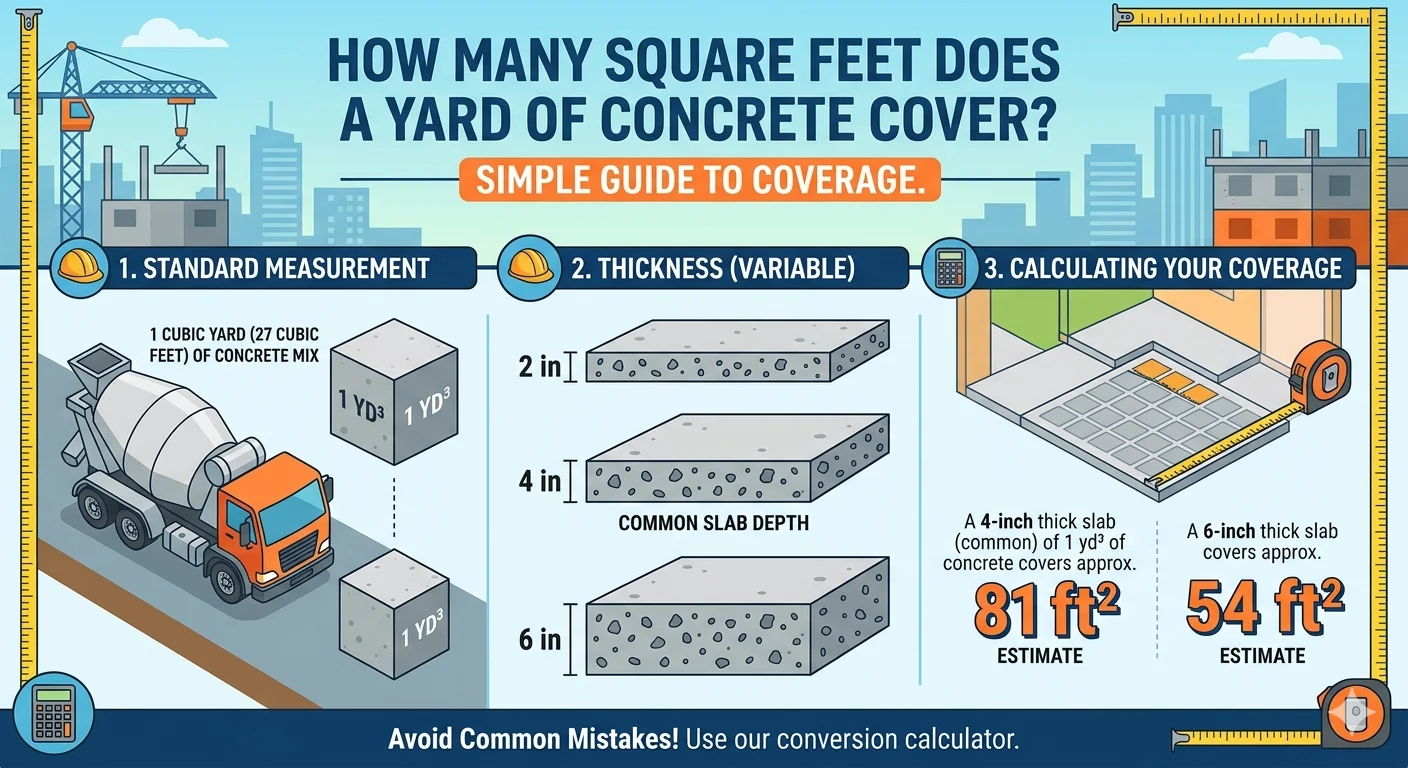
A yard of concrete refers to a cubic yard, which is a measurement of volume. However, the number of square feet it covers depends on one major factor: thickness.
This means one cubic yard of concrete can cover a large area if poured thinly, or a smaller area if poured thickly. In this guide, we’ll explain exactly how it works, provide easy formulas, and show real-life examples so you can calculate concrete coverage with confidence.
What Is a Yard of Concrete?
Before calculating coverage, it’s important to understand what a yard of concrete actually means.
A cubic yard is equal to:
- 3 feet long
- 3 feet wide
- 3 feet deep
That means:
1 cubic yard = 27 cubic feet
This is the standard way concrete is measured and sold for construction projects.
However, since most projects are measured in square feet, you need to convert that volume into area coverage based on slab thickness.
Why Thickness Changes Concrete Coverage
The answer to how many square feet does a yard of concrete cover depends entirely on how thick the concrete slab will be.
For example:
- A thin 2-inch slab covers more area
- A thick 6-inch slab covers less area
This happens because the total amount of concrete stays the same, but the depth changes how far it spreads.
So, there is no one-size-fits-all answer.
Simple Formula to Calculate Concrete Coverage
You can calculate concrete coverage using this formula:
Square Feet Covered = 27 ÷ Thickness in Feet
Since slab thickness is usually measured in inches, you first need to convert inches into feet.
Quick conversion guide:
- 2 inches = 0.167 feet
- 3 inches = 0.25 feet
- 4 inches = 0.333 feet
- 5 inches = 0.417 feet
- 6 inches = 0.5 feet
Once converted, divide 27 by the thickness.
Concrete Coverage Chart by Thickness
Here is a quick reference chart showing how many square feet one yard of concrete covers:
| Thickness | Coverage Per Cubic Yard |
| 2 inches | 162 sq ft |
| 3 inches | 108 sq ft |
| 4 inches | 81 sq ft |
| 5 inches | 65 sq ft |
| 6 inches | 54 sq ft |
This chart is especially helpful for homeowners and contractors who need fast estimates.
How Many Square Feet Does a Yard of Concrete Cover at 4 Inches?
A 4-inch slab is the most common thickness for residential projects like:
- Driveways
- Patios
- Garage floors
- Sidewalks
At 4 inches thick:
1 cubic yard of concrete covers about 81 square feet
This is the standard estimate many contractors use for home improvement projects.
Real-Life Example: Driveway Calculation
Let’s say you want to pour a driveway that measures:
- Length = 20 feet
- Width = 20 feet
Total area:
20 × 20 = 400 square feet
If the slab thickness is 4 inches:
- 1 yard covers about 81 sq ft
So:
400 ÷ 81 = approximately 5 cubic yards
To be safe, you should order a little extra concrete.
Most professionals recommend adding 5–10% extra for waste and uneven surfaces.
So your final order might be:
5.5 cubic yards
Patio Example
Suppose you are building a backyard patio:
- Length = 12 feet
- Width = 15 feet
Total area:
12 × 15 = 180 square feet
If the patio uses a 3-inch slab:
- 1 yard covers about 108 sq ft
Calculation:
180 ÷ 108 = 1.67 cubic yards
You would likely order:
2 cubic yards
This ensures enough material for finishing and leveling.
Sidewalk Example
A sidewalk usually has thinner concrete and covers longer distances.
For example:
- Length = 30 feet
- Width = 4 feet
Area:
30 × 4 = 120 square feet
At 4 inches thickness:
120 ÷ 81 = 1.48 cubic yards
You would order about:
1.5 to 2 cubic yards
Common Mistakes When Estimating Concrete
Many people make simple but expensive mistakes when estimating concrete.
1. Ignoring Thickness
Even one extra inch of thickness can significantly change the amount of concrete needed.
Always confirm the required slab depth before ordering.
2. Forgetting Waste Factor
Concrete can be lost due to:
- Spillage
- Uneven ground
- Form setup
- Surface leveling
Always order a little more than your exact calculation.
3. Wrong Unit Conversion
Mixing inches, feet, and yards incorrectly causes inaccurate estimates.
Always convert thickness into feet before using the formula.
Expert Tips for Accurate Concrete Estimation
To avoid mistakes and improve planning, follow these simple tips:
Measure the Area Twice
Double-check your length and width before ordering.
Even small mistakes can affect the final result.
Add Extra Concrete
Order 5–10% more than your estimate.
Running short during a pour creates major problems.
Consider Soil and Base Preparation
Loose soil or gravel base may affect slab depth and final concrete use.
Prepare the site properly before pouring.
Ask Your Supplier
Concrete suppliers often help verify your calculations before delivery.
This can save both money and time.
Cost Impact of Concrete Coverage
Understanding concrete coverage also helps with budgeting.
If your area requires thicker concrete:
- You need more cubic yards
- Your total cost increases
For example:
A 6-inch slab costs much more than a 4-inch slab because it covers fewer square feet per yard.
This is especially important for:
- Large driveways
- Commercial floors
- Foundations
- Heavy-load structures
Better planning prevents surprise expenses.
Quick Practical Summary
Here’s the simple answer:
How many square feet does a yard of concrete cover?
It depends on thickness:
- 2 inches = 162 sq ft
- 3 inches = 108 sq ft
- 4 inches = 81 sq ft
- 5 inches = 65 sq ft
- 6 inches = 54 sq ft
For most residential jobs, the standard answer is:
1 cubic yard of concrete covers about 80 square feet at 4 inches thick
This is the estimate most homeowners use.
Final Thoughts
Understanding how many square feet does a yard of concrete cover is one of the most important parts of planning a successful concrete project.
Whether you’re building a driveway, patio, sidewalk, or foundation, accurate concrete estimation saves money, reduces waste, and helps avoid delays.
The key is simple:
- Know your total area
- Know your slab thickness
- Use the right formula
- Add extra for safety
With proper planning, your project becomes easier, faster, and far more cost-effective.
Discover More Articles
how many square feet in a half an acre
how many square feet in an acre of land