
/
If you are buying mulch, gravel, soil, sand, or concrete, you have probably asked: how many cubic feet per yard?
This is one of the most common measurement questions in construction and landscaping. Understanding this conversion helps you avoid buying too much—or too little—material.
The simple answer is:
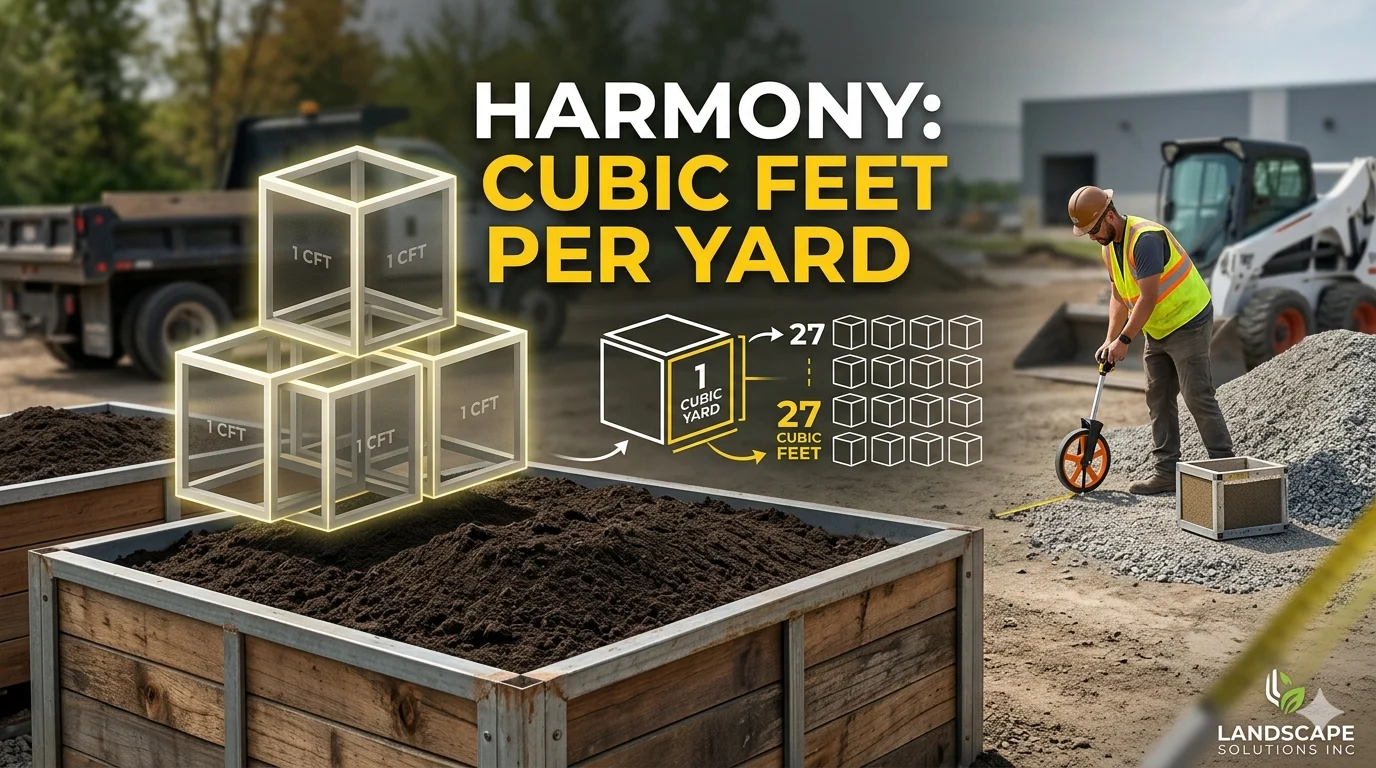
1 cubic yard = 27 cubic feet
That’s it.
But to use this correctly in real projects, you need to understand how the math works, when to use it, and how to avoid common mistakes.
In this complete guide, we’ll explain everything in simple words with formulas, charts, and practical examples.
Understanding Cubic Feet and Cubic Yards
Before learning the conversion, it helps to understand what these measurements actually mean.
What Is a Cubic Foot?
A cubic foot measures volume.
It represents a space that is:
- 1 foot long
- 1 foot wide
- 1 foot high
Think of a small box that is 12 inches on all sides.
That box equals:
1 cubic foot
It is written as:
1 ft³
What Is a Cubic Yard?
A cubic yard is also a volume measurement, but much larger.
It represents a space that is:
- 3 feet long
- 3 feet wide
- 3 feet high
Since each side is 3 feet, the total volume becomes:
3 × 3 × 3 = 27
So:
1 cubic yard = 27 cubic feet
It is written as:
1 yd³
How Many Cubic Feet Per Yard?
The Exact Answer
The exact conversion is:
1 Cubic Yard = 27 Cubic Feet
This never changes.
Whether you are measuring:
- concrete
- gravel
- mulch
- topsoil
- sand
- compost
- stone
…the conversion stays the same.
Quick Conversion Formula
Use this simple formula:
Cubic Yards × 27 = Cubic Feet
For example:
2 cubic yards × 27 = 54 cubic feet
Very easy.
Cubic Yard to Cubic Feet Conversion Chart
Here is a quick reference table:
| Cubic Yards | Cubic Feet |
| 1 | 27 |
| 2 | 54 |
| 3 | 81 |
| 4 | 108 |
| 5 | 135 |
| 6 | 162 |
| 7 | 189 |
| 8 | 216 |
| 9 | 243 |
| 10 | 270 |
This chart is especially useful for landscaping and construction estimates.
How to Convert Cubic Yards to Cubic Feet Step by Step
Let’s break it down.
Formula Explained
The formula is:
Cubic Feet = Cubic Yards × 27
Why 27?
Because:
1 yard = 3 feet
And volume uses three dimensions:
3 × 3 × 3 = 27
That’s why every cubic yard contains exactly 27 cubic feet.
Practical Example
Let’s say you are ordering mulch for your garden.
The supplier says:
“You need 4 cubic yards.”
How many cubic feet is that?
Solution:
4 × 27 = 108 cubic feet
Answer:
4 cubic yards = 108 cubic feet
Now you can compare bag sizes more easily.
How to Convert Cubic Feet Back to Cubic Yards
Sometimes stores list materials in cubic feet, but contractors use cubic yards.
In that case, reverse the formula.
Cubic Feet ÷ 27 = Cubic Yards
Example:
81 cubic feet ÷ 27 = 3 cubic yards
So:
81 cubic feet = 3 cubic yards
This is common when comparing mulch bags.
Real-World Uses of Cubic Yard Conversions
This conversion matters more than most people realize.
Let’s look at where it is used.
Landscaping Projects
When buying:
- mulch
- topsoil
- compost
- decorative stone
- sand
Most suppliers sell by the cubic yard.
But bagged products are often sold in cubic feet.
Knowing the conversion helps you compare prices and quantities.
Example:
A mulch bag may contain 2 cubic feet.
Since 1 cubic yard = 27 cubic feet:
27 ÷ 2 = 13.5 bags
So you need about 14 bags for one cubic yard.
Concrete Work
Concrete is often ordered in cubic yards.
For patios, driveways, and slabs, accurate estimates are critical.
Ordering too little delays the project.
Ordering too much wastes money.
That’s why builders rely heavily on cubic yard conversions.
Moving and Storage
Storage containers and moving trucks may be measured in cubic feet.
Large waste containers may be measured in cubic yards.
Understanding both helps with planning.
Common Mistakes People Make
Many people confuse yards and cubic yards.
Here are the most common mistakes.
Mistake 1: Confusing Square Yards with Cubic Yards
A square yard measures area.
A cubic yard measures volume.
These are completely different.
Area = flat surface
Volume = space with depth
Always check which one you need.
Mistake 2: Forgetting the Third Dimension
Some people only multiply length and width.
That gives area—not volume.
You must include:
- length
- width
- depth
to get cubic measurement.
Mistake 3: Mixing Inches and Feet
If your measurements are in inches, convert them to feet first.
Example:
12 inches = 1 foot
18 inches = 1.5 feet
This prevents major calculation errors.
Expert Tips for Accurate Volume Calculation
Professionals use a few simple tricks.
These save time and money.
Always Add a Little Extra
For soil, gravel, and mulch, order about 5–10% extra.
Why?
Because:
- settling happens
- uneven surfaces exist
- spillage is common
Running short costs more than ordering slightly extra.
Use Depth Carefully
Even a small depth mistake changes the total volume a lot.
Example:
3 inches vs 4 inches makes a big difference across a large yard.
Measure carefully.
Compare Bulk vs Bagged Pricing
Bulk cubic yards are often cheaper than buying many small bags.
Use the 27 cubic feet rule to compare prices fairly.
This can save significant money.
Cubic Yard vs Square Yard vs Linear Yard
These terms confuse many buyers.
Let’s simplify them.
| Type | Measures | Example |
| Linear Yard | Length | Fabric |
| Square Yard | Area | Carpet |
| Cubic Yard | Volume | Soil |
If material has depth like gravel or concrete, you need:
Cubic yards
Not square yards.
Frequently Asked Questions
How many cubic feet are in 2 yards?
There are:
2 × 27 = 54 cubic feet
So:
2 cubic yards = 54 cubic feet
How many cubic feet per yard of concrete?
The same rule applies.
1 cubic yard of concrete = 27 cubic feet
This is the standard industry measurement.
How many 2 cubic foot bags make 1 cubic yard?
Use this formula:
27 ÷ 2 = 13.5
So you need about:
14 bags
to equal 1 cubic yard.
Is a cubic yard bigger than a cubic foot?
Yes—much bigger.
1 cubic yard equals:
27 cubic feet
So a cubic yard is 27 times larger.
How do I calculate cubic yards from feet?
Use this formula:
Length × Width × Depth = Cubic Feet
Then:
Cubic Feet ÷ 27 = Cubic Yards
This gives your final answer.
Conclusion
So, how many cubic feet per yard?
The answer is simple:
1 cubic yard = 27 cubic feet
This conversion is essential for:
- landscaping
- concrete work
- home improvement
- construction planning
- bulk material purchases
Once you remember the number 27, most volume calculations become much easier.
Use:
Cubic Yards × 27 = Cubic Feet
or
Cubic Feet ÷ 27 = Cubic Yards
Whether you are buying mulch, gravel, concrete, or soil, understanding this conversion helps you save money, avoid mistakes, and plan smarter.
Keep this guide handy the 27 rule will be useful again and again.
Discover More Art
how many square feet in a half an acre
how many square feet in an acre of land