
If you are planning a concrete project, one of the most common questions is: how many square feet are in a yard of concrete? Whether you are pouring a driveway, patio, sidewalk, or garage floor, understanding concrete coverage helps you estimate costs, avoid waste, and order the correct amount.
The answer depends on one important factor: thickness.
Concrete is measured in cubic yards, not square feet. A cubic yard measures volume, while square feet measure area. Because of this, the square footage covered by one yard of concrete changes depending on how thick the slab will be.
In this guide, you will learn exactly how to calculate concrete coverage, understand common slab thicknesses, and estimate how much concrete your project needs.
Understanding a Yard of Concrete
Before calculating square footage, it is important to understand what a yard of concrete actually means.
What Is a Cubic Yard?
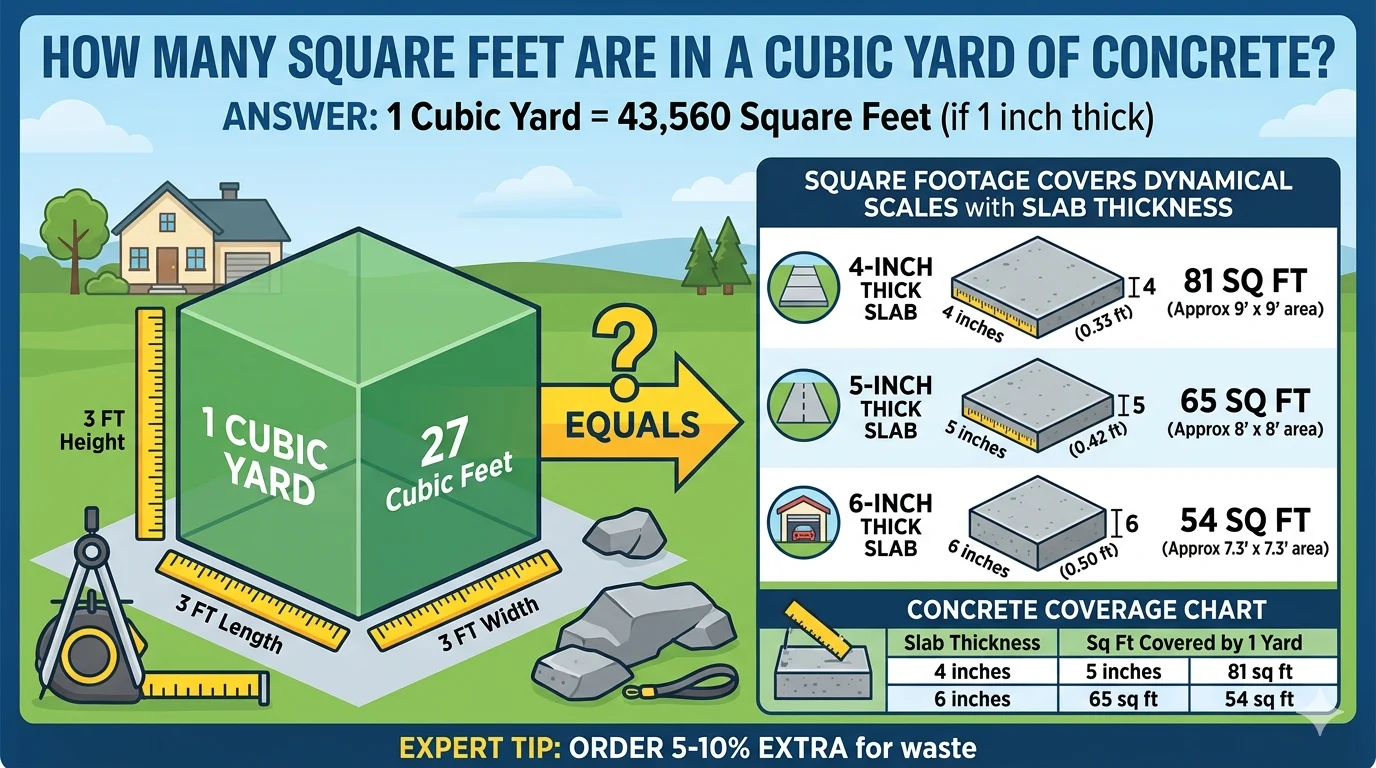
A cubic yard is a measurement of volume equal to:
- 3 feet wide
- 3 feet long
- 3 feet high
That equals:
So, one cubic yard of concrete contains 27 cubic feet of material.
Why Concrete Is Measured in Cubic Yards
Concrete contractors and suppliers use cubic yards because concrete is poured in three dimensions:
- Length
- Width
- Depth
The deeper the slab, the less surface area one yard of concrete can cover.
For example:
- A thin sidewalk covers more square feet
- A thick driveway covers fewer square feet
That is why thickness matters so much in concrete calculations.
How Many Square Feet Are in a Yard of Concrete?
There is no single answer because coverage changes with slab depth.
Here are the most common concrete thicknesses and their coverage areas.
Coverage Based on Thickness
| Concrete Thickness | Square Feet Covered by 1 Cubic Yard |
|---|---|
| 1 inch | 324 sq ft |
| 2 inches | 162 sq ft |
| 3 inches | 108 sq ft |
| 4 inches | 81 sq ft |
| 5 inches | 65 sq ft |
| 6 inches | 54 sq ft |
This chart shows that thicker concrete reduces total coverage.
Standard Concrete Thickness Examples
Different projects usually require different slab thicknesses:
| Project Type | Typical Thickness |
|---|---|
| Sidewalk | 4 inches |
| Patio | 4 inches |
| Shed base | 4–5 inches |
| Driveway | 5–6 inches |
| Garage floor | 6 inches |
For example:
- 1 yard of concrete at 4 inches thick covers about 81 square feet.
- 1 yard at 6 inches thick covers about 54 square feet.
Concrete Coverage Chart
Here is a more detailed concrete coverage chart you can use for quick estimates.
| Cubic Yards | 4-Inch Thickness | 5-Inch Thickness | 6-Inch Thickness |
|---|---|---|---|
| 1 yard | 81 sq ft | 65 sq ft | 54 sq ft |
| 2 yards | 162 sq ft | 130 sq ft | 108 sq ft |
| 3 yards | 243 sq ft | 195 sq ft | 162 sq ft |
| 5 yards | 405 sq ft | 325 sq ft | 270 sq ft |
| 10 yards | 810 sq ft | 650 sq ft | 540 sq ft |
This table makes it easier to estimate larger projects quickly.
Formula to Calculate Concrete Coverage
If you want a precise estimate, use the standard concrete formula.
Step-by-Step Formula
The formula for concrete volume is:
Where:
- Length = feet
- Width = feet
- Thickness = feet
- 27 = cubic feet in one cubic yard
Remember to convert inches into feet.
For example:
- 4 inches = 0.333 feet
- 6 inches = 0.5 feet
Simple Example Calculation
Suppose you want to pour a patio that measures:
- 18 feet long
- 12 feet wide
- 4 inches thick
Step 1: Convert thickness to feet.
Step 2: Multiply dimensions.
Step 3: Convert to cubic yards.
You would need approximately 2.7 cubic yards of concrete.
Most contractors recommend ordering slightly extra to account for waste.
Common Concrete Project Examples
Understanding real-world examples makes calculations easier.
Driveways
Driveways typically require thicker concrete because vehicles add heavy weight.
Typical specs:
- Thickness: 5–6 inches
- Coverage: 54–65 sq ft per yard
Example:
A driveway measuring 20 × 20 feet equals:
At 5 inches thick, divide by 65:
You would need around 6.5 cubic yards.
Patios
Most patios use 4-inch concrete slabs.
Coverage:
- 1 yard = about 81 sq ft
A 10 × 10 patio equals 100 sq ft, so you would need:
Order around 1.5 yards for safety.
Sidewalks
Sidewalks are usually narrow and long.
Example:
- 3 feet wide
- 40 feet long
- 4 inches thick
Area:
Concrete needed:
Garage Floors
Garage floors often need 6-inch concrete for strength.
At 6 inches:
- 1 yard covers about 54 sq ft
A two-car garage measuring 24 × 24 feet equals:
Concrete needed:
You would likely order 11 cubic yards.
Factors That Affect Concrete Coverage
Several factors can change how much area a yard of concrete actually covers.
Thickness Changes
Even a small increase in slab thickness can significantly reduce coverage.
For example:
- 4 inches → 81 sq ft
- 6 inches → 54 sq ft
That difference matters on large projects.
Waste and Spillage
Concrete projects almost always involve some waste due to:
- Spillage
- Uneven pouring
- Over-excavation
- Form leaks
Most experts recommend ordering 5% to 10% extra concrete.
Uneven Ground
Uneven surfaces require more concrete because low spots need additional filling.
Always prepare and level the base before pouring concrete.
Common Mistakes When Estimating Concrete
Many homeowners underestimate their concrete needs. Here are the most common mistakes.
Forgetting Thickness Conversion
One major error is forgetting to convert inches into feet.
Example:
- 4 inches is not 4 feet
- It equals 0.333 feet
Ordering Exact Amounts
Ordering exactly the calculated amount can cause problems if:
- The ground shifts
- Concrete spills
- Measurements are slightly off
Always add a small safety margin.
Ignoring Reinforcement Requirements
Some projects require:
- Rebar
- Wire mesh
- Gravel base
These materials do not reduce concrete volume directly, but they affect project planning and cost.
Measuring Incorrectly
Small measuring mistakes can create major shortages on larger slabs.
Measure twice before ordering.
Expert Tips for Accurate Concrete Estimates
Professionals use a few simple tricks to avoid costly mistakes.
Use Online Calculators
Concrete calculators can quickly estimate:
- Cubic yards
- Slab thickness
- Total cost
They help reduce math errors.
Round Up, Not Down
It is usually safer to order slightly more concrete than too little.
Running out during a pour can create weak joints and uneven surfaces.
Consider Delivery Minimums
Concrete suppliers often have minimum order requirements.
For very small projects, ready-mix bags may be cheaper than truck delivery.
Prepare the Site Properly
Good preparation improves coverage accuracy:
- Compact soil
- Install forms
- Add gravel base
- Check depth evenly
This prevents overuse of concrete.
FAQs
How many square feet does 1 yard of concrete cover?
One yard of concrete covers approximately:
- 81 sq ft at 4 inches thick
- 65 sq ft at 5 inches thick
- 54 sq ft at 6 inches thick
Coverage depends on slab thickness.
Is a yard of concrete the same as a square yard?
No. A cubic yard measures volume, while a square yard measures area. Concrete is sold by cubic yard because thickness matters.
How much concrete do I need for a 10×10 slab?
A 10×10 slab equals 100 square feet. At 4 inches thick, you need about 1.25 cubic yards of concrete.
Why does slab thickness affect square footage?
Thicker slabs use more concrete volume, so one cubic yard covers less area.
Should I order extra concrete?
Yes. Most contractors recommend ordering 5% to 10% extra for waste, uneven surfaces, and spillage.
Conclusion
Understanding how many square feet are in a yard of concrete is essential for accurate project planning. Since concrete is measured in cubic yards, the total square footage depends entirely on slab thickness.
As a quick rule:
- 1 yard covers about 81 square feet at 4 inches thick
- 65 square feet at 5 inches thick
- 54 square feet at 6 inches thick
Using the correct formula, checking slab depth, and ordering a little extra concrete can help you avoid shortages and unnecessary costs. Whether you are building a driveway, patio, sidewalk, or garage floor, accurate concrete calculations make your project smoother, safer, and more cost-effective.