
Understanding how many feet per second is supersonic is one of the most interesting topics in basic physics and aviation science. Supersonic speed refers to any speed that exceeds the speed of sound in air, but when we convert it into real-world units like feet per second, it becomes much easier to visualize.
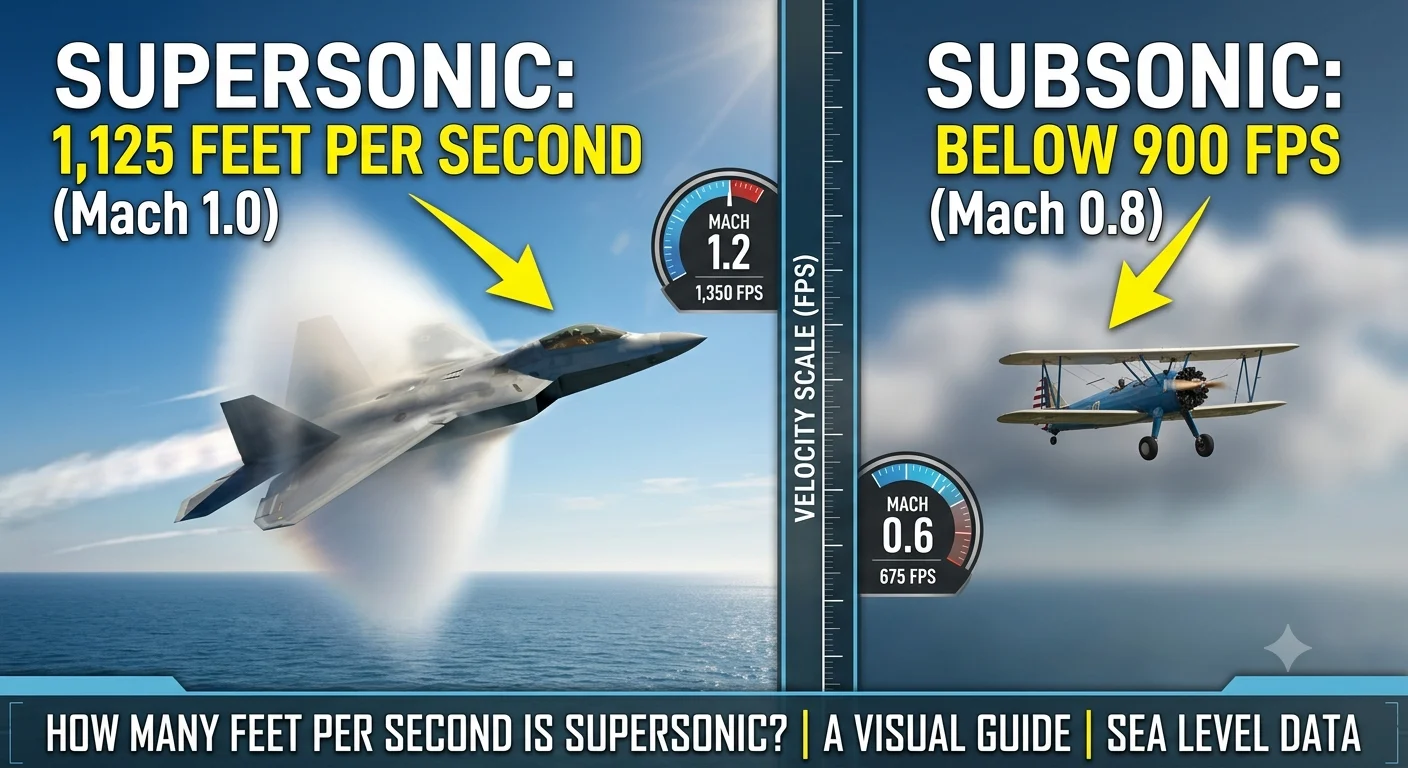
In simple terms, supersonic speed starts at around 1,125 feet per second (fps) at sea level. This is known as Mach 1, and anything faster than this is considered supersonic.
But there is much more to understand, including how altitude changes this value, how jets use supersonic speeds, and why it matters in real life. Let’s break it down step by step.
What Does Supersonic Speed Mean?
Supersonic speed means moving faster than the speed of sound in air. The speed of sound is not a fixed number—it changes based on temperature, air pressure, and altitude.
To measure this speed, scientists use a unit called the Mach number.
What is Mach Number?
Mach number is the ratio of an object’s speed to the speed of sound.
- Mach 1 = speed of sound
- Mach 2 = twice the speed of sound
- Mach 3 = three times the speed of sound
So when an aircraft breaks Mach 1, it enters supersonic speed.
Difference Between Subsonic, Transonic, and Supersonic
- Subsonic: Below Mach 0.8 (slower than sound)
- Transonic: Around Mach 0.8 to 1.2 (mixed airflow effects)
- Supersonic: Above Mach 1 (faster than sound)
This classification helps engineers design aircraft for different speed ranges.
How Many Feet Per Second Is Supersonic Speed?
Now let’s answer the main question clearly.
At sea level, the speed of sound is approximately:
1,125 feet per second (fps)
So, how many feet per second is supersonic?
Anything above 1,125 fps is supersonic.
Speed of Sound in Feet Per Second
| Mach Number | Speed (fps) | Description |
|---|---|---|
| Mach 0.5 | ~562 fps | Subsonic |
| Mach 1 | ~1,125 fps | Speed of sound |
| Mach 2 | ~2,250 fps | Supersonic |
| Mach 3 | ~3,375 fps | High supersonic |
| Mach 5 | ~5,625 fps | Hypersonic (edge range) |
Mach 1 Conversion Explained
At sea level:
- 1 Mach ≈ 1,125 feet per second
- 1 Mach ≈ 767 miles per hour
- 1 Mach ≈ 340 meters per second
So when something crosses Mach 1, it crosses the sound barrier.
Supersonic Range in FPS
Supersonic speeds generally include:
- Mach 1 = 1,125 fps
- Mach 2 = 2,250 fps
- Mach 3 = 3,375 fps
- Mach 4 = 4,500 fps
- Mach 5 = 5,625 fps
Why Supersonic Speed Changes With Altitude
The speed of sound is not constant everywhere.
Temperature and Air Density Effects
- Warm air → faster sound speed
- Cold air → slower sound speed
Temperature has the biggest impact on Mach speed.
Sea Level vs High Altitude
- Sea level: ~1,125 fps (Mach 1)
- High altitude: ~1,000 fps or lower for Mach 1
This means Mach 1 depends on environmental conditions.
Real-World Examples of Supersonic Speeds
Fighter Jets
Modern jets like the F-22 Raptor can reach:
- Mach 1.5 to Mach 2.5
- Around 1,700–2,800 fps
Concorde Aircraft
- Cruised at Mach 2
- About 2,250 fps
- One of the fastest passenger jets ever built
Missiles and Spacecraft
- Missiles: Mach 2–5
- Spacecraft re-entry: Mach 20+
These represent extreme supersonic and hypersonic speeds.
Supersonic vs Subsonic Speed Comparison
| Category | Mach Range | Feet Per Second |
|---|---|---|
| Subsonic | < 0.8 | < 900 fps |
| Transonic | 0.8–1.2 | ~900–1,350 fps |
| Supersonic | 1–5 | 1,125–5,625 fps |
| Hypersonic | 5+ | 5,625+ fps |
Practical Uses of Supersonic Speed
Military Use
- Fast interception
- Missile systems
- Air superiority
Space Exploration
- Launch and re-entry phases
- Orbital travel
Research
- Wind tunnel testing
- Aerodynamic studies
Common Misconceptions
- Mach 1 is not always the same fps
- Supersonic speed depends on air temperature
- Breaking Mach 1 does not mean constant speed everywhere
Final Thoughts
How many feet per second is supersonic?
The simple answer is: around 1,125 feet per second at sea level.
Anything above this speed enters the supersonic range, where physics changes dramatically due to shock waves and air compression.
Understanding this helps explain everything from fighter jets to space travel in a clear and practical way.