

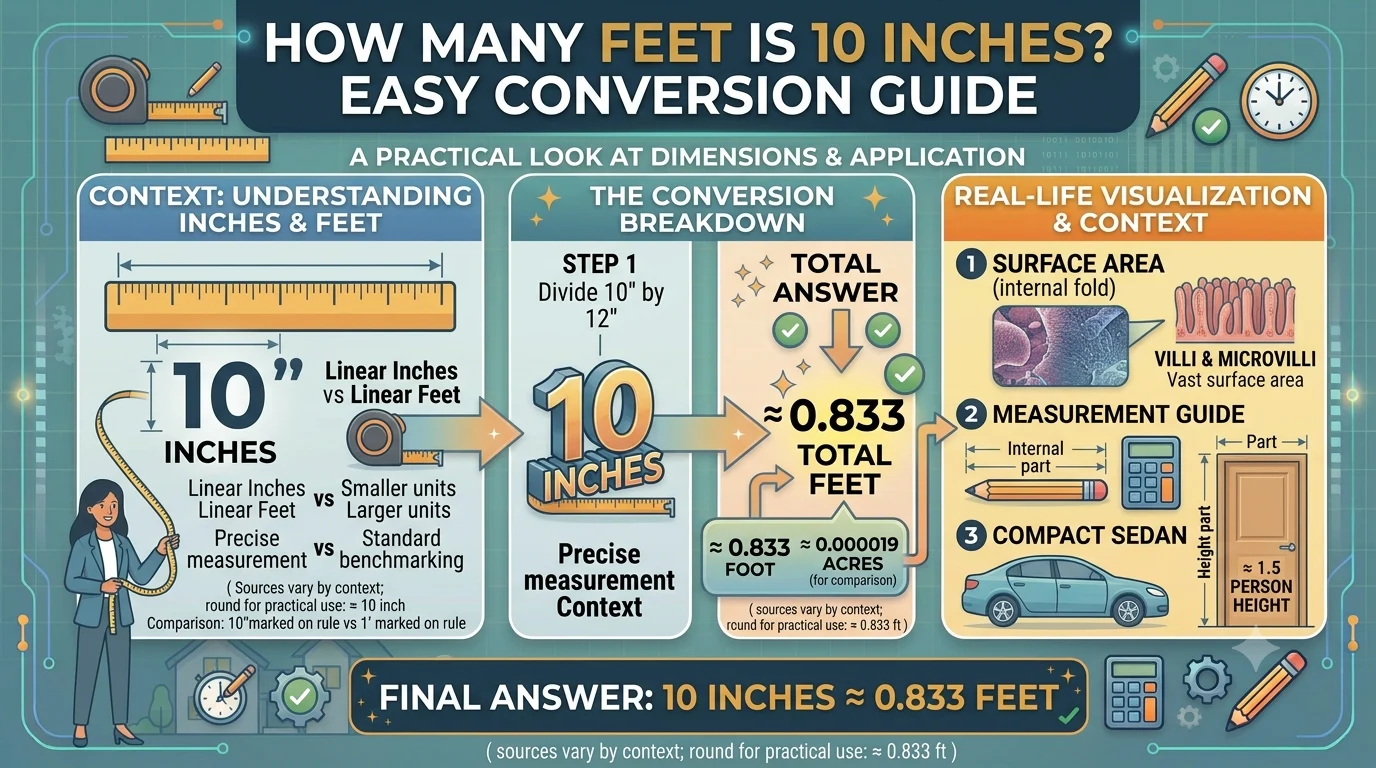
If you’re wondering how many feet is 10 inches, the answer is simple:
10 inches = 0.8333 feet (or 5/6 of a foot).
Since there are 12 inches in 1 foot, you can convert inches to feet by dividing the number of inches by 12.
Formula:
Feet = Inches ÷ 12
For 10 inches:
10 ÷ 12 = 0.8333 feet
This measurement is commonly used in construction, home improvement, woodworking, interior design, and everyday calculations. Understanding how to convert inches to feet helps you read measuring tapes, estimate dimensions, and communicate measurements accurately.
Inches to Feet Conversion Chart
| Inches | Feet | Fraction of a Foot |
|---|---|---|
| 1 | 0.0833 ft | 1/12 |
| 2 | 0.1667 ft | 1/6 |
| 3 | 0.25 ft | 1/4 |
| 4 | 0.3333 ft | 1/3 |
| 5 | 0.4167 ft | 5/12 |
| 6 | 0.5 ft | 1/2 |
| 7 | 0.5833 ft | 7/12 |
| 8 | 0.6667 ft | 2/3 |
| 9 | 0.75 ft | 3/4 |
| 10 | 0.8333 ft | 5/6 |
| 11 | 0.9167 ft | 11/12 |
| 12 | 1 ft | 1 |
How to Convert 10 Inches to Feet
Follow these simple steps:
- Write down the number of inches.
- Divide by 12.
- The result is the measurement in feet.
Example:
- 10 inches ÷ 12 = 0.8333 feet
You can also express it as:
- 0.8333 feet
- 5/6 foot
- 0 feet 10 inches (feet-and-inches format)
Why Convert Inches to Feet?
Converting inches to feet is useful in many situations, including:
- Measuring furniture
- Planning room layouts
- DIY projects
- Construction work
- Carpentry
- Landscaping
- Reading blueprints
- Buying building materials
Many products are listed in feet, while measuring tapes often show inches. Knowing how to convert between the two saves time and reduces mistakes.
Real-World Examples
Example 1: Shelf Width
A shelf measures 10 inches wide.
- In feet: 0.8333 ft
Example 2: Picture Frame
A picture frame is 10 inches tall.
- Height in feet: 0.8333 ft
Example 3: Pipe Length
A plumbing pipe extends 10 inches.
- Equivalent length: 0.8333 feet
Example 4: Craft Project
A piece of wood measures 10 inches.
- In feet: 0.8333 ft
Inches vs. Feet
| Inches | Feet |
|---|---|
| Smaller unit | Larger unit |
| Used for short measurements | Used for longer measurements |
| 12 inches = 1 foot | 1 foot = 12 inches |
Common Inches to Feet Conversions
| Inches | Feet |
|---|---|
| 6 inches | 0.5 ft |
| 8 inches | 0.6667 ft |
| 10 inches | 0.8333 ft |
| 12 inches | 1 ft |
| 18 inches | 1.5 ft |
| 24 inches | 2 ft |
| 30 inches | 2.5 ft |
| 36 inches | 3 ft |
| 48 inches | 4 ft |
| 60 inches | 5 ft |
Practical Uses of 10 Inches
A measurement of 10 inches is commonly seen in:
- Tablet screens
- Kitchen utensils
- Decorative items
- Storage boxes
- Small shelves
- Flower pots
- Hand tools
- Electronic devices
Knowing that these items measure about 0.8333 feet can help when comparing dimensions or planning space.
Tips for Accurate Conversions
- Always remember 12 inches = 1 foot.
- Divide inches by 12 to get feet.
- Keep a calculator handy for decimal conversions.
- Use fractions when precision matters in woodworking or construction.
- Double-check measurements before cutting materials.
Common Mistakes to Avoid
- Dividing by 10 instead of 12.
- Confusing decimal feet with feet-and-inches notation.
- Rounding too early during calculations.
- Forgetting that 10 inches is less than one foot.
Quick Reference Formula
Feet = Inches ÷ 12
Examples:
- 10 inches = 0.8333 feet
- 20 inches = 1.6667 feet
- 30 inches = 2.5 feet
- 40 inches = 3.3333 feet
Frequently Asked Questions
Is 10 inches equal to 1 foot?
No. One foot equals 12 inches, so 10 inches is 0.8333 feet.
What is 10 inches as a fraction of a foot?
It is 5/6 of a foot.
How do I convert inches to feet?
Divide the number of inches by 12.
Why is the conversion based on 12?
The U.S. customary measurement system defines 1 foot as exactly 12 inches.
Can I round 0.8333 feet?
Yes. For everyday use, you can round it to 0.83 feet or 0.8 feet, depending on the level of precision required.
Conclusion
If you need to know how many feet is 10 inches, the answer is 0.8333 feet, or 5/6 of a foot. Simply divide the number of inches by 12 to convert inches into feet. Whether you’re measuring furniture, planning a DIY project, or working on construction, understanding this quick conversion makes everyday measurements easier and more accurate.
