

Understanding how many feet in a cubic yard is important for construction, landscaping, and material estimation. Whether you are ordering soil, gravel, sand, or concrete, this conversion helps you calculate the correct quantity and avoid costly mistakes.
A cubic yard is a volume measurement, not a simple length measurement, which is why many people get confused. In this guide, you will learn exactly what a cubic yard means, how many feet it contains, how to convert it, and how it is used in real-world projects.
What Is a Cubic Yard?
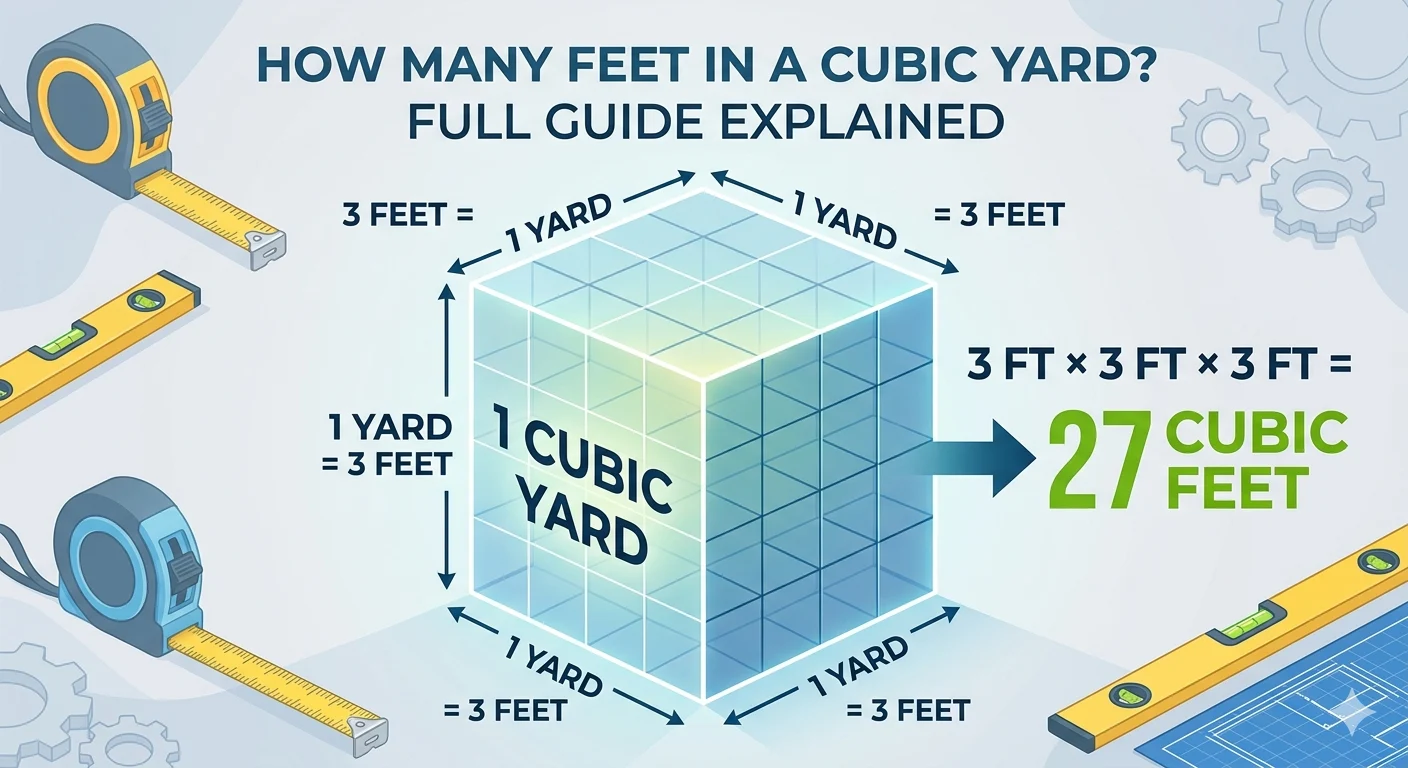
A cubic yard is a unit used to measure volume in three-dimensional space. It represents a cube where each side is one yard in length.
Since:
- 1 yard = 3 feet
A cubic yard is a cube measuring:
- 3 feet × 3 feet × 3 feet
This means it represents a physical space that can hold material such as soil, concrete, or gravel.
Simple Visualization
To imagine a cubic yard, think of:
- A box that is 3 feet long
- 3 feet wide
- 3 feet deep
It is roughly the size of:
- A small household washing machine
- A large garden waste bin
- About 9 standard wheelbarrow loads of soil
This makes it easier to understand when estimating construction materials.
How Many Feet in a Cubic Yard?
Now to the main question: how many feet in a cubic yard
The correct answer is:
1 cubic yard = 27 cubic feet
This is because volume is calculated by multiplying three dimensions:
- 3 feet (length)
- 3 feet (width)
- 3 feet (height)
So: 3 × 3 × 3 = 27 cubic feet
Important Note
This is not the same as linear feet. Many people mistakenly think it is just 3 feet, but that only represents one side of the cube.
A cubic yard always refers to a full 3D space.
Understanding the Conversion Formula
To fully understand how many feet in a cubic yard, you need to break down the formula.
Basic Formula
Cubic Yard to Cubic Feet:
1 cubic yard = 27 cubic feet
Why 27?
Because:
- 1 yard = 3 feet
- So volume becomes: 3 × 3 × 3
This is a cube, so all three dimensions are multiplied together.
Step-by-Step Example
Let’s say you have a box:
- Length = 3 feet
- Width = 3 feet
- Height = 3 feet
Now multiply:
3 × 3 × 3 = 27 cubic feet
So the space inside is exactly 1 cubic yard.
Real-Life Examples of Cubic Yards
Cubic yards are used in many practical fields. Understanding them helps in planning and budgeting materials correctly.
1. Construction Work
In construction, cubic yards are used for:
- Concrete pouring
- Foundation filling
- Road base material
Example:
- A driveway may require 8–12 cubic yards of concrete depending on size.
2. Landscaping Projects
Landscapers use cubic yards for:
- Soil filling
- Garden leveling
- Tree planting pits
Example:
- A medium backyard garden might need 2–5 cubic yards of topsoil.
3. Gravel and Sand Orders
Bulk materials like gravel and sand are sold in cubic yards because:
- It is easier to transport large quantities
- It reduces measurement errors
Cubic Yard to Cubic Feet Conversion Table
Here is a quick reference to help you convert easily:
| Cubic Yards | Cubic Feet |
|---|---|
| 1 | 27 |
| 2 | 54 |
| 3 | 81 |
| 4 | 108 |
| 5 | 135 |
| 10 | 270 |
| 15 | 405 |
| 20 | 540 |
This table is useful for quick project planning.
Step-by-Step: How to Calculate Cubic Yards
If you want to calculate material requirements, follow this process:
Step 1: Measure Dimensions in Feet
Measure:
- Length
- Width
- Depth
Step 2: Multiply to Get Cubic Feet
Formula: Length × Width × Depth = Cubic Feet
Step 3: Convert to Cubic Yards
Divide cubic feet by 27:
Cubic Feet ÷ 27 = Cubic Yards
Example Calculation
A garden bed measures:
- Length = 9 feet
- Width = 6 feet
- Depth = 0.5 feet
Step 1: 9 × 6 × 0.5 = 27 cubic feet
Step 2: 27 ÷ 27 = 1 cubic yard
So you need exactly 1 cubic yard of soil.
Common Mistakes People Make
When learning how many feet in a cubic yard, people often make mistakes.
1. Confusing Feet and Cubic Feet
- Feet = length
- Cubic feet = volume
They are not the same.
2. Forgetting Depth
Many calculations fail because depth is ignored.
Without depth, you cannot calculate volume.
3. Mixing Units
Mixing yards, feet, and inches without converting leads to incorrect results.
Always use a single unit before calculating.
Why Cubic Yards Are Important
Understanding cubic yards is useful because it helps in:
- Accurate material estimation
- Cost control in construction
- Reducing waste
- Better project planning
For contractors and homeowners, this knowledge is essential for avoiding over-ordering or under-ordering materials.
Expert Tips for Accurate Measurement
Here are some practical tips:
1. Always Convert Early
Convert all measurements into feet before calculation.
2. Double Check Depth
Depth is often the most ignored but most important measurement.
3. Use Simple Tools
Use measuring tapes or digital tools for accuracy.
4. Keep a Conversion Chart
Having a quick reference helps save time on-site.
Quick Summary
- 1 cubic yard = 27 cubic feet
- It is a volume measurement (3D space)
- Used in construction, landscaping, and bulk material estimation
- Calculated using length × width × height
FAQs
1. How many feet are in a cubic yard?
A cubic yard equals 27 cubic feet.
2. Is a cubic yard 3 feet?
No. 3 feet is only one dimension. A cubic yard is 3 × 3 × 3 feet.
3. How do you convert cubic yards to feet?
Multiply cubic yards by 27.
4. Why is a cubic yard equal to 27 cubic feet?
Because 3 feet × 3 feet × 3 feet = 27 cubic feet.
5. What is a cubic yard used for?
It is used in construction, landscaping, soil filling, gravel, and concrete measurement.
Conclusion
Knowing how many feet in a cubic yard helps you understand volume measurement in a practical and accurate way. A single cubic yard equals 27 cubic feet, based on the simple cube formula of 3 × 3 × 3.
This conversion is widely used in construction, landscaping, and material estimation. Once you understand it, you can easily calculate how much material you need for any project, saving both time and money while improving accuracy.