
If you’re working on a landscaping project, mixing concrete, filling raised garden beds, or transporting materials, you may wonder how many cubic feet in a five gallon bucket. Knowing this conversion helps you estimate material quantities accurately, reduce waste, and plan projects more efficiently.
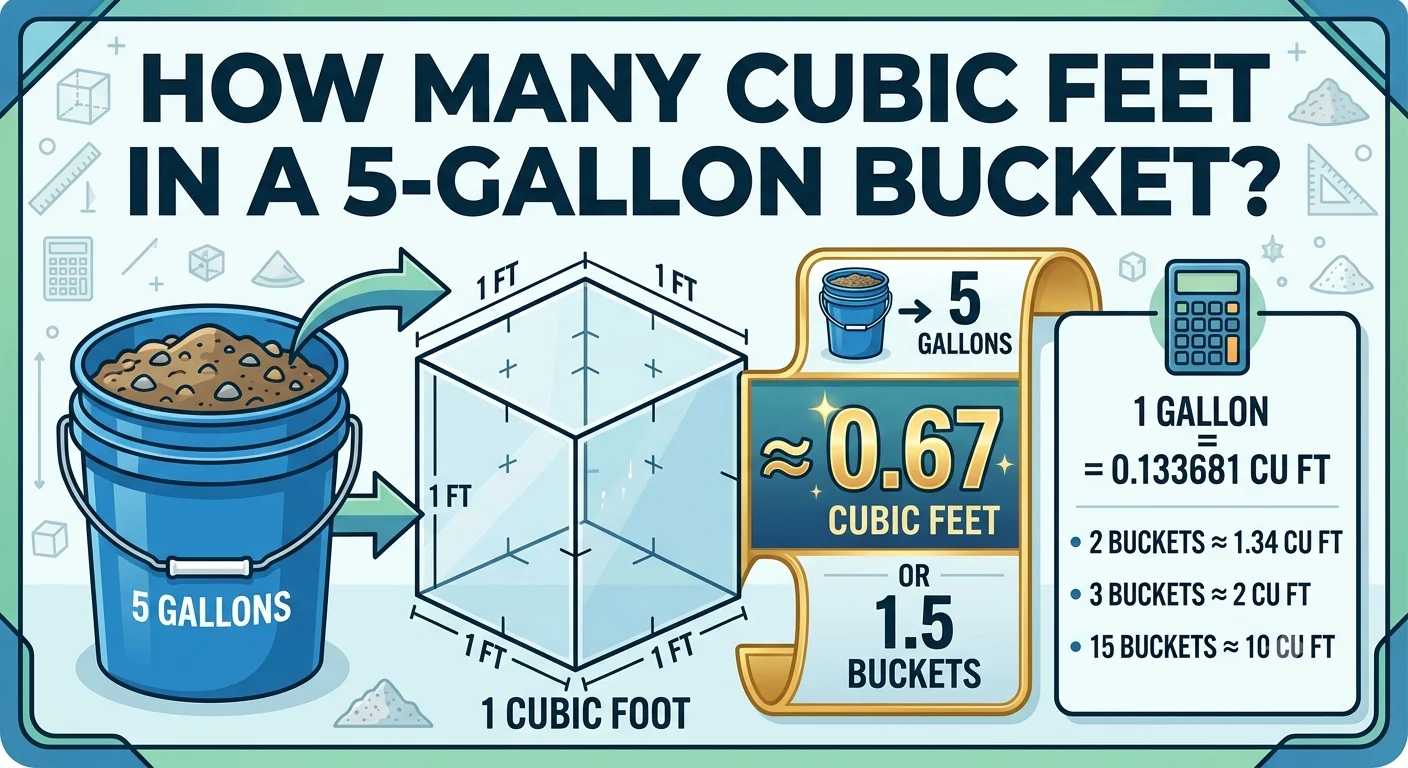
A standard five gallon bucket holds approximately 0.67 cubic feet. While this may seem like a small measurement, it’s one of the most useful conversions for homeowners, contractors, gardeners, and DIY enthusiasts.
In this guide, you’ll learn exactly how the conversion works, why it matters, practical ways to use it, and how to calculate material quantities with confidence.
Quick Answer
A standard U.S. five gallon bucket holds:
Measurement| Value
Gallons| 5
Cubic Feet| 0.668 cubic feet
Rounded Value| 0.67 cubic feet
Cubic Inches| 1,155 cubic inches
Cubic Yards| 0.0247 cubic yards
For nearly all household and construction projects, rounding to 0.67 cubic feet provides an accurate estimate.
Understanding Gallons and Cubic Feet
Before converting between these units, it’s helpful to understand what each one measures.
A gallon measures liquid volume in the U.S. customary system. It’s commonly used for water, paint, gasoline, and other liquids.
A cubic foot measures three-dimensional space. Imagine a cube that measures one foot long, one foot wide, and one foot high. The space inside that cube equals one cubic foot.
Construction and landscaping materials are often sold by cubic feet because they occupy physical space rather than simply holding liquid.
Examples include:
- Soil
- Sand
- Gravel
- Mulch
- Compost
- Concrete mix
- Decorative rocks
How to Convert Gallons to Cubic Feet
The standard conversion factor is:
1 U.S. gallon = 0.133681 cubic feet
To convert gallons into cubic feet, use this formula:
Cubic Feet = Gallons × 0.133681
For a five gallon bucket:
5 × 0.133681 = 0.668405 cubic feet
Rounded:
≈ 0.67 cubic feet
This is the value used by professionals and DIY homeowners alike.
Step-by-Step Example
Let’s calculate the volume of a five gallon bucket.
Step 1
Determine the number of gallons.
5 gallons
Step 2
Multiply by the conversion factor.
5 × 0.133681
Step 3
Calculate the result.
0.668405 cubic feet
Step 4
Round for practical use.
0.67 cubic feet
That’s all there is to it.
Why This Conversion Is Important
Knowing the cubic feet in a five gallon bucket helps with many everyday projects.
For example, you can:
- Estimate soil for garden beds
- Measure mulch
- Calculate gravel quantities
- Mix concrete accurately
- Transport sand
- Measure compost
- Estimate storage volume
- Buy the correct amount of landscaping materials
Instead of guessing, you’ll have a reliable measurement for planning your project.
Common Uses of a Five Gallon Bucket
Five gallon buckets are incredibly versatile and are found in homes, workshops, and construction sites.
Some common uses include:
Gardening
- Potting soil
- Compost
- Fertilizer
- Mulch
- Watering plants
Construction
- Concrete
- Mortar
- Sand
- Gravel
- Paint
Home Projects
- Cleaning supplies
- Storage
- Emergency water
- Pet food
- Firewood kindling
Because their capacity is standardized, they also serve as a convenient measuring container.
Cubic Feet Conversion Chart
Gallons| Cubic Feet
1| 0.134
2| 0.267
3| 0.401
4| 0.535
5| 0.668
6| 0.802
7| 0.936
8| 1.069
9| 1.203
10| 1.337
This chart is useful when comparing bucket sizes or estimating material requirements.
Practical Examples
Example 1: Filling a Raised Garden Bed
Suppose your raised garden bed requires 12 cubic feet of soil.
Each five gallon bucket holds approximately 0.67 cubic feet.
12 ÷ 0.67 = 18 buckets
You’ll need about 18 full five gallon buckets of soil.
Example 2: Moving Mulch
If you’ve purchased 5 cubic feet of mulch:
5 ÷ 0.67 = 7.5 buckets
Round up, and you’ll need about 8 bucket loads.
Example 3: Mixing Concrete
A project requires 2 cubic feet of concrete.
2 ÷ 0.67 = 3 buckets
You’ll need approximately three full buckets of mixed concrete.
Material Comparison
Different materials have different weights even though they occupy the same volume.
Material| Approximate Amount in One 5-Gallon Bucket
Potting Soil| 0.67 cubic feet
Compost| 0.67 cubic feet
Mulch| 0.67 cubic feet
Sand| 0.67 cubic feet
Gravel| 0.67 cubic feet
Water| 5 gallons
Remember, the volume stays the same, but the weight changes depending on the material.
Benefits of Using a Five Gallon Bucket for Measuring
Many professionals use five gallon buckets because they offer several advantages.
Benefits include:
- Consistent measurements
- Easy to transport
- Affordable
- Durable
- Widely available
- Great for estimating landscaping materials
- Helpful for DIY projects
Using a bucket as a measuring tool often eliminates the need for specialized equipment.
Common Mistakes to Avoid
Many people make small errors when converting gallons to cubic feet.
Here are the most common mistakes:
Confusing Weight with Volume
A bucket of gravel weighs much more than a bucket of mulch, but both occupy the same volume.
Using Imperial Instead of U.S. Gallons
This article uses U.S. gallons. Imperial gallons used in some countries have a different conversion.
Overfilling the Bucket
A bucket filled above the rim contains more than five gallons.
Ignoring Air Spaces
Materials like mulch and gravel contain air pockets, so actual packed volume may vary slightly.
Expert Tips
To improve accuracy during your projects, keep these tips in mind:
- Round to 0.67 cubic feet for everyday calculations.
- Buy slightly more material than estimated.
- Compact soil before measuring if consistency matters.
- Use the same bucket throughout your project.
- Double-check calculations for large landscaping jobs.
These simple practices help reduce waste and prevent shortages.
When Is This Conversion Most Useful?
Knowing the cubic feet in a five gallon bucket is especially helpful for:
- Landscaping projects
- Gardening
- Concrete work
- Home renovations
- Construction jobs
- Soil delivery estimates
- Mulch calculations
- Compost preparation
- DIY home improvement
- Farm and ranch work
Whether you’re filling containers or estimating bulk materials, this conversion saves both time and money.
Frequently Asked Questions
Is a five gallon bucket exactly 0.67 cubic feet?
A standard U.S. five gallon bucket holds 0.668 cubic feet, which is commonly rounded to 0.67 cubic feet.
How much soil fits in a five gallon bucket?
Approximately 0.67 cubic feet of soil fits into a standard five gallon bucket.
How many five gallon buckets equal one cubic foot?
One cubic foot equals approximately 1.5 five gallon buckets.
How many buckets are in one cubic yard?
One cubic yard equals 27 cubic feet.
27 ÷ 0.67 ≈ 40 five gallon buckets.
Can I use this conversion for gravel, mulch, or sand?
Yes. The volume remains the same regardless of the material. However, each material has a different weight.
Conclusion
Understanding how many cubic feet in a five gallon bucket makes estimating materials much easier for gardening, landscaping, construction, and home improvement projects. A standard U.S. five gallon bucket holds approximately 0.668 cubic feet, which rounds to 0.67 cubic feet for everyday use.
Whether you’re measuring soil, mulch, gravel, compost, sand, or concrete, knowing this conversion helps you purchase the right amount of material, minimize waste, and complete projects more efficiently. By using the simple conversion formula and practical examples in this guide, you can confidently estimate volumes for projects of any size.