

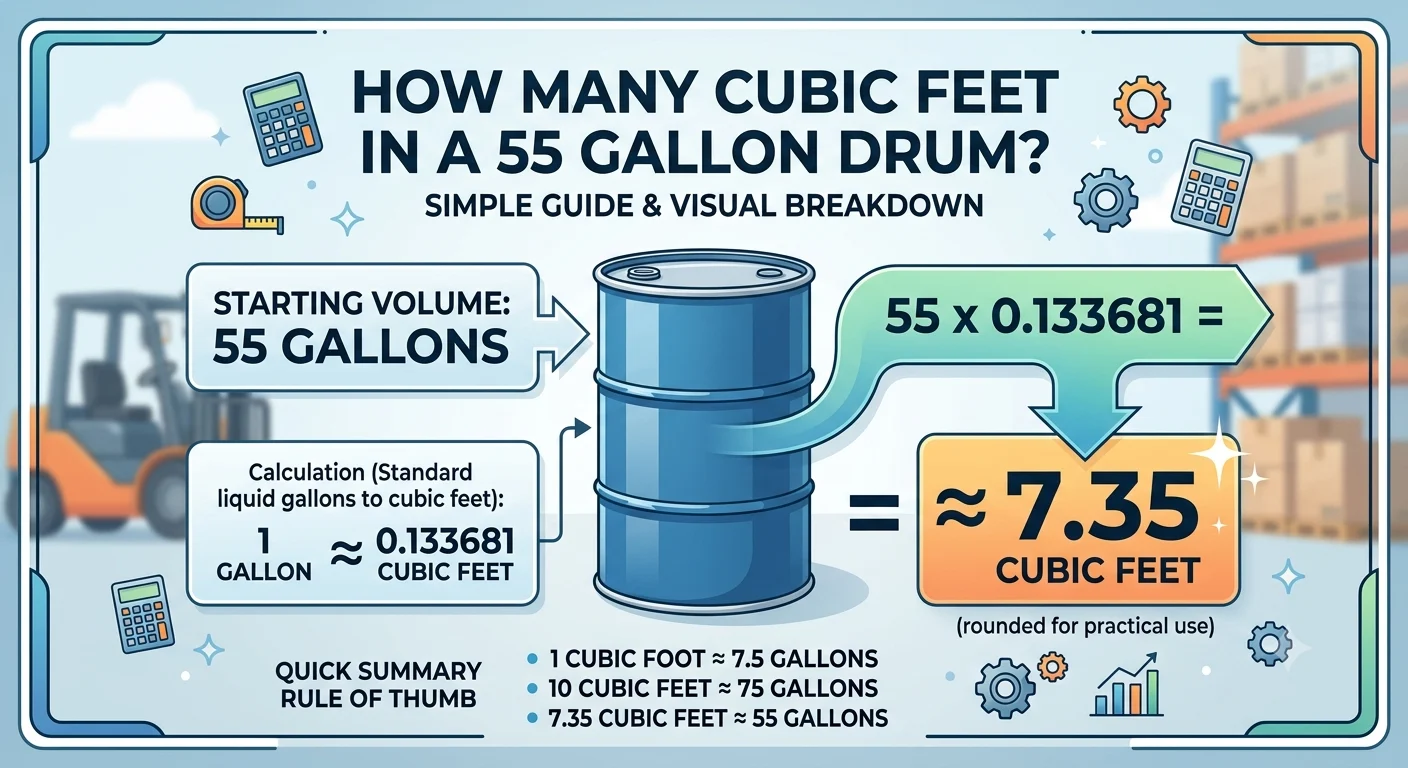
A how many cubic feet in a 55 gallon drum conversion is essential for storage planning, shipping, and industrial calculations. Whether you are working in logistics, construction, or simply using a drum for home storage, knowing the exact volume in cubic feet helps you estimate space accurately and avoid costly mistakes.
A 55-gallon drum is a standard container used worldwide, but most people think in gallons rather than cubic feet. That’s where confusion starts. Let’s break it down in a simple, practical way.
Understanding a 55 Gallon Drum
A 55-gallon drum is a cylindrical storage container designed for holding liquids, solids, or semi-liquids. It is one of the most commonly used industrial containers.
What is a standard 55 gallon drum used for?
- Oil and fuel storage
- Chemical transport and safety storage
- Water collection and emergency supply
- Industrial raw materials
- Bulk shipping and warehousing
Most drums are made from steel, plastic, or fiber, but their internal volume remains standardized at 55 US gallons.
Why volume conversion matters
Industries often use cubic feet instead of gallons because:
- Warehouse space is measured in cubic units
- Shipping containers are calculated in cubic volume
- Storage optimization requires consistent units
- Engineering and design use cubic measurements
That’s why converting gallons to cubic feet is important in real-world applications.
Exact Conversion: Gallons to Cubic Feet
To solve how many cubic feet in a 55 gallon drum, we use a standard conversion formula:
Basic conversion rule
1 US gallon = 0.133681 cubic feet
Step-by-step calculation
55 gallons × 0.133681 = 7.351455 cubic feet
So:
- 55 gallons = 7.35 cubic feet (approx.)
Final Answer: Cubic Feet in a 55 Gallon Drum
A standard 55-gallon drum holds:
👉 Approximately 7.35 cubic feet of volume
This is the most accurate and widely accepted conversion used in engineering, logistics, and storage planning.
Why it is not a round number
The result is not a whole number because:
- Gallons measure liquid volume
- Cubic feet measure 3D space
- They come from different measurement systems
So decimals are always expected in conversions.
Real-World Uses of This Conversion
Knowing how many cubic feet a 55-gallon drum holds is useful in many practical situations.
Storage and logistics
Companies use this value to:
- Plan warehouse space
- Calculate shipping capacity
- Estimate load sizes
- Organize pallets efficiently
Industrial applications
Factories and industries use it for:
- Chemical storage planning
- Production material handling
- Safety compliance calculations
Home and DIY uses
People also use 55-gallon drums for:
- Rainwater harvesting
- Composting systems
- Emergency water storage
- Bulk item storage
Understanding cubic feet helps estimate how much physical space the drum will occupy.
Conversion Table for Quick Reference
| Gallons | Cubic Feet |
|---|---|
| 1 gallon | 0.1337 cu ft |
| 10 gallons | 1.337 cu ft |
| 25 gallons | 3.34 cu ft |
| 50 gallons | 6.68 cu ft |
| 55 gallons | 7.35 cu ft |
This table helps you quickly estimate volume without manual calculation.
Factors That Affect Real Capacity
Even though the mathematical answer is clear, actual usable capacity can vary slightly.
Drum shape and design
A 55-gallon drum is not a perfect mathematical cylinder:
- Wall thickness reduces internal space
- Slight curvature affects volume
- Lid design may limit usable space
Filling safety limits
In real use, drums are rarely filled completely because:
- Liquids need expansion space
- Transport safety rules apply
- Spillage prevention requires empty headspace
Liquid vs solid storage
- Liquids fill space completely
- Solids create air gaps
So solid materials may take more physical space than expected.
Common Mistakes in Conversion
Many people miscalculate drum volume due to simple errors.
Confusing gallon types
- US gallon = 0.133681 cubic feet
- UK gallon is different and larger
Using the wrong system gives incorrect results.
Rounding too early
Rounding 7.351 to 7.3 or 7.5 can reduce accuracy in engineering or logistics work.
Ignoring container limitations
Assuming full theoretical volume without considering real-world constraints leads to errors in planning.
Expert Tips for Better Accuracy
- Always confirm US gallon standard before converting
- Use full decimal values for technical work
- Leave 5–10% empty space for safety in real storage
- Cross-check manufacturer specifications
- Use digital conversion tools for bulk calculations
These small steps improve accuracy in professional settings.
Practical Examples
Example 1: Warehouse planning
If you have 80 drums:
80 × 7.35 = 588 cubic feet
This helps estimate required storage space.
Example 2: Shipping calculation
If a container has 1,000 cubic feet capacity:
1,000 ÷ 7.35 ≈ 136 drums
This helps determine transport efficiency.
FAQs
1. How many cubic feet in a 55 gallon drum?
A 55-gallon drum holds approximately 7.35 cubic feet.
2. Is a 55 gallon drum exactly 7.5 cubic feet?
No, the accurate value is closer to 7.35 cubic feet, not 7.5.
3. Does drum material affect volume?
No, but it can slightly affect usable internal space due to thickness.
4. Can a 55 gallon drum hold exactly 55 gallons?
Yes, it is designed to hold 55 US gallons under standard conditions.
5. Why is cubic feet used instead of gallons?
Cubic feet is better for measuring physical space in storage and transport.
Conclusion
Understanding how many cubic feet in a 55 gallon drum is important for storage, shipping, and industrial planning. A standard 55-gallon drum holds about 7.35 cubic feet, making it easier to calculate space requirements in warehouses, transport systems, and home storage setups.
This simple conversion helps you plan smarter, reduce errors, and manage space more efficiently in real-world applications.