

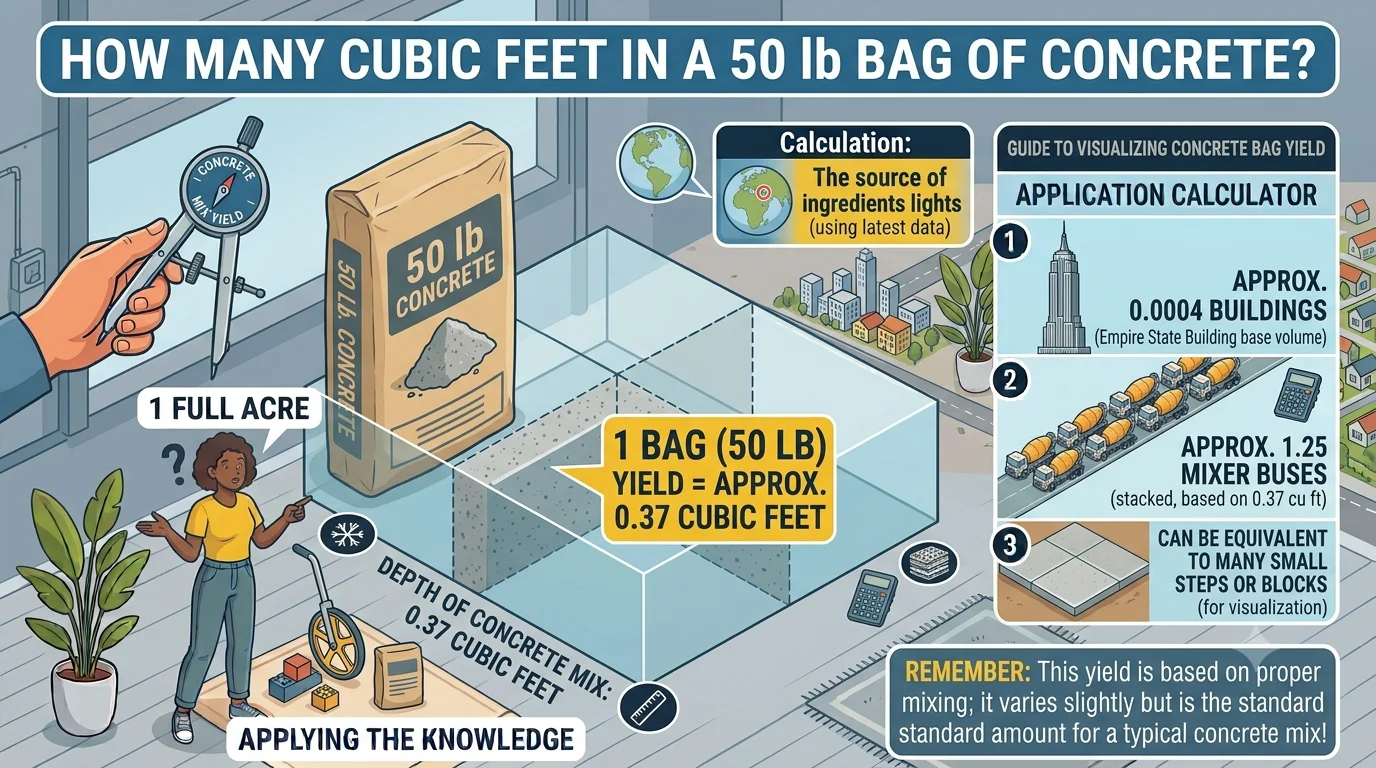
If you are planning a concrete project, one of the most common questions is how many cubic feet in a 50 lb bag of concrete. Whether you are pouring a small patio, repairing a sidewalk, setting fence posts, or building concrete steps, knowing the yield of each bag helps you buy the right amount of material and avoid unnecessary waste.
A standard 50 lb bag of concrete mix produces approximately 0.375 cubic feet of cured concrete when mixed according to the manufacturer’s instructions. This value may vary slightly depending on the brand, water content, and aggregate size, but 0.375 cubic feet is the standard estimate used by most contractors and DIY homeowners.
Understanding this simple measurement makes it easier to estimate how many bags you need for projects of every size.
What Is the Yield of a 50 lb Bag of Concrete?
Concrete yield refers to the amount of finished concrete produced after mixing the dry ingredients with water.
Here is the standard yield for common bag sizes.
Bag Size| Approximate Yield
40 lb| 0.30 cubic feet
50 lb| 0.375 cubic feet
60 lb| 0.45 cubic feet
80 lb| 0.60 cubic feet
Therefore, the answer to how many cubic feet in a 50 lb bag of concrete is:
50 lb bag = approximately 0.375 cubic feet of concrete.
This measurement refers to finished concrete after proper mixing.
Why Is Concrete Yield Important?
Knowing the yield allows you to:
- Estimate the number of bags needed.
- Save money by avoiding overbuying.
- Prevent running out of concrete during a pour.
- Plan transportation more efficiently.
- Reduce construction waste.
Professional contractors always calculate concrete volume before purchasing materials.
Understanding Cubic Feet
Concrete is measured by volume rather than weight.
One cubic foot represents a space measuring:
- 1 foot long
- 1 foot wide
- 1 foot high
When calculating concrete needs, you first determine the total cubic feet required and then divide by the yield of one bag.
Formula to Calculate Bags Needed
The basic formula is:
Number of Bags = Total Cubic Feet Needed ÷ 0.375
This simple equation works for almost every residential concrete project.
Example 1: Filling One Cubic Foot
Suppose your project requires exactly one cubic foot of concrete.
Calculation:
1 ÷ 0.375 = 2.67
Since you cannot purchase a fraction of a bag, round up.
You will need 3 bags of 50 lb concrete mix.
Example 2: Small Concrete Slab
Suppose you are pouring a slab measuring:
- Length: 4 feet
- Width: 3 feet
- Thickness: 4 inches
Convert thickness:
4 inches ÷ 12 = 0.333 feet
Volume:
4 × 3 × 0.333
= 3.996 cubic feet
Approximately 4 cubic feet.
Now calculate bags:
4 ÷ 0.375
= 10.67
Round up to 11 bags.
Example 3: Fence Post Installation
A typical fence post hole measures:
- Diameter: 12 inches
- Depth: 24 inches
One hole usually requires approximately 0.8 cubic feet.
Calculation:
0.8 ÷ 0.375
= 2.13
Round up.
You need 3 bags for one fence post.
Example 4: Concrete Footing
Suppose a footing measures:
- Length: 10 feet
- Width: 1 foot
- Thickness: 6 inches
Convert thickness:
6 inches = 0.5 feet
Volume:
10 × 1 × 0.5
= 5 cubic feet
Bags needed:
5 ÷ 0.375
= 13.33
Round up.
You need 14 bags.
Common Projects and Bag Estimates
Project| Approximate Concrete Needed| 50 lb Bags
Fence post| 0.8 cu ft| 3
Mailbox post| 0.5 cu ft| 2
Small step| 2 cu ft| 6
Sidewalk repair| 4 cu ft| 11
Garden bench base| 3 cu ft| 8
Patio section| 8 cu ft| 22
These estimates help during project planning.
How to Measure Your Project
Before buying concrete, measure:
- Length
- Width
- Depth
Always convert inches into feet.
For example:
- 2 inches = 0.167 feet
- 4 inches = 0.333 feet
- 6 inches = 0.5 feet
- 8 inches = 0.667 feet
- 12 inches = 1 foot
Multiply:
Length × Width × Depth
The result is total cubic feet.
Factors That Affect Concrete Yield
Although the standard yield is 0.375 cubic feet, several factors may change the final amount.
Extra Water
Adding excessive water makes the mix easier to pour but weakens the finished concrete and changes consistency.
Mixing Method
Machine mixing usually provides a more consistent yield than hand mixing.
Aggregate Size
Different manufacturers use slightly different aggregate blends, which can slightly affect volume.
Waste
Spillage, uneven forms, and cleanup often increase material usage.
Buying one extra bag is usually a good idea.
Popular Uses for a 50 lb Bag of Concrete
A 50 lb bag is ideal for:
- Fence posts
- Mailbox posts
- Garden edging
- Concrete repairs
- Small slabs
- Stepping stones
- Patio repairs
- Outdoor furniture bases
- Basketball pole installation
Its manageable weight makes it popular with DIY homeowners.
50 lb vs 60 lb vs 80 lb Bags
Choosing the right bag depends on project size and lifting ability.
Bag Size| Yield| Best For
40 lb| 0.30 cu ft| Small repairs
50 lb| 0.375 cu ft| DIY projects
60 lb| 0.45 cu ft| Medium jobs
80 lb| 0.60 cu ft| Large pours
A 50 lb bag offers a good balance between weight and coverage.
Tips for Mixing Concrete Correctly
For the best results:
- Use clean water.
- Follow manufacturer instructions.
- Mix thoroughly.
- Avoid adding excessive water.
- Pour immediately after mixing.
- Finish before the concrete begins to set.
Proper mixing ensures maximum strength and durability.
Estimating Bags for Larger Projects
Suppose you need 12 cubic feet.
Calculation:
12 ÷ 0.375
= 32 bags
For 20 cubic feet:
20 ÷ 0.375
= 53.3
Round up to 54 bags.
Larger projects may be more economical using ready-mix concrete instead of bagged mixes.
Common Calculation Mistakes
Many DIY builders make these errors:
Forgetting to Convert Inches
Always convert thickness into feet before calculating volume.
Buying the Exact Number of Bags
Always purchase one or two extra bags for unexpected needs.
Ignoring Waste
Concrete can spill during transport and pouring.
Adding Too Much Water
Extra water reduces concrete strength and durability.
Avoiding these mistakes saves both time and money.
Expert Tips
Professional concrete installers recommend:
- Measure twice before buying materials.
- Prepare forms before mixing.
- Keep tools nearby.
- Work in manageable batches.
- Wear gloves and eye protection.
- Protect fresh concrete from rain and freezing temperatures.
- Allow adequate curing time before heavy use.
These simple practices improve both appearance and long-term performance.
Quick Reference Chart
Cubic Feet Needed| 50 lb Bags Required
1| 3
2| 6
3| 8
4| 11
5| 14
6| 16
8| 22
10| 27
12| 32
15| 40
20| 54
Keep this chart handy when shopping for concrete.
Frequently Asked Questions
Is a 50 lb bag of concrete enough for one cubic foot?
No. A 50 lb bag produces only about 0.375 cubic feet, so you need approximately three bags for one cubic foot.
How many 50 lb bags make one cubic yard?
One cubic yard equals 27 cubic feet.
27 ÷ 0.375 = 72
You need approximately 72 bags.
Can concrete yield vary by brand?
Yes. Most brands produce around 0.375 cubic feet, but always check the bag label for the exact yield.
Should I buy extra bags?
Yes. Purchasing one or two extra bags helps account for waste, uneven surfaces, and measurement errors.
Is a 50 lb bag suitable for large projects?
It works well for small and medium jobs. For larger slabs, driveways, or foundations, ready-mix concrete is usually more efficient and cost-effective.
Conclusion
If you have been wondering how many cubic feet in a 50 lb bag of concrete, the answer is simple: a standard 50 lb bag yields approximately 0.375 cubic feet of finished concrete. This measurement is widely used for estimating materials for home improvement projects, fence posts, patios, walkways, repairs, and small slabs.
By calculating your project’s total cubic feet and dividing by 0.375, you can accurately estimate the number of bags required. Always round up to the next whole bag and consider purchasing an extra bag or two to account for waste and unexpected needs. Careful planning, accurate measurements, and proper mixing techniques will help ensure your concrete project is completed efficiently, with minimal waste and professional-quality results.