
If you’ve ever purchased soil, mulch, gravel, sand, or concrete, you’ve probably noticed that suppliers often sell these materials by the cubic yard instead of the cubic foot. This can make estimating the right amount confusing if you’re unfamiliar with volume measurements. A common question people ask is: how many cubic feet are in one cubic yard?
The answer is simple:
One cubic yard equals 27 cubic feet.
While the answer is easy to remember, understanding why this conversion works can help you confidently estimate materials for landscaping, construction, gardening, and home improvement projects.
In this guide, you’ll learn what cubic yards and cubic feet are, how to convert between them, practical examples, conversion charts, and expert tips to help you avoid costly mistakes.
Quick Answer
The exact conversion is:
1 cubic yard = 27 cubic feet
To convert cubic yards into cubic feet, use this formula:
Cubic Feet = Cubic Yards × 27
For example:
- 1 cubic yard = 27 cubic feet
- 2 cubic yards = 54 cubic feet
- 3 cubic yards = 81 cubic feet
- 5 cubic yards = 135 cubic feet
- 10 cubic yards = 270 cubic feet
Remembering the number 27 makes volume conversions much easier.
What Is a Cubic Yard?
A cubic yard is a unit of volume used in the U.S. customary measurement system. Volume measures the amount of three-dimensional space an object or material occupies.
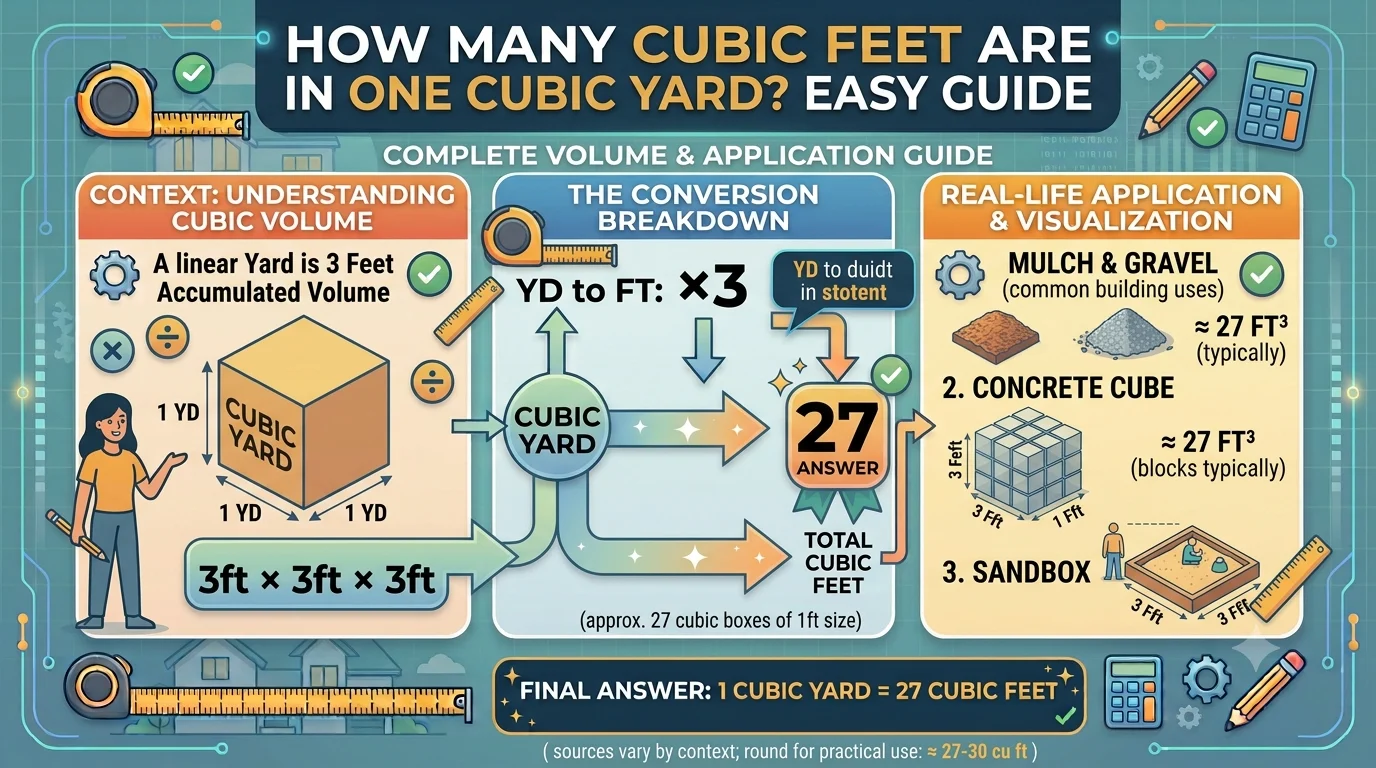
Imagine a cube that measures:
- 3 feet long
- 3 feet wide
- 3 feet high
That cube represents exactly one cubic yard.
Because each side measures three feet, the total volume equals:
3 × 3 × 3 = 27 cubic feet
This is why one cubic yard always contains 27 cubic feet.
What Is a Cubic Foot?
A cubic foot is another unit of volume.
Picture a cube that measures:
- 1 foot long
- 1 foot wide
- 1 foot high
The volume of that cube is:
1 × 1 × 1 = 1 cubic foot
Since a cubic yard measures three feet in every direction, it contains 27 of these one-foot cubes.
How Many Cubic Feet Are in One Cubic Yard?
The exact answer is:
One cubic yard = 27 cubic feet
This conversion never changes because it’s based on fixed measurements.
The Formula
To convert cubic yards into cubic feet:
Cubic Feet = Cubic Yards × 27
Examples:
| Cubic Yards | Cubic Feet |
|---|---|
| 1 | 27 |
| 2 | 54 |
| 3 | 81 |
| 4 | 108 |
| 5 | 135 |
| 10 | 270 |
| 20 | 540 |
Why Is the Answer 27?
Many people wonder why the number is 27 instead of 9.
The reason is simple.
One yard equals 3 feet.
Since volume measures length, width, and height, you multiply three dimensions:
3 × 3 × 3 = 27 cubic feet
That’s why every cubic yard contains exactly 27 cubic feet.
Cubic Yard to Cubic Feet Conversion Chart
Use this quick chart whenever you need to convert cubic yards into cubic feet.
| Cubic Yards | Cubic Feet |
|---|---|
| 0.25 | 6.75 |
| 0.5 | 13.5 |
| 0.75 | 20.25 |
| 1 | 27 |
| 1.5 | 40.5 |
| 2 | 54 |
| 2.5 | 67.5 |
| 3 | 81 |
| 4 | 108 |
| 5 | 135 |
| 6 | 162 |
| 8 | 216 |
| 10 | 270 |
| 15 | 405 |
| 20 | 540 |
Cubic Feet to Cubic Yard Conversion Chart
Sometimes you’ll know the volume in cubic feet and need to convert it into cubic yards.
Use this formula:
Cubic Yards = Cubic Feet ÷ 27
| Cubic Feet | Cubic Yards |
|---|---|
| 27 | 1 |
| 54 | 2 |
| 81 | 3 |
| 108 | 4 |
| 135 | 5 |
| 162 | 6 |
| 216 | 8 |
| 270 | 10 |
| 540 | 20 |
Real-World Examples
Understanding the conversion becomes much easier when you apply it to everyday projects.
Example 1: Buying Topsoil
You’re building a raised garden bed and your supplier offers soil by the cubic yard.
You order 2 cubic yards.
Calculation:
2 × 27 = 54 cubic feet
You’ll receive 54 cubic feet of soil.
Example 2: Ordering Mulch
Your landscaping project requires 81 cubic feet of mulch.
Convert to cubic yards:
81 ÷ 27 = 3 cubic yards
You’ll need to order 3 cubic yards.
Example 3: Concrete Project
A contractor estimates you’ll need 5 cubic yards of concrete.
Convert to cubic feet:
5 × 27 = 135 cubic feet
This helps you understand the actual amount of concrete being delivered.
Example 4: Gravel for a Driveway
You calculate that your driveway needs 135 cubic feet of gravel.
Convert:
135 ÷ 27 = 5 cubic yards
Since gravel suppliers usually sell by the cubic yard, you’ll order 5 cubic yards.
How to Calculate Cubic Feet
Before converting to cubic yards, you may first need to calculate cubic feet.
Use this formula:
Length × Width × Height
For example:
Length = 8 feet
Width = 4 feet
Depth = 2 feet
Volume:
8 × 4 × 2 = 64 cubic feet
To convert into cubic yards:
64 ÷ 27 = 2.37 cubic yards
How to Convert Cubic Feet to Cubic Yards
If you know the volume in cubic feet, divide by 27.
Formula:
Cubic Yards = Cubic Feet ÷ 27
Examples:
- 54 ÷ 27 = 2 cubic yards
- 108 ÷ 27 = 4 cubic yards
- 162 ÷ 27 = 6 cubic yards
- 270 ÷ 27 = 10 cubic yards
This simple calculation works for every conversion.
Common Uses for Cubic Yard Conversions
Knowing how many cubic feet are in one cubic yard is useful when buying:
- Topsoil
- Mulch
- Compost
- Gravel
- Sand
- Concrete
- Decorative stone
- Crushed rock
- Fill dirt
- Wood chips
Most suppliers sell these materials by the cubic yard, making this conversion essential for accurate ordering.
Why This Conversion Matters
Ordering the correct amount of material can save both time and money.
If you order too little:
- Your project may stop halfway.
- You’ll likely pay another delivery fee.
- Completion may be delayed.
If you order too much:
- You’ll spend more than necessary.
- Extra materials may go to waste.
- Disposal can become an additional expense.
Understanding the conversion helps you estimate materials with confidence and reduce unnecessary costs.
Common Mistakes to Avoid
Many beginners make simple mistakes when calculating volume.
Confusing Square Feet with Cubic Feet
Square feet measure area.
Cubic feet measure volume.
They are completely different measurements and cannot be used interchangeably.
Forgetting the Height
Volume always requires three dimensions:
- Length
- Width
- Height
Leaving out the depth or height will produce incorrect results.
Multiplying by 9 Instead of 27
Some people mistakenly calculate:
3 × 3 = 9
However, volume uses three dimensions:
3 × 3 × 3 = 27
Always multiply all three measurements.
Mixing Measurement Units
Always measure everything using the same unit before calculating.
For example, don’t mix inches and feet in the same calculation unless you convert them first.
Expert Tips
Professionals recommend these practices for more accurate estimates:
- Measure carefully before ordering materials.
- Round up slightly to account for waste and settling.
- Double-check all dimensions before placing an order.
- Keep a conversion chart handy for quick reference.
- Use cubic yards when ordering bulk materials.
- Use cubic feet when measuring smaller spaces.
- Confirm how your supplier measures and prices materials.
Following these tips can help you avoid delays and unnecessary expenses.
Quick Reference Formulas
Keep these formulas handy:
Cubic Feet = Cubic Yards × 27
Cubic Yards = Cubic Feet ÷ 27
Cubic Feet = Length × Width × Height
These three formulas cover nearly every volume conversion you’ll encounter in construction, landscaping, or home improvement projects.
Frequently Asked Questions
1. How many cubic feet are in one cubic yard?
There are exactly 27 cubic feet in one cubic yard.
2. Why does one cubic yard equal 27 cubic feet?
Because one yard equals three feet, and volume is calculated by multiplying length, width, and height:
3 × 3 × 3 = 27 cubic feet.
3. How do I convert cubic feet into cubic yards?
Divide the number of cubic feet by 27.
For example:
81 ÷ 27 = 3 cubic yards.
4. Is a cubic yard larger than a cubic foot?
Yes. One cubic yard contains 27 cubic feet, making it much larger than a single cubic foot.
5. What materials are commonly sold by the cubic yard?
Materials commonly sold by the cubic yard include topsoil, mulch, gravel, sand, compost, crushed stone, fill dirt, decorative rock, and concrete.
Conclusion
Understanding how many cubic feet are in one cubic yard is an essential skill for anyone working on landscaping, construction, gardening, or home improvement projects. The conversion is simple: 1 cubic yard equals 27 cubic feet. By remembering this key number and using the formulas provided, you can accurately estimate materials, compare supplier quotes, and avoid costly ordering mistakes.
Whether you’re buying soil for a garden, gravel for a driveway, mulch for landscaping, or concrete for a patio, knowing how to convert between cubic yards and cubic feet will help you plan your project with confidence and ensure you order the right amount every time.