

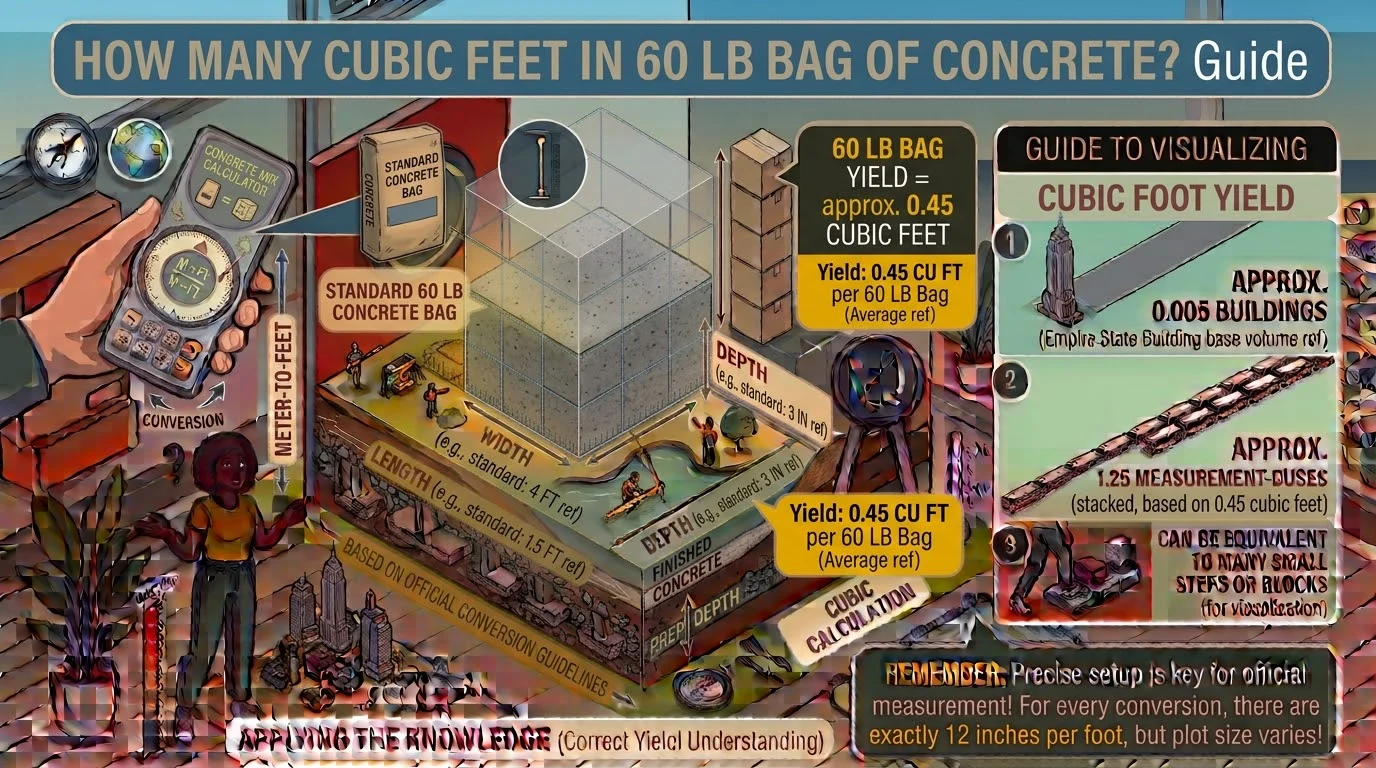
If you’re planning a concrete project, one of the first questions you’ll likely ask is, how many cubic feet in 60 lb bag of concrete? Whether you’re pouring a small patio, setting fence posts, building a walkway, or installing deck footings, knowing the yield of each bag helps you estimate materials accurately and avoid costly mistakes. A standard 60-pound bag of concrete produces approximately 0.45 cubic feet of finished concrete, making it easy to calculate how many bags you’ll need for projects of any size. In this guide, you’ll learn how to calculate concrete volume, estimate the number of bags required, compare different bag sizes, and use practical examples to plan your project with confidence.
What Is the Volume of a 60 lb Bag of Concrete?
A standard 60 lb bag of concrete yields approximately 0.45 cubic feet of cured concrete when mixed according to the manufacturer’s instructions. This measurement is important when estimating how many bags you’ll need for patios, fence posts, sidewalks, slabs, and other concrete projects.
Knowing the cubic feet per bag helps reduce waste, save money, and ensure you purchase the correct amount of concrete before starting your project.
How Many Cubic Feet in 60 lb Bag of Concrete?
A 60-pound bag of concrete equals approximately 0.45 cubic feet of finished concrete.
| Bag Size | Approximate Yield |
|---|---|
| 40 lb | 0.30 cubic feet |
| 50 lb | 0.375 cubic feet |
| 60 lb | 0.45 cubic feet |
| 80 lb | 0.60 cubic feet |
These values are averages provided by most major concrete manufacturers.
Why Does a 60 lb Bag Yield Only 0.45 Cubic Feet?
Many people assume a 60-pound bag should produce a much larger volume. However, concrete is dense because it contains a mixture of Portland cement, sand, gravel or aggregate, and water. Once mixed, these materials create a durable product with a relatively small finished volume compared to its weight.
The actual yield may vary slightly depending on the brand, water added, and mixing method, but 0.45 cubic feet is the standard estimate used for planning.
How to Calculate Concrete Volume
Calculating the amount of concrete you need is straightforward.
Use this formula:
Volume = Length × Width × Depth
Measure all dimensions in feet.
For example:
- Length = 10 feet
- Width = 4 feet
- Depth = 4 inches (0.333 feet)
Calculation:
10 × 4 × 0.333 = 13.32 cubic feet
Since each 60 lb bag yields about 0.45 cubic feet:
13.32 ÷ 0.45 = 29.6 bags
Always round up, so you’ll need 30 bags.
Quick Chart: Number of 60 lb Bags Needed
| Concrete Needed | 60 lb Bags Required |
|---|---|
| 1 cubic foot | 3 bags |
| 2 cubic feet | 5 bags |
| 5 cubic feet | 12 bags |
| 10 cubic feet | 23 bags |
| 20 cubic feet | 45 bags |
| 27 cubic feet (1 cubic yard) | 60 bags |
Buying one or two extra bags is always a good idea in case of spills or slight miscalculations.
How Many 60 lb Bags Make One Cubic Yard?
One cubic yard equals 27 cubic feet.
To find the number of bags:
27 ÷ 0.45 = 60 bags
Therefore, you’ll need approximately 60 bags of 60 lb concrete to produce one cubic yard of concrete.
Common Concrete Project Examples
Fence Post Installation
A typical fence post hole measuring 12 inches in diameter and 24 inches deep usually requires about 2 bags of 60 lb concrete.
Basketball Pole
Depending on the manufacturer’s installation guidelines and hole dimensions, you’ll generally need 3 to 5 bags.
Deck Footing
A footing measuring 12 inches in diameter and 36 inches deep typically requires around 3 bags.
Small Sidewalk
Dimensions:
- Length: 8 feet
- Width: 3 feet
- Thickness: 4 inches
Volume:
8 × 3 × 0.333 = approximately 8 cubic feet
Bags needed:
8 ÷ 0.45 = approximately 18 bags.
Practical Uses for 60 lb Concrete Bags
A 60 lb concrete bag is ideal for many residential and DIY projects, including:
- Fence posts
- Mailbox posts
- Deck footings
- Garden edging
- Concrete steps
- Walkway repairs
- Small patios
- Shed foundations
- Air conditioner pads
- Small slabs
For larger projects such as driveways or house foundations, ordering ready-mix concrete is usually more economical.
60 lb vs 80 lb Concrete Bags
| Feature | 60 lb Bag | 80 lb Bag |
|---|---|---|
| Yield | 0.45 cubic feet | 0.60 cubic feet |
| Easier to Carry | Yes | No |
| Bags per Cubic Yard | 60 | 45 |
| Best For | DIY projects | Larger projects |
Many homeowners prefer 60 lb bags because they are easier to lift and transport.
How Much Area Does One 60 lb Bag Cover?
Coverage depends on the thickness of the concrete.
| Thickness | Approximate Coverage |
|---|---|
| 1 inch | 5.4 square feet |
| 2 inches | 2.7 square feet |
| 3 inches | 1.8 square feet |
| 4 inches | 1.35 square feet |
These figures are approximate and may vary slightly depending on the mix.
Factors That Affect Concrete Yield
Several factors can influence the final volume of concrete produced from a bag.
These include:
- Adding too much water
- Poor mixing
- Air pockets
- Material waste
- Uneven surfaces
- Different concrete brands
- Aggregate size
Following the manufacturer’s mixing instructions helps achieve the expected yield.
Step-by-Step Guide to Estimate Concrete Bags
Step 1
Measure the length of your project.
Step 2
Measure the width.
Step 3
Measure the depth.
Step 4
Convert inches into feet if necessary.
Step 5
Multiply:
Length × Width × Depth
Step 6
Divide the total cubic feet by 0.45.
Step 7
Round up to the nearest whole bag.
Real-World Example
Suppose you’re building a concrete pad for an outdoor air conditioning unit.
Dimensions:
- Length: 3 feet
- Width: 3 feet
- Thickness: 4 inches (0.333 feet)
Volume:
3 × 3 × 0.333 = approximately 3 cubic feet
Concrete bags needed:
3 ÷ 0.45 = 6.67 bags
Round up to 7 bags.
Benefits of Using 60 lb Concrete Bags
Using 60 lb bags offers several advantages.
- Easier to lift than 80 lb bags
- Convenient for DIY homeowners
- Easy to transport
- Ideal for small repairs
- Less physical strain
- Widely available
- Helps reduce waste on smaller projects
Drawbacks
Although useful, there are a few disadvantages.
- More bags are needed for larger jobs
- More mixing time
- Increased labor
- Can become more expensive than ready-mix concrete for large pours
Common Mistakes to Avoid
Avoid these common errors when estimating concrete.
- Forgetting to convert inches into feet
- Buying too few bags
- Adding too much water
- Ignoring waste
- Mixing inconsistent batches
- Not following manufacturer instructions
Planning carefully can save both time and money.
Expert Tips
- Purchase one or two extra bags for unexpected needs.
- Use the recommended amount of water for the best strength.
- Mix thoroughly for a consistent finish.
- Work quickly before the concrete begins to set.
- Wear gloves, safety glasses, and protective clothing while handling concrete.
Frequently Asked Questions
How many cubic feet are in a 60 lb bag of concrete?
A standard 60 lb bag of concrete yields approximately 0.45 cubic feet of finished concrete.
How many 60 lb bags make one cubic yard?
Since one cubic yard equals 27 cubic feet, you’ll need approximately 60 bags of 60 lb concrete.
Is the yield always exactly 0.45 cubic feet?
No. While 0.45 cubic feet is the standard estimate, the actual yield can vary slightly depending on the manufacturer and mixing process.
Can I use a 60 lb bag for fence posts?
Yes. Most fence post installations require between 1 and 3 bags, depending on the size and depth of the hole.
Should I buy extra concrete bags?
Yes. Buying one or two extra bags helps cover waste, spills, uneven ground, and minor calculation errors.
Conclusion
Understanding how many cubic feet in 60 lb bag of concrete is essential for planning any concrete project accurately. A standard 60-pound bag produces approximately 0.45 cubic feet of finished concrete, making it easy to estimate the number of bags needed for patios, fence posts, footings, walkways, and other DIY projects. By measuring your project’s dimensions, calculating the total volume, and dividing by 0.45, you can purchase the right amount of concrete, minimize waste, and complete your project efficiently and confidently.