
Understanding how many cu feet in a yard is essential for anyone working on construction, landscaping, gardening, or DIY home projects. Whether you are buying soil, gravel, sand, or mulch, knowing this simple conversion helps you estimate materials correctly and avoid wasting money.
In real-world projects, small measurement errors can lead to major cost differences. That’s why learning this basic unit conversion is so useful for both beginners and professionals.
In this guide, you will clearly learn the exact conversion, how to calculate it, real-life examples, and practical tips to use it confidently in any project.
What Does a Cubic Yard Mean?
Before learning how many cu feet in a yard, you need to understand what a cubic yard actually represents.
A cubic yard is a unit of volume used mainly in the United States to measure large quantities of materials. It measures space in three dimensions:
- Length
- Width
- Height
Understanding 3D Volume Measurement
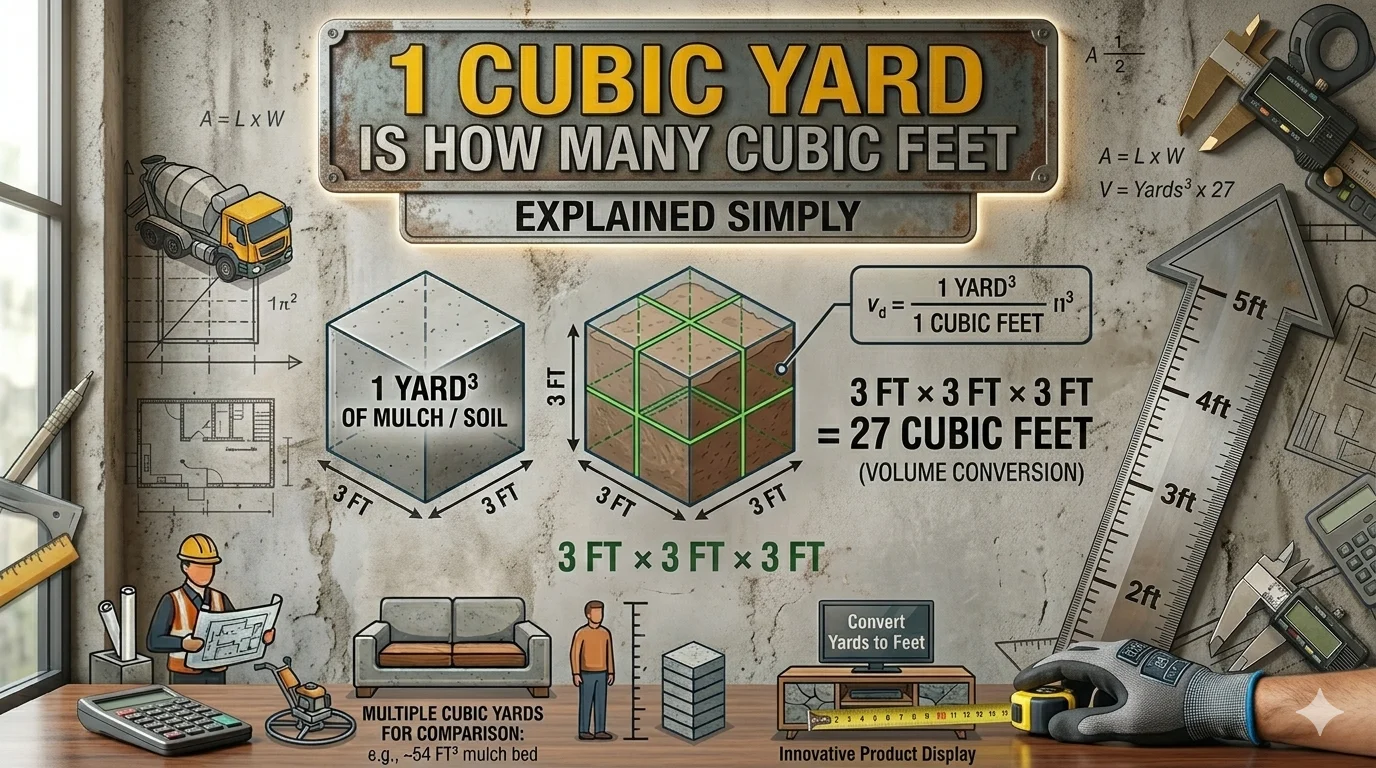
A cubic yard is a cube where each side is exactly 1 yard long.
Since:
- 1 yard = 3 feet
So a cubic yard becomes:
- 3 feet × 3 feet × 3 feet
This 3D structure is the reason cubic yards are used for bulk materials like soil and gravel.
Why Cubic Yards Are Commonly Used
Cubic yards are widely used because:
- They simplify large quantity calculations
- They reduce large numbers into manageable units
- They are the standard measurement in construction and landscaping
Instead of saying “81 cubic feet of material,” professionals prefer “3 cubic yards.”
How Many Cu Feet in a Yard?
Now let’s answer the main question: how many cu feet in a yard?
Exact Conversion
1 cubic yard = 27 cubic feet
Step-by-Step Breakdown
Since:
- 1 yard = 3 feet
Then:
- 1 cubic yard = 3 × 3 × 3
- 1 cubic yard = 27 cubic feet
So the final and most important answer is:
👉 1 cubic yard = 27 cubic feet
This is the foundation of all cubic yard conversions.
Cubic Yard to Cubic Feet Conversion Table
Here is a simple reference table for quick use:
| Cubic Yards | Cubic Feet |
|---|---|
| 1 yard | 27 cu ft |
| 2 yards | 54 cu ft |
| 3 yards | 81 cu ft |
| 4 yards | 108 cu ft |
| 5 yards | 135 cu ft |
| 10 yards | 270 cu ft |
Common Material Examples
- Soil is often measured in cubic yards for garden beds
- Gravel for driveways is ordered in cubic yards
- Mulch for landscaping is also sold in cubic yards
This makes it easier to estimate large outdoor projects.
Real-Life Uses of Cubic Yard Conversion
Understanding how many cu feet in a yard is useful in many real situations.
Gardening and Soil Filling
If you are building raised beds or filling garden spaces, you need to calculate soil volume.
Example:
- Garden bed = 54 cubic feet
- Divide by 27
- You need 2 cubic yards of soil
Construction Projects
In construction, accuracy is critical:
- Concrete slabs
- Foundations
- Driveways
Materials are always ordered in cubic yards for efficiency and consistency.
Landscaping Work
Landscapers rely on cubic yard measurements for:
- Lawn leveling
- Tree planting
- Decorative stone placement
It ensures even coverage across large areas.
Step-by-Step Guide to Convert Cubic Yards to Cubic Feet
The conversion process is very simple.
Manual Method
Step 1: Identify cubic yards
Step 2: Multiply by 27
Step 3: Get cubic feet result
Example:
- 3 cubic yards × 27 = 81 cubic feet
Quick Shortcut
Just remember:
- Multiply cubic yards by 27
That’s it.
Common Mistakes in Conversion
Even simple conversions can go wrong if you are not careful.
Mixing Linear and Cubic Units
A common mistake is confusing:
- Linear feet (one direction)
- Cubic feet (3D space)
These are completely different measurements.
Not Accounting for Depth
Many people forget to include depth when calculating volume, which leads to incorrect estimates.
Expert Tips for Accurate Measurement
Professionals use a few simple tricks to avoid mistakes.
Always Add Extra Material
Order:
- 5% to 10% extra material
This covers:
- Spillage
- Uneven surfaces
- Small calculation errors
Double-Check Your Measurements
Before placing an order:
- Recheck length, width, and depth
- Confirm unit conversions
- Verify supplier measurement units
This prevents costly errors.
Cubic Yard vs Cubic Feet Comparison
Understanding both units helps you choose the right one.
Key Differences
| Feature | Cubic Feet | Cubic Yards |
|---|---|---|
| Size | Small | Large |
| Use | Small projects | Bulk materials |
| Accuracy | High detail | Easy bulk estimation |
When to Use Each
Use cubic feet for:
- Small home projects
- Indoor measurements
Use cubic yards for:
- Landscaping
- Construction
- Bulk material delivery
Common Uses in Daily Life
Knowing how many cu feet in a yard helps in:
- Buying soil for gardens
- Ordering gravel for driveways
- Planning landscaping layouts
- Filling outdoor pits or beds
- Estimating concrete requirements
This simple knowledge saves both time and money.
FAQs About Cubic Yard Conversion
1. How many cu feet in a yard?
1 cubic yard equals 27 cubic feet.
2. Why is 1 cubic yard equal to 27 cubic feet?
Because 1 yard equals 3 feet, and 3 × 3 × 3 = 27 cubic feet.
3. How do I convert cubic feet to cubic yards?
Divide cubic feet by 27.
4. Is cubic yard used worldwide?
It is mainly used in the United States for construction and landscaping.
5. What materials are measured in cubic yards?
Soil, gravel, sand, mulch, and concrete are commonly measured in cubic yards.
Conclusion
Understanding how many cu feet in a yard is a simple but powerful skill for everyday projects. The key formula to remember is:
👉 1 cubic yard = 27 cubic feet
This conversion is widely used in construction, gardening, and landscaping. Once you master it, you can easily estimate materials, avoid waste, and plan your projects more accurately and confidently.