
Introduction
If you are working in construction, landscaping, or even basic geometry, you have probably come across the question: 1 cubic yard is how many cubic feet. This conversion is one of the most commonly used in real-world measurement because it helps you calculate materials like concrete, soil, sand, gravel, and other bulk items.
Understanding this conversion is not just about math—it directly impacts budgeting, planning, and accuracy in projects. A small mistake in volume calculation can lead to ordering too much or too little material, which can cost time and money.
In this guide, you will clearly learn 1 cubic yard is how many cubic feet, how the conversion works, step-by-step methods to calculate it, and real-life examples where this knowledge is essential.
Understanding Cubic Measurements
Before answering the main question, it is important to understand what cubic units actually mean.
What is a cubic yard?
A cubic yard is a unit of volume used mainly in construction and landscaping. It measures a space that is:
- 1 yard long
- 1 yard wide
- 1 yard high
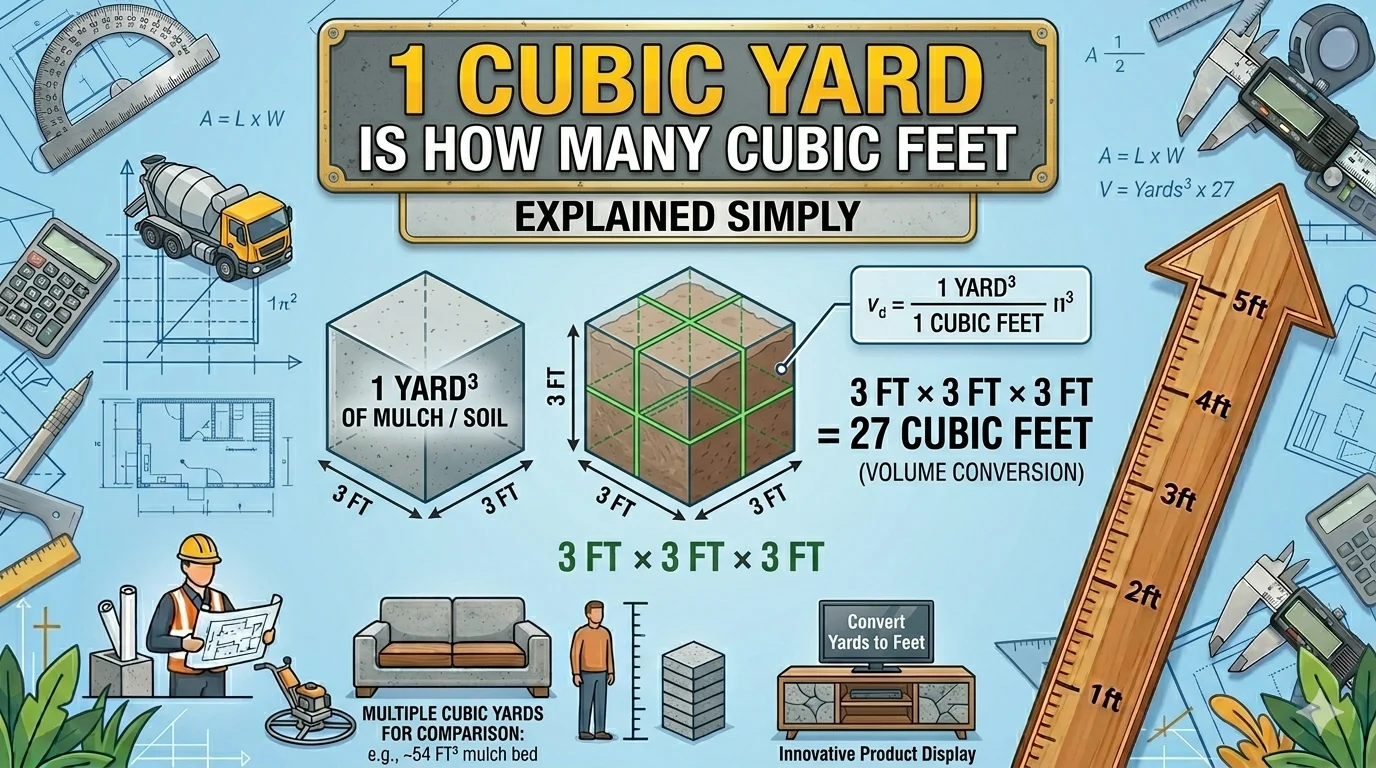
Since 1 yard equals 3 feet, a cubic yard represents a cube that is:
- 3 feet × 3 feet × 3 feet
This makes it a large unit of measurement, especially useful when dealing with bulk materials like soil, gravel, or concrete.
What is a cubic foot?
A cubic foot is a smaller unit of volume. It measures a space that is:
- 1 foot long
- 1 foot wide
- 1 foot high
Cubic feet are commonly used for smaller-scale measurements such as room sizes, storage capacity, and packaging volume.
1 Cubic Yard is How Many Cubic Feet?
The exact answer
The direct answer to the question 1 cubic yard is how many cubic feet is:
1 cubic yard = 27 cubic feet
This is a fixed and universal conversion used in mathematics, engineering, and construction.
Why 1 cubic yard equals 27 cubic feet
To understand this clearly, let’s break it down step by step.
We know:
- 1 yard = 3 feet
So,
- 1 cubic yard = 3 feet × 3 feet × 3 feet
Now multiply:
- 3 × 3 × 3 = 27
So,
1 cubic yard = 27 cubic feet
This is why whenever you convert cubic yards into cubic feet, you always multiply by 27.
Step-by-Step Conversion Method
Understanding the formula is helpful, but knowing how to apply it is even more important.
Method 1: Cubic yard to cubic feet
To convert cubic yards into cubic feet:
- Take the number of cubic yards
- Multiply by 27
- The result is cubic feet
Example
If you have 4 cubic yards of material:
4 × 27 = 108 cubic feet
So, 4 cubic yards equals 108 cubic feet.
Method 2: Cubic feet to cubic yards
To convert the other way around:
- Take cubic feet
- Divide by 27
- The result is cubic yards
Example
If you have 81 cubic feet:
81 ÷ 27 = 3 cubic yards
Real-Life Applications of Cubic Yard Conversion
This conversion is not just theoretical. It is widely used in practical fields.
1. Concrete measurement in construction
Concrete is usually ordered in cubic yards, especially for large construction projects like slabs, foundations, and roads.
For example:
If a project needs 12 cubic yards of concrete:
12 × 27 = 324 cubic feet
This helps contractors estimate how much material is needed before pouring.
Incorrect calculation can result in delays or weak structural work.
2. Soil and excavation work
In excavation projects, soil is measured in cubic yards because of the large quantities involved.
For example:
A foundation requires 6 cubic yards of soil removal:
6 × 27 = 162 cubic feet
This makes it easier to estimate digging and transport requirements.
3. Landscaping projects
Landscapers often deal with mulch, gravel, and sand in cubic yards.
For example:
A garden bed needs 3 cubic yards of mulch:
3 × 27 = 81 cubic feet
This ensures proper coverage without overbuying materials.
4. Waste removal and dumpsters
Dumpster sizes are often given in cubic yards. Knowing the conversion helps estimate capacity.
For example:
A 10 cubic yard dumpster equals:
10 × 27 = 270 cubic feet of waste space
Cubic Yard vs Cubic Feet Comparison Table
Here is a simple comparison to make conversions easier:
| Cubic Yards | Cubic Feet |
|---|---|
| 1 | 27 |
| 2 | 54 |
| 3 | 81 |
| 5 | 135 |
| 10 | 270 |
| 20 | 540 |
This table helps you quickly estimate values without recalculating every time.
Common Mistakes in Conversion
Many people make errors when dealing with cubic measurements. Here are the most common mistakes:
1. Confusing linear and cubic units
Some people confuse feet (length) with cubic feet (volume). These are completely different measurements.
2. Forgetting to cube the conversion
Since 1 yard = 3 feet, some people only multiply by 3 instead of cubing it. The correct operation is:
3 × 3 × 3 = 27
3. Using incorrect formulas
Another common mistake is mixing formulas for area and volume. Remember:
- Area = length × width
- Volume = length × width × height
4. Not checking unit consistency
Always ensure that all measurements are in the same unit system before calculating.
Expert Tips for Easy Conversion
Here are some simple tricks to make conversions faster:
- Always remember: 1 cubic yard = 27 cubic feet
- Use multiplication instead of repeated addition
- Break large numbers into smaller parts
- Double-check calculations for construction work
- Keep a reference table handy for quick estimation
These small habits can save time and prevent costly mistakes.
Why This Conversion is Important in Real Life
Understanding 1 cubic yard is how many cubic feet is important for many reasons:
1. Accurate material estimation
You avoid ordering too much or too little material.
2. Cost savings
Correct calculations reduce waste and unnecessary expenses.
3. Better project planning
Construction timelines depend on accurate material estimates.
4. Improved efficiency
Workers can complete projects faster with proper planning.
5. Professional accuracy
Engineers and contractors rely on precise measurements for safe structures.
Practical Example Scenario
Let’s take a real-world example:
A contractor is building a driveway that requires 8 cubic yards of concrete.
Step 1: Convert to cubic feet
8 × 27 = 216 cubic feet
Step 2: Understand requirement
The contractor now knows exactly how much space the concrete will fill.
This ensures proper ordering and avoids delays during construction.
Simple Memory Trick
If you ever forget the conversion, remember this:
- 1 yard = 3 feet
- So volume = 3 × 3 × 3
That equals:
27 cubic feet
This simple cube logic helps you never forget the answer to 1 cubic yard is how many cubic feet.
Frequently Asked Questions
1. What is 1 cubic yard in cubic feet?
1 cubic yard equals 27 cubic feet.
2. How do you convert cubic yards to cubic feet?
Multiply cubic yards by 27 to get cubic feet.
3. Why is 1 cubic yard equal to 27 cubic feet?
Because 1 yard equals 3 feet, and volume requires cubing: 3 × 3 × 3 = 27.
4. Where is cubic yard used most?
It is widely used in construction, landscaping, excavation, and waste management.
5. Is a cubic yard bigger than a cubic foot?
Yes, a cubic yard is much larger. It equals 27 cubic feet.
Conclusion
The answer to 1 cubic yard is how many cubic feet is simple and fixed: 27 cubic feet. This conversion plays a major role in construction, landscaping, engineering, and many real-world applications.
Once you understand the logic behind it—3 feet × 3 feet × 3 feet—it becomes easy to remember and apply in any situation.
Whether you are calculating concrete for a slab, soil for a garden, or gravel for a driveway, this conversion helps you plan accurately, reduce waste, and save money.
Mastering this basic unit conversion is a small step that makes a big difference in real-world projects.