

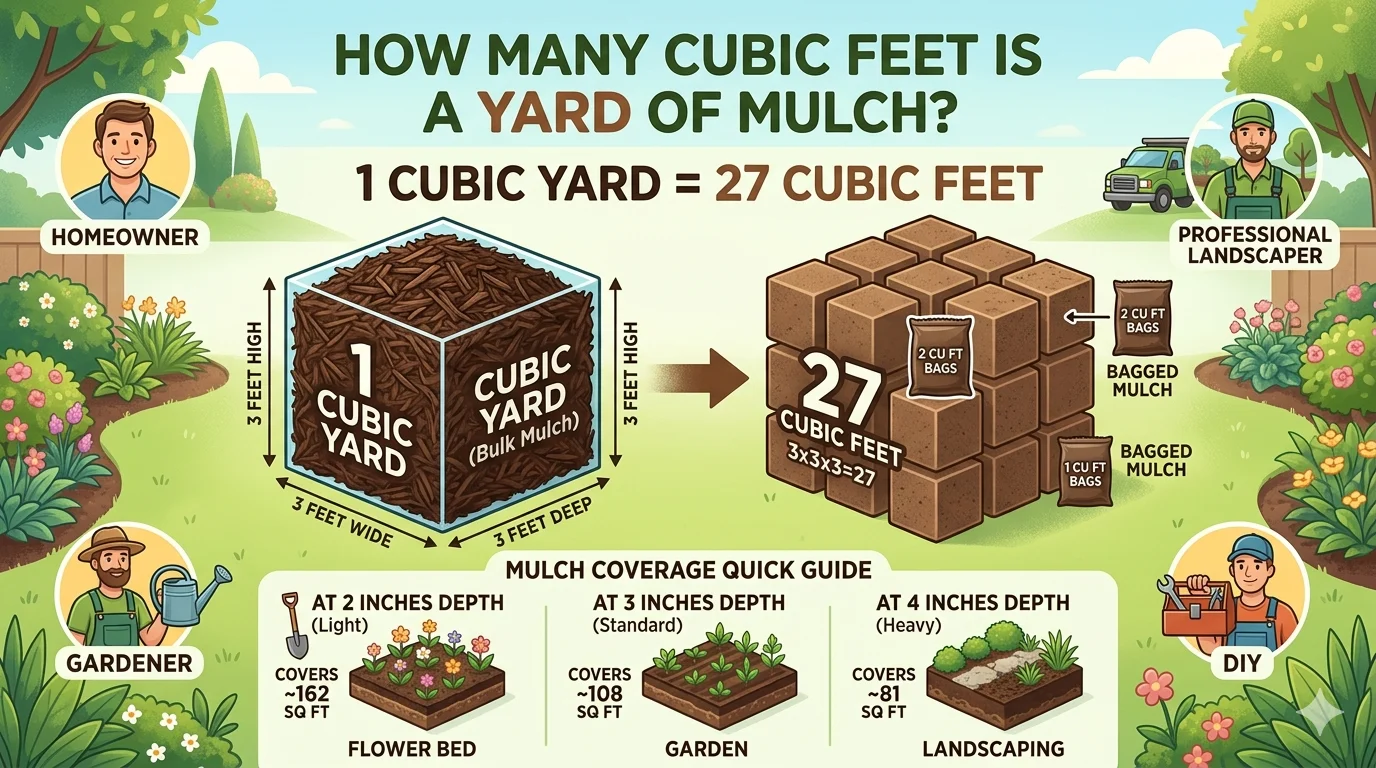
If you are planning a landscaping or gardening project, one of the most common questions you will face is how many cubic feet is a yard of mulch. Getting this right is important because it directly affects how much mulch you need, how much you spend, and how well your garden will look after installation.
Mulch is usually sold in cubic yards in bulk, but many homeowners are more familiar with cubic feet, especially when buying bagged mulch. Understanding the conversion between these two units helps you avoid overbuying or running short during your project.
Quick Answer: Cubic Feet in a Yard of Mulch
One cubic yard of mulch equals 27 cubic feet.
This is a standard measurement used in landscaping, construction, and gardening. No matter what type of mulch you use—wood chips, bark mulch, or rubber mulch—the volume conversion stays the same.
Understanding Cubic Yards and Cubic Feet
To fully understand the question how many cubic feet is a yard of mulch, you need to understand both units.
What Is a Cubic Yard?
A cubic yard is a large volume measurement used in landscaping. It represents a space that is:
- 3 feet long
- 3 feet wide
- 3 feet high
When multiplied together: 3 × 3 × 3 = 27 cubic feet
So, a cubic yard is simply a big cube made of smaller cubic feet units.
What Is a Cubic Foot?
A cubic foot is a smaller volume measurement used for everyday materials like bagged mulch. It represents:
- 1 foot × 1 foot × 1 foot
This is why mulch bags are often labeled in cubic feet such as 1.5 cu ft or 2 cu ft.
Why Mulch Is Sold in Cubic Yards
Mulch suppliers sell in cubic yards because it is more practical for large landscaping work.
Benefits include:
- Easier bulk transportation
- Lower cost per volume
- Less packaging waste
- Better for large garden and lawn projects
On the other hand, small home projects often use bagged mulch measured in cubic feet.
Conversion Formula: Cubic Yards to Cubic Feet
The formula is simple:
Cubic yards × 27 = Cubic feet
Examples:
- 1 cubic yard = 27 cubic feet
- 2 cubic yards = 54 cubic feet
- 3 cubic yards = 81 cubic feet
- 5 cubic yards = 135 cubic feet
This makes it easy to scale your mulch requirement based on project si
LlHow Much Area Does 1 Cubic Yard of Mulch Cover?
Although we know how many cubic feet is a yard of mulch, coverage depends on depth. Mulch is usually spread in layers, not solid blocks.
At 2 Inches Depth
- Covers about 162 square feet
At 3 Inches Depth (Most Common)
- Covers about 108 square feet
At 4 Inches Depth
- Covers about 81 square feet
Thicker layers provide better weed control and moisture retention but cover less area.
Mulch Coverage Chart
| Depth (inches) | Coverage (sq ft per cubic yard) |
| 1 inch | 324 sq ft |
| 2 inches | 162 sq ft |
| 3 inches | 108 sq ft |
| 4 inches | 81 sq ft |
This chart helps you quickly estimate how much mulch you need.
Real-Life Example Calculations
Example 1: Small Garden Bed
- Area: 10 ft × 10 ft = 100 sq ft
- Depth: 3 inches
You will need about 1 cubic yard of mulch
Example 2: Medium Yard Area
- Area: 200 sq ft
- Depth: 2 inches
You will need around 1.25 cubic yards
Example 3: Large Landscaping Area
- Area: 500 sq ft
- Depth: 3 inches
You will need approximately 4.5 cubic yards
Step-by-Step: How to Calculate Mulch Needed
Step 1: Measure Your Area
Multiply length × width to get square feet.
Example: 12 ft × 15 ft = 180 sq ft
Step 2: Decide Mulch Depth
Common depths:
- 2 inches (light coverage)
- 3 inches (standard landscaping)
- 4 inches (heavy weed protection)LlLl
Step 3: Convert to Cubic Yards
Use this formula:
(Square feet × depth in inches) ÷ 324 = cubic yards
Example: (180 × 3) ÷ 324 = 1.67 cubic yards
Bagged Mulch vs Bulk Mulch
| Type | Measurement | Best For |
| Bagged mulch | Cubic feet | Small home gardens |
| Bulk mulch | Cubic yards | Large landscaping |
Important Tip:
1 cubic yard = about 13.5 bags (2 cubic feet each)
Common Mistakes People Make
When figuring out how many cubic feet is a yard of mulch, people often make mistakes such as:
- Confusing square feet with cubic feet
- Not measuring depth correctly
- Buying exact quantity without extra buffer
- Ignoring compaction of mulch over time
- Using incorrect conversion formulas
Avoiding these mistakes helps save money and prevents shortages.
Expert Tips for Better Mulching
- Always round up your calculation
- Add 10% extra mulch for settling
- Use 3 inches for best balance of coverage and protection
- Apply mulch evenly for a clean look
- Refresh mulch every 1–2 years for best results
Why This Conversion Matters
Understanding how many cubic feet is a yard of mulch is not just about math. It directly impacts:
- Cost of your landscaping project
- Quality of soil protection
- Moisture retention in plants
- Weed control effectiveness
- Overall garden appearance
Correct measurement ensures professional-level results even for DIY projects.
Conclusion
So, how many cubic feet is a yard of mulch?
The clear answer is 27 cubic feet.
Knowing this simple conversion helps you plan your landscaping projects more accurately, avoid waste, and buy the right amount of mulch every time. Whether you are working on a small garden bed or a large outdoor area, this measurement is the foundation of smart landscaping planning.
FAQs
1. How many cubic feet are in 1 yard of mulch?
There are 27 cubic feet in 1 cubic yard of mulch.
2. How many bags of mulch equal 1 cubic yard?
Around 13 to 14 bags of 2 cubic feet mulch equal 1 cubic yard.
3. How much area does 1 yard of mulch cover?
It covers about 108–162 square feet, depending on depth.
4. What is the best depth for mulch?
Most experts recommend 2 to 3 inches for optimal results.
L
5. Is cubic yard the same for all mulch types?
Yes, the volume stays the same regardless of mulch type.
2