
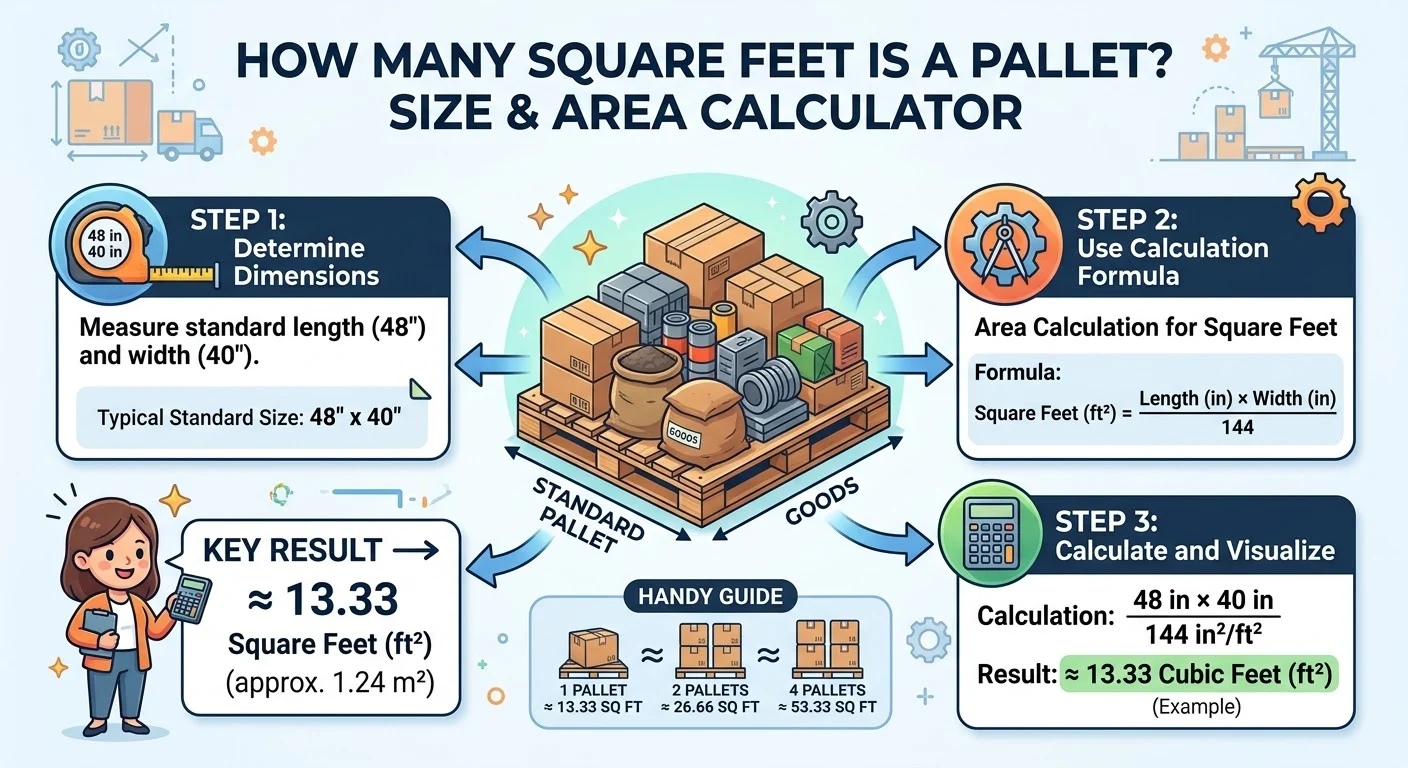
If you’ve ever asked how many square feet is a pallet, the answer depends on the pallet’s dimensions. The most common standard pallet in North America measures 48 inches × 40 inches, which covers 13.33 square feet of floor space.
Understanding pallet size is useful for warehouse planning, freight shipping, storage calculations, flooring estimates, and logistics management. In this guide, you’ll learn how to calculate pallet square footage, compare standard pallet sizes, and use practical examples for real-world applications.
What Is a Pallet?
A pallet is a flat platform designed to support goods during storage, handling, and transportation. Forklifts and pallet jacks lift pallets to move products efficiently throughout warehouses and shipping facilities.
Pallets are made from:
- Wood
- Plastic
- Metal
- Composite materials
While pallet dimensions vary by country and industry, the standard 48 × 40-inch pallet is the most widely used.
How Many Square Feet Is a Pallet?
The square footage of a pallet depends on its length and width.
Formula
Square Feet = (Length in Inches × Width in Inches) ÷ 144
There are 144 square inches in one square foot, so dividing by 144 converts square inches into square feet.
Standard 48 × 40 Pallet
Length = 48 inches
Width = 40 inches
Area = 48 × 40 = 1,920 square inches
1,920 ÷ 144 = 13.33 square feet
Answer: A standard 48 × 40 pallet covers approximately 13.33 square feet.
Common Pallet Sizes and Square Feet
| Pallet Size | Square Inches | Square Feet |
|---|---|---|
| 48 × 40 inches | 1,920 | 13.33 sq ft |
| 42 × 42 inches | 1,764 | 12.25 sq ft |
| 48 × 48 inches | 2,304 | 16 sq ft |
| 36 × 36 inches | 1,296 | 9 sq ft |
| 48 × 45 inches | 2,160 | 15 sq ft |
| 60 × 48 inches | 2,880 | 20 sq ft |
This chart makes it easy to estimate storage requirements for different pallet types.
Why Knowing Pallet Square Footage Matters
Understanding pallet area helps in many situations.
Warehouse Planning
Warehouse managers need accurate pallet dimensions to:
- Maximize storage space
- Plan rack layouts
- Improve workflow
- Reduce unused floor space
Shipping Estimates
Freight companies often calculate rates based on:
- Floor space
- Weight
- Dimensions
- Freight class
Knowing pallet size helps estimate shipping capacity.
Retail Storage
Retail businesses use pallets to organize inventory while maintaining efficient aisle spacing.
Construction Projects
Construction suppliers frequently deliver materials on pallets. Knowing pallet size helps determine:
- Delivery space
- Storage area
- Site organization
How to Calculate Square Feet for Any Pallet
Follow these simple steps.
Step 1: Measure Length
Measure the pallet from one end to the other in inches.
Example:
48 inches
Step 2: Measure Width
Measure across the pallet.
Example:
40 inches
Step 3: Multiply
48 × 40 = 1,920 square inches
Step 4: Divide by 144
1,920 ÷ 144 = 13.33 square feet
That’s the pallet’s floor area.
Example Calculations
Example 1
Pallet Size:
48 × 48 inches
Area:
48 × 48 = 2,304 square inches
2,304 ÷ 144 = 16 square feet
Example 2
Pallet Size:
36 × 36 inches
36 × 36 = 1,296
1,296 ÷ 144 = 9 square feet
Example 3
Pallet Size:
60 × 48 inches
60 × 48 = 2,880
2,880 ÷ 144 = 20 square feet
Square Feet vs Cubic Feet
Many people confuse square feet with cubic feet.
| Square Feet | Cubic Feet |
|---|---|
| Measures area | Measures volume |
| Uses length × width | Uses length × width × height |
| Used for floor space | Used for storage volume |
| Two-dimensional | Three-dimensional |
For example:
A pallet measuring 48 × 40 inches covers 13.33 square feet.
If stacked 60 inches high, its volume becomes:
48 × 40 × 60 = 115,200 cubic inches
115,200 ÷ 1,728 = 66.67 cubic feet
Standard Pallet Dimensions Around the World
Different regions use different pallet sizes.
| Region | Typical Pallet Size | Square Feet |
|---|---|---|
| North America | 48 × 40 inches | 13.33 sq ft |
| Europe | 47.24 × 31.5 inches | 10.33 sq ft |
| Australia | 45.9 × 45.9 inches | 14.63 sq ft |
| Asia | Varies | Varies |
Always verify pallet dimensions before calculating storage needs.
How Many Pallets Fit in a Space?
You can estimate pallet capacity by dividing available floor space by pallet size.
Example:
Warehouse floor:
1,000 square feet
Standard pallet:
13.33 square feet
1,000 ÷ 13.33 ≈ 75 pallets
In practice, you’ll fit fewer pallets because you need room for:
- Walking aisles
- Forklifts
- Safety clearance
- Loading areas
Pallet Sizes by Industry
Different industries use specialized pallet sizes.
Grocery
Usually 48 × 40 inches.
Beverage
Often 48 × 40 or 48 × 48 inches.
Automotive
May use oversized pallets for large parts.
Chemical Industry
Heavy-duty plastic or metal pallets are common.
Pharmaceutical
Clean plastic pallets are frequently used to meet hygiene standards.
Practical Uses of Pallet Area Calculations
Knowing pallet square footage helps with:
- Warehouse design
- Shipping estimates
- Inventory planning
- Truck loading
- Container optimization
- Retail stock organization
- Manufacturing logistics
Expert Tips
- Always measure the actual pallet before calculating.
- Include product overhang if goods extend beyond the pallet.
- Leave aisle space when planning warehouse layouts.
- Use metric-to-imperial conversions carefully.
- Round measurements only after completing calculations.
Common Mistakes
Forgetting to Convert Inches
Never multiply inches and call the result square feet.
Always divide by 144.
Confusing Area with Volume
Square feet measure floor area.
Cubic feet measure storage volume.
Ignoring Pallet Variations
Not every pallet is 48 × 40 inches.
Measure first.
Excluding Product Dimensions
Large products may extend beyond pallet edges, increasing the actual space needed.
Quick Reference Chart
| Pallet Dimensions | Square Feet |
|---|---|
| 48 × 40 | 13.33 |
| 48 × 48 | 16 |
| 42 × 42 | 12.25 |
| 36 × 36 | 9 |
| 48 × 45 | 15 |
| 60 × 48 | 20 |
Keep this chart handy for quick warehouse or shipping calculations.
Frequently Asked Questions
How many square feet is a standard pallet?
A standard 48 × 40-inch pallet covers 13.33 square feet.
How do I calculate square feet for a pallet?
Multiply the pallet’s length by its width in inches, then divide by 144.
Is every pallet 13.33 square feet?
No. Only the common 48 × 40-inch pallet measures 13.33 square feet. Other pallet sizes have different areas.
Why is pallet square footage important?
It helps with warehouse planning, shipping estimates, inventory storage, truck loading, and space optimization.
Can I calculate pallet area using centimeters?
Yes. First calculate the area in square centimeters, then convert to square feet, or convert the measurements to inches before using the standard formula.
Conclusion
Knowing how many square feet is a pallet makes it easier to plan storage, estimate shipping capacity, organize warehouses, and calculate floor space accurately. The standard 48 × 40-inch pallet covers 13.33 square feet, but pallet sizes vary by industry and region. By measuring the pallet’s length and width and dividing the total square inches by 144, you can quickly determine the square footage of any pallet. Whether you’re managing inventory, loading freight, or organizing a workspace, this simple calculation helps you make better use of available space.