

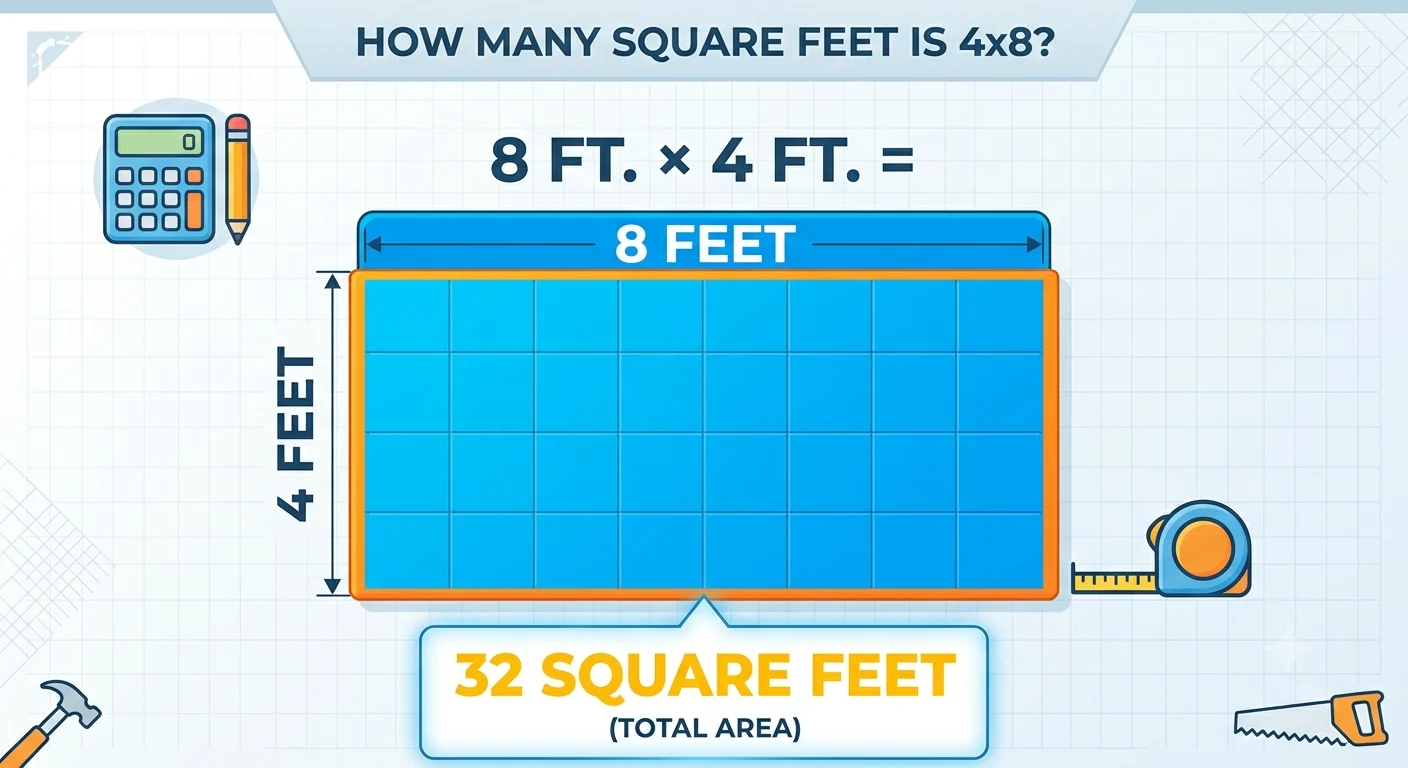
When working on home improvement projects, construction, woodworking, flooring, or DIY tasks, one common question is: how many square feet is 4×8? A 4×8 measurement refers to an area that is 4 feet wide and 8 feet long. To find the total square footage, you simply multiply the length by the width.
A 4×8 area equals 32 square feet.
Understanding this calculation is useful when buying plywood sheets, drywall panels, flooring materials, tiles, insulation, or planning a small building project. Knowing how to calculate square feet helps prevent buying too much or too little material and makes project budgeting easier.
In this guide, you will learn exactly how many square feet a 4×8 area covers, how the calculation works, practical examples, common uses, material estimates, and expert tips for measuring areas correctly.
How Many Square Feet Is 4×8?
A 4×8 area is 32 square feet.
The calculation is simple:
Square feet = Length × Width
For a 4×8 measurement:
4 feet × 8 feet = 32 square feet
This means a sheet or surface that measures 4 feet by 8 feet covers a total area of 32 square feet.
For example, a standard sheet of plywood is often sold in a 4×8 size. When you purchase one sheet, you are buying enough material to cover approximately 32 square feet of surface area.
Understanding the 4×8 Measurement
The numbers in a 4×8 measurement represent two dimensions:
- 4 feet = width
- 8 feet = length
When these measurements are multiplied together, they create a two-dimensional area.
Unlike linear measurements, which measure only distance, square feet measure the total surface space. This difference is important because covering a floor, wall, or ceiling requires calculating area rather than just length.
For example:
- A 4-foot-long board is a linear measurement.
- A 4-foot by 8-foot plywood sheet is an area measurement.
- The total area is 32 square feet.
4×8 Square Feet Calculation Formula
The formula for calculating square footage is:
Square Footage = Length (feet) × Width (feet)
For a 4×8 space:
| Measurement | Value |
|---|---|
| Length | 8 feet |
| Width | 4 feet |
| Calculation | 8 × 4 |
| Total Area | 32 square feet |
This same formula works for any rectangular space.
Examples:
- 5×10 feet = 50 square feet
- 6×12 feet = 72 square feet
- 10×10 feet = 100 square feet
- 12×20 feet = 240 square feet
Common Uses of a 4×8 Area
A 4×8 size is one of the most common dimensions used in construction and home projects. Many building materials are manufactured in this size because it is easy to transport, cut, and install.
Common uses include:
Plywood Sheets
The most familiar example of a 4×8 measurement is plywood. Standard plywood sheets are usually:
- 4 feet wide
- 8 feet long
- 32 square feet in total area
Builders use plywood for:
- Flooring
- Roofing
- Wall sheathing
- Cabinets
- Furniture
- Shelving
Drywall Panels
Many drywall sheets also come in 4×8 sizes. A single drywall panel can cover:
32 square feet of wall or ceiling area
However, installers usually need multiple sheets because walls and ceilings are much larger.
Flooring Projects
If you are installing flooring, a 4×8 area helps estimate material needs.
For example:
A small room measuring 8 feet by 12 feet:
8 × 12 = 96 square feet
Since each 4×8 sheet covers 32 square feet:
96 ÷ 32 = 3 sheets
You would need approximately three 4×8 sheets to cover the area, depending on waste and cutting requirements.
How to Calculate How Many 4×8 Sheets You Need
Knowing that one 4×8 sheet equals 32 square feet allows you to estimate material requirements.
The formula is:
Number of sheets needed = Total square feet ÷ 32
Example:
You need to cover a wall measuring 10 feet by 16 feet.
First calculate the wall area:
10 × 16 = 160 square feet
Then divide by the coverage of one 4×8 sheet:
160 ÷ 32 = 5 sheets
You would need at least 5 sheets.
However, experts usually recommend adding extra material because of:
- Cutting waste
- Mistakes
- Damaged pieces
- Irregular measurements
A good rule is to buy around 10% extra material.
4×8 Square Feet Comparison Chart
| Size | Square Feet |
|---|---|
| 2×4 | 8 sq ft |
| 3×6 | 18 sq ft |
| 4×8 | 32 sq ft |
| 5×10 | 50 sq ft |
| 8×8 | 64 sq ft |
| 10×10 | 100 sq ft |
This comparison helps you quickly understand how different rectangular measurements convert into square feet.
Real-Life Examples of a 4×8 Area
A 32-square-foot area can represent many practical spaces.
Example 1: Small Floor Section
Imagine a small storage area:
- Width: 4 feet
- Length: 8 feet
Calculation:
4 × 8 = 32 square feet
The area is large enough for:
- Shelving
- Storage boxes
- Small equipment
Example 2: Garden Bed
A raised garden bed measuring 4 feet by 8 feet covers:
32 square feet
This is a popular garden size because it provides enough growing space while remaining easy to maintain.
Example 3: Wall Coverage
A wall section that is 4 feet high and 8 feet wide has:
4 × 8 = 32 square feet
This measurement is useful when estimating paint, wallpaper, insulation, or paneling.
How Many Square Feet Does a 4×8 Sheet Cover?
A standard 4×8 sheet covers exactly:
32 square feet
However, actual coverage may be slightly lower depending on installation.
For example:
- Flooring may require cutting around corners.
- Drywall may need openings for windows and doors.
- Plywood may need trimming.
Because of this, contractors usually include additional material when purchasing supplies.
Difference Between Square Feet and Linear Feet
Many people confuse square feet with linear feet.
The difference is:
Linear feet measure length only.
Example:
A board that is 8 feet long has:
8 linear feet
Square feet measure area.
Example:
A 4-foot by 8-foot sheet has:
4 × 8 = 32 square feet
If you are buying materials like carpet, flooring, paint, or panels, knowing whether the measurement is linear feet or square feet is important.
How Much Material Covers 32 Square Feet?
Since a 4×8 area equals 32 square feet, you can estimate different materials needed.
Paint
Paint coverage depends on the product, but many gallons cover around 350–400 square feet for one coat.
A 32-square-foot wall section requires only a small amount of paint.
Flooring
If your flooring covers 20 square feet per box:
32 ÷ 20 = 1.6 boxes
You would need 2 boxes.
Tiles
If tiles cover 10 square feet per box:
32 ÷ 10 = 3.2 boxes
You would need about 4 boxes.
Always check manufacturer coverage because package sizes vary.
Common Mistakes When Calculating 4×8 Square Feet
Although the calculation is simple, mistakes can happen.
Mistake 1: Adding Measurements Instead of Multiplying
Some people calculate:
4 + 8 = 12
This is incorrect.
Square feet require multiplication:
4 × 8 = 32
Mistake 2: Mixing Feet and Inches
Measurements must use the same unit.
For example:
4 feet × 8 feet works correctly.
But:
4 feet × 8 inches requires converting inches into feet first.
Mistake 3: Forgetting Extra Material
Buying exactly 32 square feet of material may not be enough because of:
- Cuts
- Errors
- Waste
Always consider adding extra material.
Mistake 4: Confusing Area With Perimeter
A 4×8 rectangle has:
- Area: 32 square feet
- Perimeter: 24 feet
The area tells you how much surface it covers. The perimeter tells you the distance around the edges.
Expert Tips for Measuring Square Feet Accurately
Follow these tips for accurate calculations:
- Measure every side carefully.
- Write measurements down before calculating.
- Convert all measurements into feet.
- Multiply length by width.
- Add 10% extra material for most projects.
- Double-check unusual shapes by dividing them into smaller rectangles.
For large construction projects, accurate measurements can save hundreds of dollars in material costs.
Why Knowing Square Footage Matters
Understanding how to calculate square feet helps with:
- Home renovations
- Construction planning
- Flooring installation
- Painting projects
- Landscaping
- Material budgeting
- Real estate measurements
Whether you are a homeowner, contractor, or DIY enthusiast, knowing that a 4×8 area equals 32 square feet makes planning easier.
Frequently Asked Questions
1. How many square feet is a 4×8 sheet?
A 4×8 sheet covers 32 square feet because 4 feet multiplied by 8 feet equals 32 square feet.
2. Is a 4×8 sheet the same as 32 square feet?
Yes. A standard 4×8 sheet has an area of 32 square feet.
3. How many 4×8 sheets do I need for 100 square feet?
Divide the total area by 32:
100 ÷ 32 = 3.125
You would need approximately 4 sheets to cover 100 square feet.
4. How do you calculate square feet from dimensions?
Multiply the length by the width:
Length × Width = Square Feet
For example:
4 feet × 8 feet = 32 square feet.
5. Why are plywood sheets usually 4×8 feet?
The 4×8 size is popular because it matches common construction layouts, is easy to transport, and minimizes waste during installation.
Conclusion
Knowing how many square feet is 4×8 is essential for many home improvement, construction, and DIY projects. A 4-foot by 8-foot area equals 32 square feet, calculated by multiplying length by width.
This simple formula helps you estimate materials, plan projects, compare costs, and avoid purchasing mistakes. Whether you are installing flooring, buying plywood, covering walls, or designing a small space, understanding square footage makes every project easier.
Remember the basic rule:
Length × Width = Square Feet
For a 4×8 area:
4 × 8 = 32 square feet.