

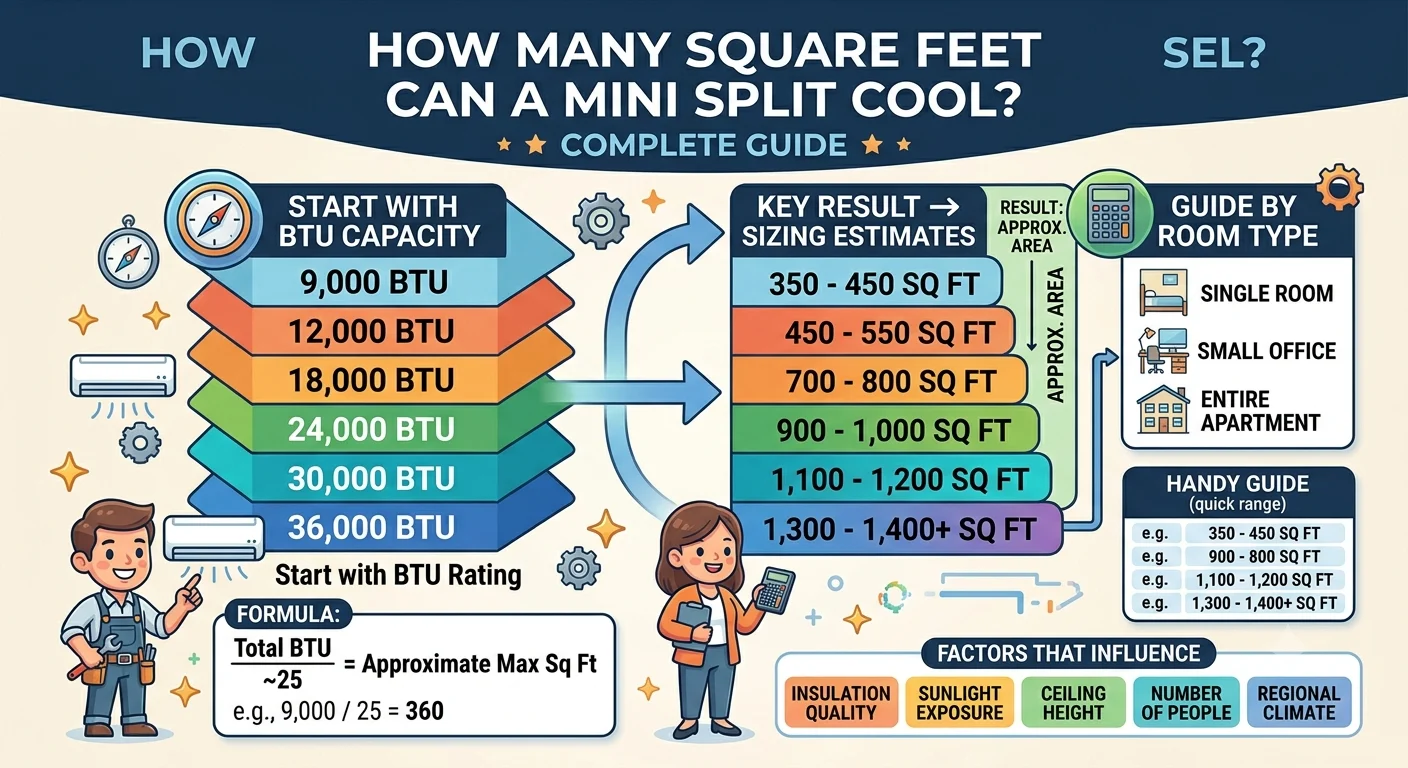
Choosing the right mini split system starts with one important question: how many square feet can a mini split cool? The answer depends mainly on the system’s BTU (British Thermal Unit) rating, but other factors like insulation, ceiling height, climate, window size, and sun exposure also play a significant role.
A properly sized mini split keeps your home comfortable, uses less electricity, and lasts longer. A system that is too small will struggle to cool the room, while an oversized unit may cycle on and off too frequently, reducing efficiency and humidity control.
This guide explains how mini split sizing works, provides easy-to-follow BTU charts, discusses the factors that affect cooling coverage, and helps you choose the right unit for your home.
Understanding Mini Split Cooling Capacity
A mini split, also called a ductless mini split, is a heating and cooling system consisting of an outdoor compressor and one or more indoor air handlers. Unlike central air conditioning, it doesn’t require ductwork, making it an excellent choice for homes, apartments, garages, additions, and offices.
Cooling capacity is measured in BTUs. The higher the BTU rating, the larger the area the mini split can cool under normal conditions.
Although square footage is the starting point, professional HVAC contractors also consider room layout, insulation quality, climate, ceiling height, and heat sources before recommending the proper size.
How Many Square Feet Can a Mini Split Cool?
The table below provides a general guideline for matching mini split capacity to room size.
| Mini Split Size | Recommended Coverage |
|---|---|
| 6,000 BTU | Up to 250 sq ft |
| 9,000 BTU | 250–400 sq ft |
| 12,000 BTU | 400–550 sq ft |
| 18,000 BTU | 550–900 sq ft |
| 24,000 BTU | 900–1,200 sq ft |
| 30,000 BTU | 1,200–1,500 sq ft |
| 36,000 BTU | 1,500–2,000 sq ft |
These are general recommendations. Actual cooling coverage varies depending on several environmental and building-related factors.
Mini Split Sizing Chart by Room Size
Here’s another quick reference based on room area.
| Room Size | Recommended BTU |
|---|---|
| 150 sq ft | 6,000 BTU |
| 250 sq ft | 6,000–9,000 BTU |
| 350 sq ft | 9,000 BTU |
| 500 sq ft | 12,000 BTU |
| 700 sq ft | 18,000 BTU |
| 1,000 sq ft | 24,000 BTU |
| 1,400 sq ft | 30,000 BTU |
| 1,800 sq ft | 36,000 BTU |
These recommendations assume standard 8-foot ceilings and average insulation.
Factors That Affect How Many Square Feet a Mini Split Can Cool
Ceiling Height
Rooms with ceilings higher than eight feet contain more air volume, requiring additional cooling capacity.
Climate
Homes in hot and humid regions typically need more BTUs than homes located in cooler climates.
Insulation
Well-insulated homes hold cool air longer, allowing the mini split to operate more efficiently.
Older homes with poor insulation may require a larger system.
Sun Exposure
Rooms with large windows that receive direct afternoon sunlight become significantly warmer and often need additional cooling capacity.
Number of Occupants
People generate heat. Bedrooms, living rooms, and entertainment areas with multiple occupants usually require more BTUs.
Heat-Producing Appliances
Kitchens, laundry rooms, home offices, and workshops contain appliances that generate extra heat, increasing cooling requirements.
Common Mini Split Sizes Explained
6,000 BTU Mini Split
Ideal for:
- Small bedrooms
- Home offices
- Guest rooms
- Small studios
Coverage: Up to approximately 250 square feet.
9,000 BTU Mini Split
Ideal for:
- Medium bedrooms
- Small living rooms
- Apartments
Coverage: Approximately 250–400 square feet.
12,000 BTU Mini Split
Ideal for:
- Large bedrooms
- Living rooms
- Small apartments
Coverage: Approximately 400–550 square feet.
18,000 BTU Mini Split
Ideal for:
- Family rooms
- Large garages
- Finished basements
Coverage: Approximately 550–900 square feet.
24,000 BTU Mini Split
Ideal for:
- Large open-concept spaces
- Small homes
- Retail spaces
Coverage: Approximately 900–1,200 square feet.
30,000 to 36,000 BTU Mini Splits
These larger systems are designed for:
- Large homes
- Open floor plans
- Commercial offices
- Restaurants
- Large workshops
Coverage ranges from approximately 1,200 to 2,000 square feet.
How to Calculate the Right Mini Split Size
Choosing the right mini split is easier than many people think.
Step 1: Measure the Room
Multiply the room length by its width.
Example:
20 feet × 25 feet = 500 square feet
Step 2: Match the Square Footage
According to the sizing chart, a 500-square-foot room generally requires about a 12,000 BTU mini split.
Step 3: Adjust for Special Conditions
Increase BTUs if:
- The room has large windows.
- The room faces west or south.
- The ceiling exceeds eight feet.
- Several people regularly occupy the space.
- The room contains many electronics.
Decrease BTUs slightly if:
- The room is heavily shaded.
- The insulation is excellent.
- Energy-efficient windows are installed.
Real-World Examples
Example 1: Bedroom
Room size: 180 square feet
Average insulation with one window.
Recommended mini split: 6,000 BTU
Example 2: Living Room
Room size: 520 square feet
Large windows with afternoon sun.
Recommended mini split: 12,000–18,000 BTU
Example 3: Home Office
Room size: 300 square feet
Computer equipment and moderate sunlight.
Recommended mini split: 9,000 BTU
Example 4: Garage Workshop
Room size: 650 square feet
Minimal insulation and power tools.
Recommended mini split: 18,000 BTU
Benefits of Choosing the Correct Mini Split Size
Proper sizing offers several advantages.
- Better indoor comfort
- Lower electricity bills
- Consistent room temperatures
- Improved humidity control
- Longer equipment lifespan
- Quieter operation
- Reduced maintenance costs
What Happens If the Mini Split Is Too Small?
An undersized unit struggles to keep the room cool.
Problems include:
- Constant operation
- Higher energy bills
- Uneven cooling
- Faster wear and tear
- Shortened equipment life
The unit works harder but never reaches the desired temperature during very hot weather.
What Happens If the Mini Split Is Too Large?
Many homeowners believe bigger is better, but that’s not true.
Oversized mini splits often experience:
- Short cycling
- Poor humidity removal
- Uneven temperatures
- Increased equipment wear
- Higher installation costs
Because the system cools the room too quickly, it doesn’t run long enough to remove moisture effectively.
Comparison of Mini Split Sizing
| Feature | Too Small | Correct Size | Too Large |
|---|---|---|---|
| Comfort | Poor | Excellent | Uneven |
| Energy Efficiency | Low | High | Moderate |
| Humidity Control | Fair | Excellent | Poor |
| Equipment Life | Short | Long | Moderate |
| Operating Cost | High | Low | Moderate |
Expert Tips for Choosing a Mini Split
To get the best performance from your system:
- Measure rooms carefully.
- Consider your local climate.
- Evaluate insulation quality.
- Account for ceiling height.
- Don’t ignore large windows.
- Choose an inverter mini split for better efficiency.
- Have an HVAC professional perform a Manual J load calculation for maximum accuracy.
Common Mini Split Sizing Mistakes
Avoid these common errors.
- Buying based only on price
- Ignoring insulation quality
- Forgetting ceiling height
- Oversizing the system
- Ignoring sunlight exposure
- Cooling multiple closed rooms with one indoor unit
- Estimating room size without measuring
Can One Mini Split Cool an Entire House?
It depends on your home’s layout.
A large open-concept home may be cooled effectively with one properly sized mini split.
However, homes with multiple bedrooms, hallways, or separate living areas usually benefit from a multi-zone mini split system. These systems connect several indoor units to one outdoor condenser, allowing each room to maintain its own temperature.
Energy Efficiency Considerations
Modern mini splits use inverter technology that automatically adjusts compressor speed based on cooling demand.
Instead of constantly turning on and off, inverter systems maintain a steady temperature while consuming less electricity.
For maximum efficiency, choose an ENERGY STAR-certified mini split and keep air filters clean according to the manufacturer’s maintenance schedule.
Frequently Asked Questions
How many square feet can a 12,000 BTU mini split cool?
A 12,000 BTU mini split typically cools between 400 and 550 square feet under average conditions.
Is it better to oversize a mini split?
No. Oversized systems often short cycle, waste energy, and provide poor humidity control.
Can one mini split cool two rooms?
It can if the rooms are connected by an open floor plan. Separate rooms usually require additional indoor units.
What size mini split do I need for 1,000 square feet?
Most 1,000-square-foot spaces require approximately 24,000 BTUs, although insulation and climate should also be considered.
What is the most accurate way to size a mini split?
The most accurate method is a Manual J load calculation performed by a qualified HVAC professional.
Conclusion
Knowing how many square feet can a mini split cool helps you choose the right system for comfort, efficiency, and long-term savings. While BTU charts provide a helpful starting point, don’t overlook important factors like insulation, ceiling height, windows, climate, and occupancy.
A properly sized mini split delivers consistent temperatures, lower energy bills, quieter operation, and a longer service life. If you’re unsure which size is best for your home, consult an HVAC professional who can perform a detailed load calculation and recommend the ideal mini split for your specific needs.