
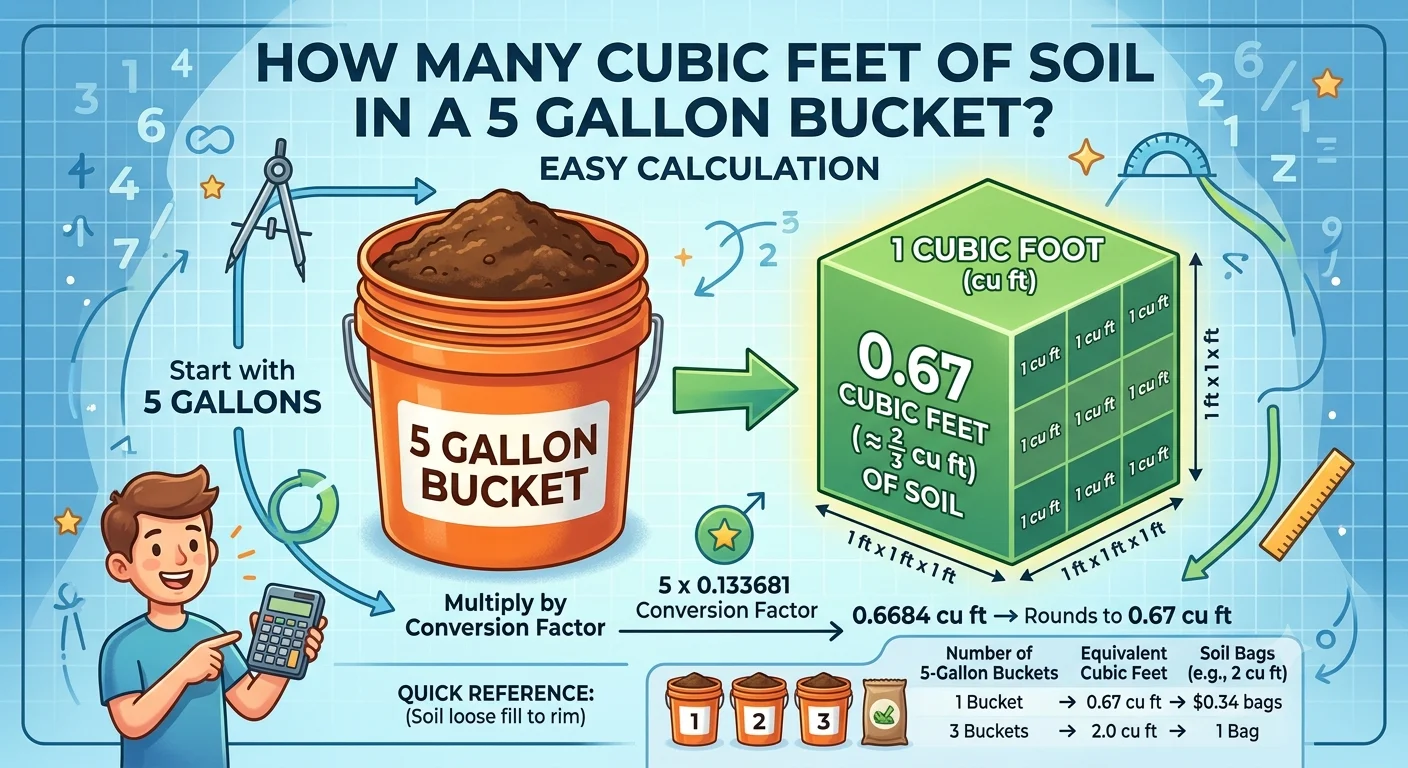
A standard 5-gallon bucket holds approximately 0.67 cubic feet of soil when filled to the top. This measurement is widely used in gardening, landscaping, construction, and DIY projects because it makes estimating soil volume much easier. Whether you’re filling raised beds, mixing potting soil, or calculating how much material you need for a landscaping job, knowing the cubic-foot capacity of a 5-gallon bucket can save time, reduce waste, and improve planning.
The exact amount of soil the bucket holds can vary slightly depending on whether the soil is loose, compacted, or contains moisture. However, for most practical purposes, 0.67 cubic feet (about two-thirds of a cubic foot) is the standard conversion.
In this guide, you’ll learn the exact conversion, how it is calculated, practical gardening examples, comparison charts, and answers to common questions.
How Many Cubic Feet of Soil in a 5 Gallon Bucket?
A standard U.S. 5-gallon bucket holds:
| Measurement | Equivalent |
|---|---|
| Gallons | 5 gallons |
| Cubic Feet | 0.668 cubic feet |
| Rounded Value | 0.67 cubic feet |
| Cubic Inches | 1,155 cubic inches |
| Cubic Yards | 0.0247 cubic yards |
| Liters | 18.93 liters |
For everyday gardening and landscaping, you can safely round the value to 0.67 cubic feet.
Understanding the Conversion
The conversion between gallons and cubic feet is based on volume.
One cubic foot equals approximately:
- 7.48 U.S. gallons
Therefore:
5 ÷ 7.48 = 0.668 cubic feet
Rounded:
5 gallons = 0.67 cubic feet
This calculation works for water, potting mix, compost, mulch, gravel, and most loose materials because it measures container volume rather than weight.
Why Gardeners Use 5-Gallon Buckets
Five-gallon buckets are one of the most useful measuring tools for gardeners because they are inexpensive, durable, and easy to carry.
Common uses include:
- Measuring potting soil
- Mixing compost
- Filling raised beds
- Measuring mulch
- Carrying gravel
- Mixing fertilizer
- Creating container gardens
- Measuring sand or topsoil
Since each bucket holds approximately 0.67 cubic feet, estimating material requirements becomes much easier.
How Much Potting Soil Fits in a 5-Gallon Bucket?
If the bucket is completely full, it holds:
- About 0.67 cubic feet
- Around 18.9 liters
- Approximately 20 quarts
Commercial potting soil is fluffy and lightweight, so the bucket usually fills completely without significant settling. If you water the soil or compact it by pressing down, the bucket may hold slightly more material by weight but not by volume.
Soil Weight in a 5-Gallon Bucket
Volume and weight are different measurements.
The weight depends on the type of soil.
| Soil Type | Approximate Weight |
|---|---|
| Dry potting mix | 10–15 pounds |
| Moist potting soil | 20–25 pounds |
| Garden soil | 25–35 pounds |
| Wet topsoil | 35–45 pounds |
| Sand | 60–70 pounds |
This is why two buckets with the same volume may feel completely different.
Practical Gardening Examples
Filling Raised Beds
Suppose your raised bed requires:
- 12 cubic feet of soil
Since one bucket equals 0.67 cubic feet:
12 ÷ 0.67 ≈ 18 buckets
You’ll need about 18 full buckets.
Filling Large Planters
A planter requiring:
- 2 cubic feet of soil
Calculation:
2 ÷ 0.67 ≈ 3 buckets
You’ll need roughly three full buckets.
Mixing Compost
If a compost recipe calls for:
- 4 cubic feet of compost
Then:
4 ÷ 0.67 ≈ 6 buckets
This makes measuring ingredients much simpler.
Bucket-to-Cubic-Foot Conversion Chart
| Buckets | Cubic Feet |
|---|---|
| 1 | 0.67 |
| 2 | 1.34 |
| 3 | 2.01 |
| 4 | 2.68 |
| 5 | 3.35 |
| 6 | 4.02 |
| 7 | 4.69 |
| 8 | 5.36 |
| 9 | 6.03 |
| 10 | 6.70 |
This chart is especially useful for landscaping estimates.
Cubic Feet to Number of Buckets
Sometimes you know the cubic feet instead.
| Cubic Feet | Buckets Needed |
|---|---|
| 1 | 1.5 buckets |
| 2 | 3 buckets |
| 5 | 7.5 buckets |
| 10 | 15 buckets |
| 20 | 30 buckets |
| 40 | 60 buckets |
Always round up if you need full coverage.
Loose Soil vs. Compacted Soil
Although the bucket’s volume remains constant, the amount of actual soil particles changes.
Loose soil:
- Easier to shovel
- Better root growth
- Contains more air
Compacted soil:
- Holds less air
- Weighs more
- Drains more slowly
Even though both fill the same bucket, their weight differs significantly.
Common Materials Measured with a 5-Gallon Bucket
Besides soil, these materials can also be measured using cubic feet.
| Material | Volume in One Bucket |
|---|---|
| Potting mix | 0.67 cu ft |
| Compost | 0.67 cu ft |
| Mulch | 0.67 cu ft |
| Gravel | 0.67 cu ft |
| Sand | 0.67 cu ft |
| Peat moss | 0.67 cu ft |
| Wood chips | 0.67 cu ft |
| Perlite | 0.67 cu ft |
Again, only the weight changes—not the volume.
Why This Conversion Matters
Knowing the cubic-foot capacity of a bucket helps you:
- Buy the right amount of soil
- Avoid overspending
- Reduce leftover materials
- Estimate raised bed volume
- Calculate compost requirements
- Mix soil recipes accurately
- Transport materials efficiently
Professional landscapers often estimate projects using buckets because they’re readily available on job sites.
Example Soil Calculations
Example 1
You purchased a bag containing:
- 2 cubic feet of soil
Buckets needed:
2 ÷ 0.67 ≈ 3 buckets
Example 2
You have:
- 8 buckets of compost
Volume:
8 × 0.67 = 5.36 cubic feet
Example 3
Your flower bed needs:
- 15 cubic feet
Buckets required:
15 ÷ 0.67 ≈ 22.4 buckets
Round up to 23 buckets.
Common Mistakes to Avoid
Many people make simple measuring mistakes.
Confusing Weight with Volume
A bucket measures volume, not weight.
Using Imperial Gallons
This guide uses U.S. gallons. Imperial gallons are larger and produce different results.
Packing Soil Too Tightly
Compacting soil changes its weight but not the bucket’s volume.
Ignoring Moisture
Wet soil weighs much more than dry soil, making transportation harder.
Expert Tips
- Level the top of the bucket for consistent measurements.
- Use the same bucket throughout your project.
- Buy slightly more soil than calculated to account for settling.
- Mix ingredients in buckets for accurate soil recipes.
- Store buckets in a dry location to prevent contamination.
Comparing Common Soil Bag Sizes
| Soil Bag Size | Equivalent Buckets |
|---|---|
| 1 cubic foot | 1.5 buckets |
| 1.5 cubic feet | 2.2 buckets |
| 2 cubic feet | 3 buckets |
| 3 cubic feet | 4.5 buckets |
| 5 cubic feet | 7.5 buckets |
This comparison makes shopping much easier when buying soil in bags.
Is Every 5-Gallon Bucket Exactly the Same?
Most standard hardware-store buckets have a capacity close to 5 U.S. gallons.
However, slight differences may exist because of:
- Manufacturer design
- Bucket shape
- Interior dimensions
- Fill level
These differences are usually too small to affect gardening projects.
Frequently Asked Questions
How many cubic feet are in a 5-gallon bucket of soil?
A standard U.S. 5-gallon bucket holds approximately 0.67 cubic feet of soil.
Does wet soil change the cubic-foot measurement?
No. Wet soil weighs more but still occupies about 0.67 cubic feet in a full 5-gallon bucket.
How many 5-gallon buckets make one cubic foot?
Since one bucket holds 0.67 cubic feet, you’ll need about 1.5 buckets to equal one cubic foot.
How many buckets are in a 2-cubic-foot bag of soil?
A 2-cubic-foot bag fills about three 5-gallon buckets.
Can I use a 5-gallon bucket to measure mulch or compost?
Yes. A standard 5-gallon bucket measures approximately 0.67 cubic feet of mulch, compost, sand, gravel, or other loose materials.
Conclusion
If you’ve been wondering how many cubic feet of soil in a 5 gallon bucket, the answer is straightforward: a standard U.S. 5-gallon bucket holds approximately 0.67 cubic feet of soil. This simple conversion is invaluable for gardeners, landscapers, homeowners, and DIY enthusiasts when estimating soil, compost, mulch, gravel, or other materials. By understanding this measurement and using the conversion charts provided, you can plan projects more accurately, purchase the right amount of material, and avoid unnecessary waste. Whether you’re filling containers, building raised beds, or mixing soil, remembering that 5 gallons equals about two-thirds of a cubic foot makes calculations quick and reliable.