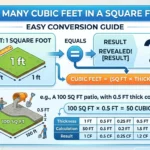

When planning a landscaping, gardening, or construction project, understanding measurements is essential. One common question people ask is: 1 yard is how many cubic feet? The answer is simple: 1 cubic yard equals 27 cubic feet.
This conversion is important because many materials such as mulch, soil, gravel, sand, and concrete are sold by the cubic yard, while smaller measurements are often calculated in cubic feet.
Knowing how to convert between cubic yards and cubic feet helps you buy the correct amount of material, avoid waste, and accurately estimate project costs.
In this guide, you will learn what a cubic yard means, how to convert it into cubic feet, see practical examples, and understand how this measurement is used in everyday projects.
Understanding How Many Cubic Feet Are in 1 Yard
The answer to 1 yard is how many cubic feet depends on the type of measurement being discussed. A regular yard measures length, but a cubic yard measures volume.
A cubic yard is a three-dimensional measurement that includes:
- Length
- Width
- Height
One cubic yard represents a space that is:
- 1 yard long
- 1 yard wide
- 1 yard high
Because each yard equals 3 feet, the calculation is:
3 feet × 3 feet × 3 feet = 27 cubic feet
Therefore:
1 cubic yard = 27 cubic feet
What Is a Cubic Yard?
A cubic yard is a unit used to measure volume in the United States. It is commonly used for materials that take up space, including:
- Garden soil
- Mulch
- Compost
- Gravel
- Sand
- Concrete
- Landscaping rocks
Unlike a regular yard that measures distance, a cubic yard measures how much material can fill a three-dimensional area.
For example, if you order one cubic yard of mulch, you are receiving enough mulch to fill a space measuring 27 cubic feet.
What Is a Cubic Foot?
A cubic foot is another volume measurement. It represents a cube that is:
- 1 foot long
- 1 foot wide
- 1 foot high
A cubic foot is much smaller than a cubic yard.
Since:
1 yard = 3 feet
The volume conversion becomes:
3 × 3 × 3 = 27
So:
One cubic yard contains 27 cubic feet.
The Formula to Convert Cubic Yards to Cubic Feet
The conversion formula is easy:
Cubic yards × 27 = Cubic feet
For example:
If you have 2 cubic yards:
2 × 27 = 54 cubic feet
So, 2 cubic yards equals 54 cubic feet.
Another example:
5 cubic yards:
5 × 27 = 135 cubic feet
This formula works for any project where you need to convert material volume.
Step-by-Step Conversion Method
Follow these simple steps:
Step 1: Identify the Number of Cubic Yards
Find out how many cubic yards of material you have.
Example:
You purchased 3 cubic yards of garden soil.
Step 2: Multiply by 27
Use the conversion formula:
3 × 27 = 81
Step 3: Get the Cubic Feet Measurement
The result is:
3 cubic yards = 81 cubic feet
This method works for landscaping, construction, and home improvement calculations.
Cubic Yard to Cubic Feet Conversion Chart
| Cubic Yards | Cubic Feet |
|---|---|
| 1 cubic yard | 27 cubic feet |
| 2 cubic yards | 54 cubic feet |
| 3 cubic yards | 81 cubic feet |
| 4 cubic yards | 108 cubic feet |
| 5 cubic yards | 135 cubic feet |
| 10 cubic yards | 270 cubic feet |
This chart makes quick calculations easier when purchasing materials.
Real-World Examples of One Cubic Yard
Understanding the practical use of one cubic yard makes the measurement easier.
Mulch and Soil Calculations
Landscaping materials are often sold by cubic yards.
For example:
A homeowner wants to add mulch to a garden bed. The supplier recommends 2 cubic yards of mulch.
Using the conversion:
2 × 27 = 54 cubic feet
The homeowner needs enough mulch to cover a 54 cubic foot area.
However, coverage also depends on depth.
For example:
- A thinner layer covers more area.
- A thicker layer covers less area.
Gardeners usually spread mulch between 2 and 4 inches deep depending on the purpose.
Concrete and Construction Uses
Concrete is another material measured in cubic yards.
Contractors calculate concrete volume before ordering because buying too little creates delays, while buying too much increases costs.
For example:
A small patio project requires 1.5 cubic yards of concrete.
Conversion:
1.5 × 27 = 40.5 cubic feet
The project requires 40.5 cubic feet of concrete.
Cubic Yard vs Cubic Foot: Key Differences
| Feature | Cubic Yard | Cubic Foot |
|---|---|---|
| Measurement type | Volume | Volume |
| Size | Larger unit | Smaller unit |
| Conversion | 1 cubic yard | 27 cubic feet |
| Common uses | Landscaping, construction | Small measurements, storage calculations |
Both measurements describe volume, but cubic yards are more convenient for large projects.
How Many Cubic Feet Are in a Yard of Common Materials?
Different materials may have different weights, but their volume remains the same.
One cubic yard equals:
- 27 cubic feet of mulch
- 27 cubic feet of soil
- 27 cubic feet of gravel
- 27 cubic feet of sand
The weight changes because materials have different densities.
For example, one cubic yard of dry mulch is much lighter than one cubic yard of wet soil.
Common Mistakes When Measuring Cubic Volume
Many people make mistakes when converting measurements. Here are some common errors:
Confusing Square Feet With Cubic Feet
Square feet measure area, while cubic feet measure volume.
Square feet include only:
- Length
- Width
Cubic feet include:
- Length
- Width
- Height
Forgetting to Multiply by 27
A common mistake is thinking one cubic yard equals 9 cubic feet because a yard contains 3 feet.
However, volume requires three dimensions:
3 × 3 × 3 = 27
Ignoring Material Depth
When calculating landscaping materials, depth matters.
For example, covering a garden with mulch requires knowing:
- Total area
- Desired thickness
- Material volume
Expert Tips for Accurate Material Estimates
Use these tips to avoid buying too much or too little material:
- Measure your project area carefully.
- Convert all measurements into the same unit.
- Include the depth or height of the material.
- Add a small extra amount for settling and waste.
- Use cubic yards for large orders.
For landscaping projects, it is often better to slightly overestimate rather than run short during installation.
Benefits of Understanding Cubic Yard Conversion
Knowing how to convert 1 yard is how many cubic feet provides several benefits:
Saves Money
Accurate measurements prevent unnecessary purchases.
Reduces Waste
You order only what your project requires.
Improves Planning
You can estimate delivery amounts and project timelines.
Helps Compare Prices
Suppliers may sell materials in different units, so conversion allows easier comparison.
Frequently Asked Questions
How many cubic feet are in 1 yard?
One cubic yard contains 27 cubic feet. The calculation is 3 feet × 3 feet × 3 feet = 27 cubic feet.
Is a yard the same as a cubic yard?
No. A yard measures length, while a cubic yard measures volume. A cubic yard includes three dimensions: length, width, and height.
How many cubic feet are in 2 yards?
Two cubic yards equal 54 cubic feet because 2 × 27 = 54.
How many cubic feet of mulch are in one yard?
One cubic yard of mulch contains 27 cubic feet. The amount of area it covers depends on how thickly the mulch is spread.
Why are materials sold by cubic yards?
Large materials like soil, gravel, and concrete are sold by cubic yards because it is easier to measure large quantities using volume instead of individual bags.
Conclusion
Understanding 1 yard is how many cubic feet is essential for accurate measurements in landscaping, construction, and home improvement projects. The simple conversion is:
1 cubic yard = 27 cubic feet
By using the formula cubic yards × 27, you can quickly calculate the cubic feet needed for any project. Whether you are ordering soil, mulch, gravel, or concrete, knowing this conversion helps you save money, reduce waste, and plan your work more efficiently.